Does a Cammed LS Need a Different Base Tune?
Installing a camshaft is one of the most common modifications made during an LS swap, but it also changes how the engine behaves at idle, during startup, and at low engine speeds.
Because of that, a cammed LS base tune normally needs more work than a stock-engine LS swap calibration.
Simply disabling VATS and clearing emissions-related trouble codes may allow a stock engine to start, but a cammed LS often needs changes to airflow, fueling, idle control, spark, and other tables before it will start and idle properly.
If you are building a Gen 3 LS swap with a P01 or P59 PCM, understanding these changes can save a lot of frustration when it comes time for the first startup.
Why Does a Camshaft Change the Tune?
A performance camshaft changes when the intake and exhaust valves open and close.
Compared with a stock camshaft, a performance cam may have:
- More duration
- More valve lift
- More overlap
- A tighter or different lobe separation angle
- Different intake centerline timing
These changes improve airflow and power at higher engine speeds, but they also change the way the engine operates at idle and low RPM.
One of the biggest differences is idle vacuum.
A stock truck LS engine may idle with relatively high manifold vacuum. A larger camshaft often produces considerably less vacuum.
Since the PCM uses engine load and airflow information to determine how much fuel, spark, and idle airflow the engine needs, installing a larger cam can move the engine into completely different operating areas of the calibration.
That is why a stock tune often struggles with a cammed engine.
What Happens If You Run a Cammed LS on a Stock Tune?
Some cammed engines will start on the original calibration, but that does not mean the calibration is correct.
Common problems include:
- Engine starts and immediately stalls
- Hard cold starts
- RPM drops too low when placed in gear
- Idle surging
- Hanging RPM
- Engine requires throttle to stay running
- Rich or lean idle
- Poor throttle response
- Excessive idle spark correction
- Stalling when coming to a stop
The larger the camshaft, the more noticeable these problems normally become.
A mild truck cam may need only moderate changes.
A larger cam with significant overlap may require substantial changes to the idle and low-load areas of the calibration.
What Is Changed in a Cammed LS Base Tune?
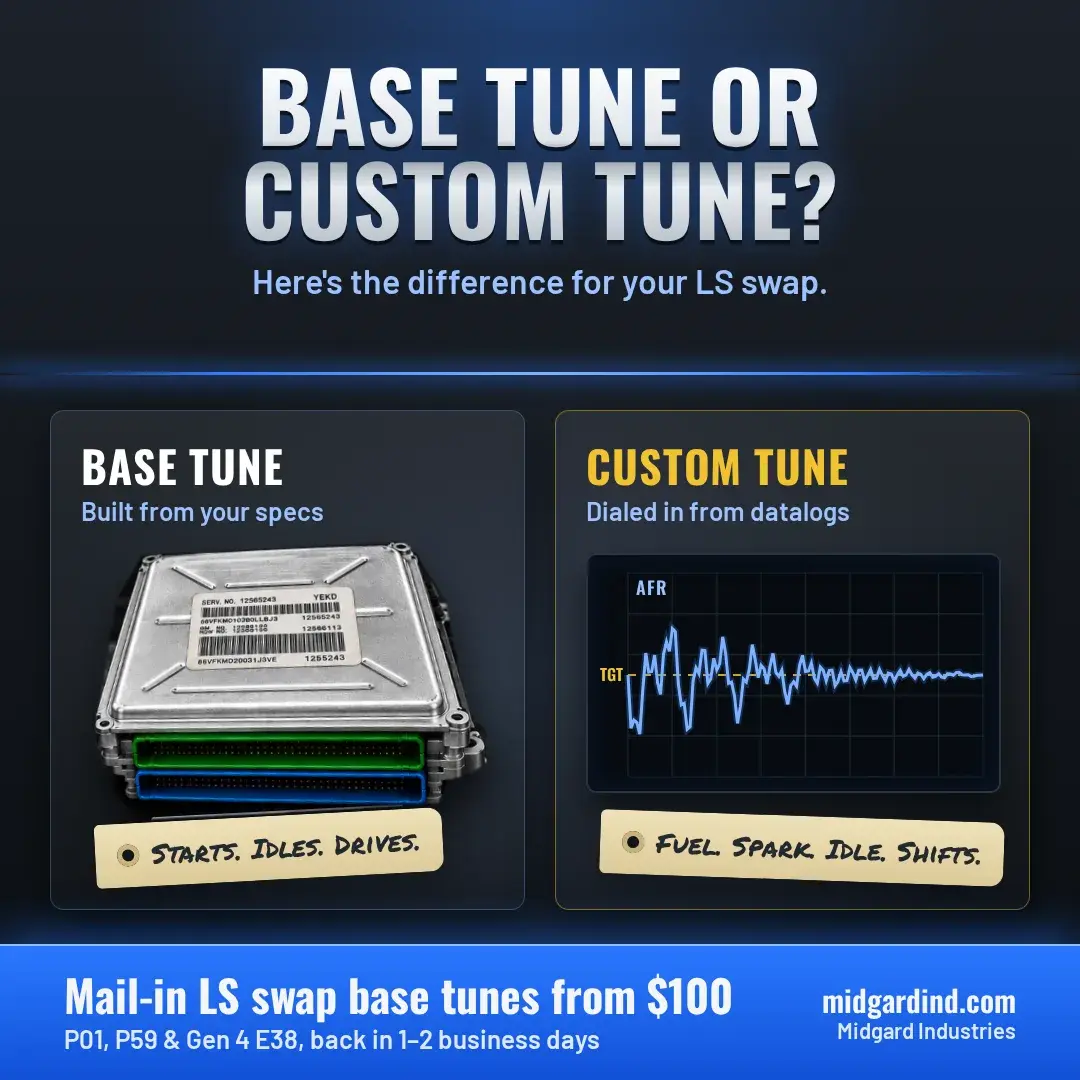
A proper cammed LS base tune is not the same thing as simply disabling VATS.
The exact changes depend on the engine combination, but several areas commonly need attention.
Idle Speed
A larger camshaft generally requires a higher idle speed than the original engine.
For example, an engine that originally idled around 600–650 RPM may need to idle around 750–900 RPM depending on the camshaft, converter, transmission, and vehicle.
Very large camshafts may require even more idle speed.
The goal is to find an RPM range where the engine produces stable airflow and consistent combustion.
Base Running Airflow
This is one of the most important areas of a cammed LS calibration.
A cammed engine usually requires more airflow to maintain idle.
If commanded airflow is too low, the PCM may struggle to keep the engine running and the throttle or idle air control system may constantly try to compensate.
Increasing the appropriate idle airflow tables provides the engine with a better starting point.
Startup Airflow
A cammed engine may also require additional airflow immediately after startup.
Without enough startup airflow, the engine may fire and then stall before the idle control system can stabilize it.
Startup airflow changes can make a major difference in cold-start behavior.
VE Table
Camshaft changes affect cylinder filling, especially in the idle and low-RPM areas.
On Gen 3 PCMs, this often means the VE table needs to be adjusted to provide a better starting point.
A stock VE table was designed around the airflow characteristics of the original camshaft.
Once the engine has considerably more overlap and different intake characteristics, those values may no longer represent the engine accurately.
MAF Calibration
If the vehicle is retaining the MAF sensor, the MAF calibration generally remains based on the physical MAF housing and airflow system rather than simply being increased because a cam was installed.
However, the engine's airflow behavior changes significantly with the cam.
For a final tune, MAF and VE fueling should be verified using actual logged data and preferably a wideband oxygen sensor.
The purpose of a base tune is to provide a reasonable starting calibration—not to guess the final airflow curve.
Idle Spark
Spark timing plays a major role in idle stability.
A cammed engine may respond much better to different idle spark values than the original factory calibration.
Too little timing can make the engine unstable.
Too much timing can cause RPM flare, hanging idle, or make the PCM's spark-based idle control less effective.
The goal is to provide enough timing for a stable idle while leaving the PCM room to add and remove timing to control engine speed.
Proportional and Integral Idle Control
Depending on the operating system, additional idle-control parameters may also need adjustment.
The factory PCM continuously corrects idle speed based on the difference between commanded RPM and actual RPM.
A cammed engine can require different airflow and spark behavior than the PCM originally expected.
A good base tune puts the calibration closer to where the engine actually wants to run so the PCM is not constantly making extreme corrections.
What About Throttle Cracker and Throttle Follower?
These tables are especially important on drive-by-cable Gen 3 LS applications.
Throttle cracker and throttle follower airflow help control how quickly RPM falls when you let off the throttle.
With a cammed engine, incorrect settings can cause:
- Hanging RPM
- RPM dropping too quickly
- Stalling when pushing in the clutch
- Stalling when approaching a stop
- Excessive deceleration RPM
These tables should not simply be maxed out.
They need to complement the engine's idle airflow requirements and vehicle combination.
Does Injector Size Matter?
Yes.
If your LS swap uses injectors that are different from the original calibration, the PCM needs accurate injector information.
That can include:
- Injector flow rate
- Offset versus voltage
- Short pulse behavior
- Minimum pulsewidth
- Other injector characterization data depending on the PCM and operating system
Entering the correct injector data is much better than trying to compensate for larger injectors by randomly changing VE or MAF tables.
A camshaft alone does not require larger injectors, but many modified LS combinations use different injectors as part of the build.
What About Automatic Transmissions and Stall Converters?
The transmission and torque converter also affect idle tuning.
A larger camshaft combined with a stock tight converter may load the engine heavily when placed in gear.
A higher-stall converter usually allows the engine to idle more comfortably with a larger camshaft.
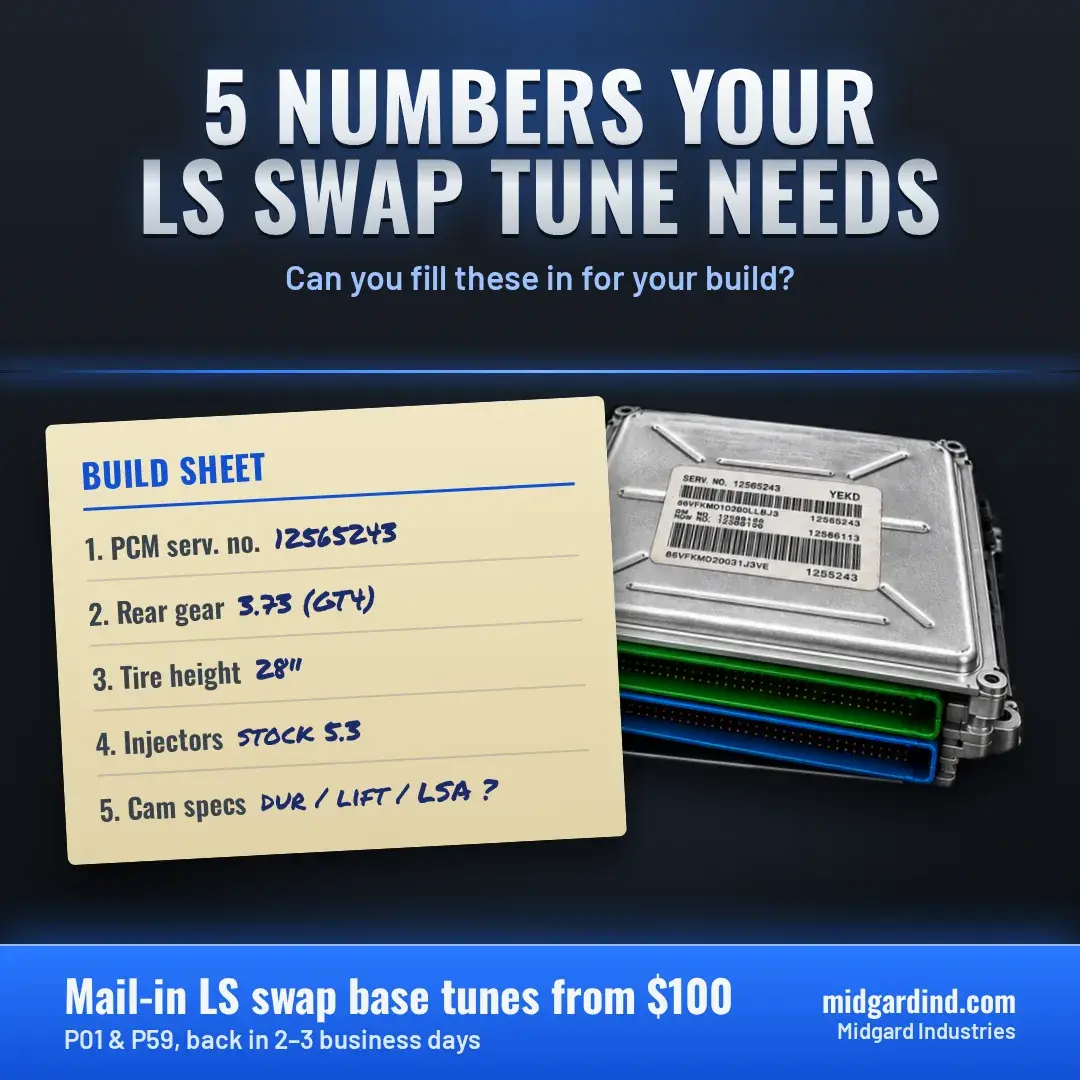
When building a cammed LS base tune, useful information includes:
- Transmission type
- Converter stall speed
- Rear gear ratio
- Tire size
- Desired idle RPM
- Camshaft specifications
This helps create a base calibration that better matches the vehicle.
Does a Manual-Transmission Cammed LS Need Different Settings?
Yes.
A manual-transmission LS swap has different deceleration behavior than an automatic transmission.
When the clutch is pushed in, engine load can disappear almost instantly.
If throttle follower, cracker airflow, idle airflow, or decay settings are not appropriate, the engine may drop below the desired idle RPM and stall.
Manual-transmission swaps often require extra attention to deceleration airflow and idle recovery.
Is a Cammed LS Base Tune the Same as a Final Tune?
No.
This distinction is important.
A base tune is designed to give the engine a reasonable calibration for startup, idle, and initial driving.
A final tune should be based on actual data from the engine.
That normally includes logging items such as:
- Air/fuel ratio
- Short-term and long-term fuel trims
- Wideband AFR or lambda
- Knock retard
- MAP
- MAF airflow
- Cylinder airmass
- Spark advance
- Idle airflow
- Engine coolant temperature
Every engine is slightly different.
Even two engines using the same camshaft can require different final adjustments because of differences in exhaust systems, intake systems, injectors, compression ratio, cylinder heads, fuel pressure, and vehicle weight.
A mail-in base tune should therefore be considered the starting calibration, not a replacement for final tuning.
What Information Is Needed for a Cammed LS Base Tune?
The more accurate the build information is, the better the starting calibration can be.
Useful information includes:
- Engine displacement
- Engine year
- PCM type
- Operating system if known
- Camshaft part number and specifications
- Cylinder heads
- Intake manifold
- Throttle body
- Injector part number and flow rate
- Fuel pressure
- MAF sensor and housing
- MAP sensor
- Transmission
- Converter stall speed
- Rear axle ratio
- Tire size
- Fan configuration
- Desired thermostat temperature
- Vehicle the engine is being installed into
Providing actual part numbers is especially useful for injectors, MAP sensors, and camshafts.
Do Mild Truck Cams Still Need a Tune?
Usually, yes.
A small truck cam may run reasonably well on the stock calibration, but that does not mean the factory tune is ideal.
Even a mild cam can change:
- Idle MAP
- Required airflow
- Startup behavior
- Low-RPM VE
- Spark requirements
- Desired idle speed
The changes may be smaller than they would be with a large performance cam, but starting with a tune designed around the modified combination generally makes the first startup much easier.
Can You Just Turn Off VATS?
Disabling VATS is necessary on many standalone LS swaps, but VATS removal is not a cam tune.
VATS simply prevents the factory vehicle security system from shutting the engine down.
It does not automatically correct:
- Idle airflow
- Injector data
- Camshaft-related VE changes
- Startup airflow
- Idle RPM
- Fan operation
- Transmission configuration
That is why a cammed engine can still run poorly even after VATS has been disabled.
Mail-In Cammed LS Base Tunes
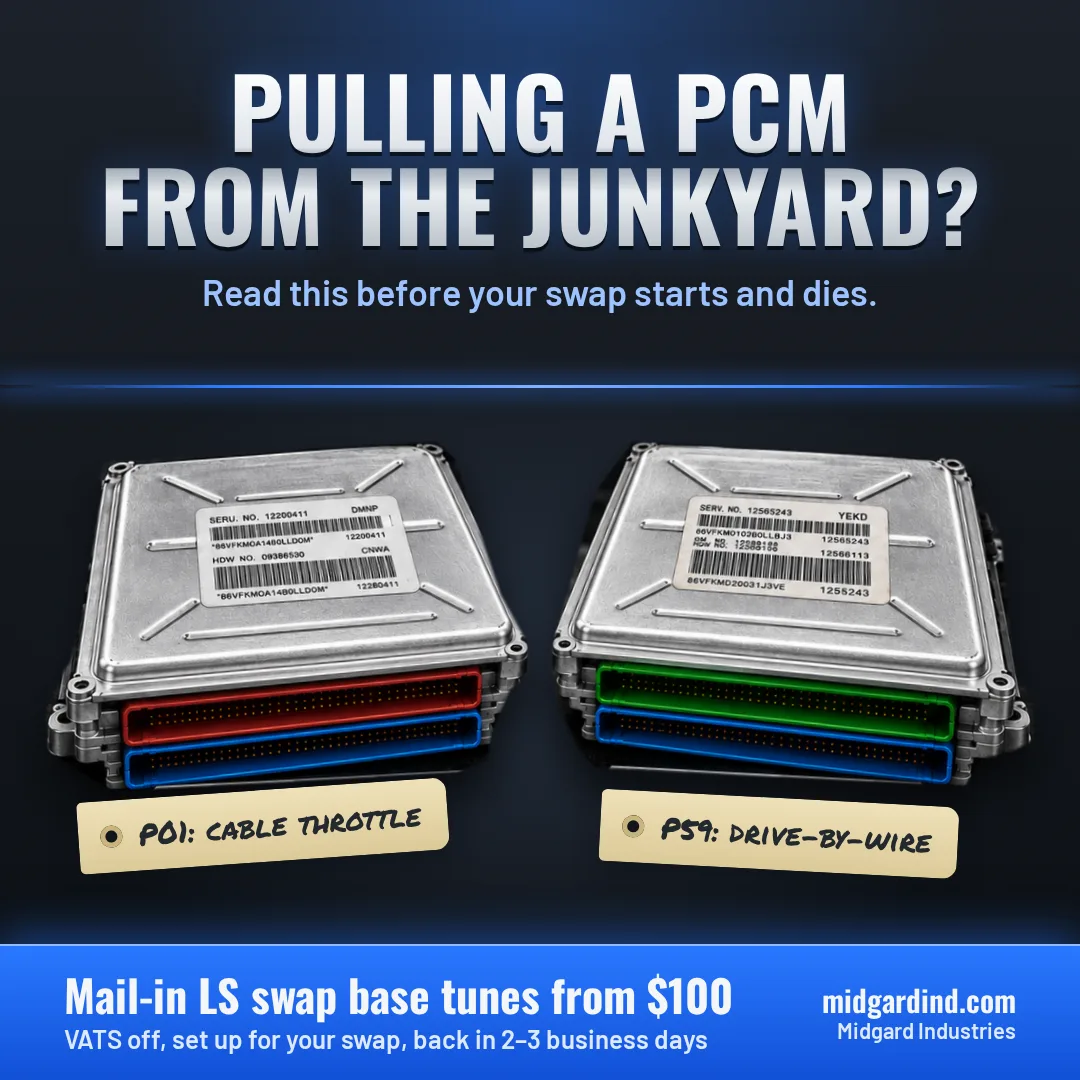
Midgard Industries offers mail-in Gen 3 LS base programming for common P01 and P59 PCM applications.
Mail in your existing ECU
Stock LS swap base tune — $100
Modified / cammed LS base tune — $150
Modified base tunes can be set up around the information you provide for your engine combination, including camshaft, injectors, transmission, displacement, fans, and other common swap requirements.
👉 Order a mail-in LS swap base tune:
https://midgardind.com/ls-swap-base-tune
If you do not already have an ECU, programmed ECU options are also available:
Stock tune + ECU — $150
Modified / cammed tune + ECU — $200
Frequently Asked Questions
Will a cammed LS run with the stock tune?
Some mild camshafts may start and run on the factory calibration, but idle quality, startup behavior, fueling, and drivability may not be correct. Larger cams are much more likely to require calibration changes.
What idle RPM should a cammed LS use?
It depends on camshaft size and the rest of the combination. Many mild-to-moderate cammed LS engines are comfortable somewhere around 750–900 RPM, while larger cams may require more.
Does a cammed LS always have low vacuum?
Performance camshafts generally reduce idle vacuum because of increased overlap and duration. The amount depends on the specific camshaft, engine displacement, compression, and installation angle.
Do I need a wideband for a cammed LS?
A wideband oxygen sensor is strongly recommended for final fueling calibration. A base tune can provide a starting point, but final VE and MAF adjustments should be based on measured data.
Is a mail-in tune a complete dyno tune?
No. A mail-in base calibration is intended to get the combination started, idling, and closer to where it needs to be. Final calibration should be verified using data from the actual vehicle.
Final Thoughts
A camshaft can completely change the way an LS engine behaves at idle and low RPM.
That is why a cammed LS base tune normally requires more than simply disabling VATS.
Idle airflow, startup airflow, idle speed, spark, VE, injector data, transmission settings, and other areas may all need to be adjusted to match the combination.
Starting with a calibration built around the actual engine setup can make the difference between an LS swap that struggles to stay running and one that starts and behaves well enough to begin final tuning.
Need a cammed LS base tune?
👉 https://midgardind.com/ls-swap-base-tune
Midgard Industries EFI Tuning
LS Swap Base Programming • P01 • P59 • Gen 3 LS
#CammedLSBaseTune #LSSwapTune #CammedLSTuning #LSPCMProgramming #P01Tuning #P59Tuning #Gen3LSTune #MailInLSTune #LSSwapECUProgramming #VATSDelete #LSIdleTuning #CammedLSIdle
Follow Midgard Industries
Don't want to tune it yourself?
Mail in your P01/P59 and get a VATS-deleted, swap-ready base tune for $100. Typical turnaround is 1-2 business days after the ECU is received.