Your LS Swap Is Running. Now Log It: A Beginner’s Guide to Datalogging With HP Tuners VCM Scanner
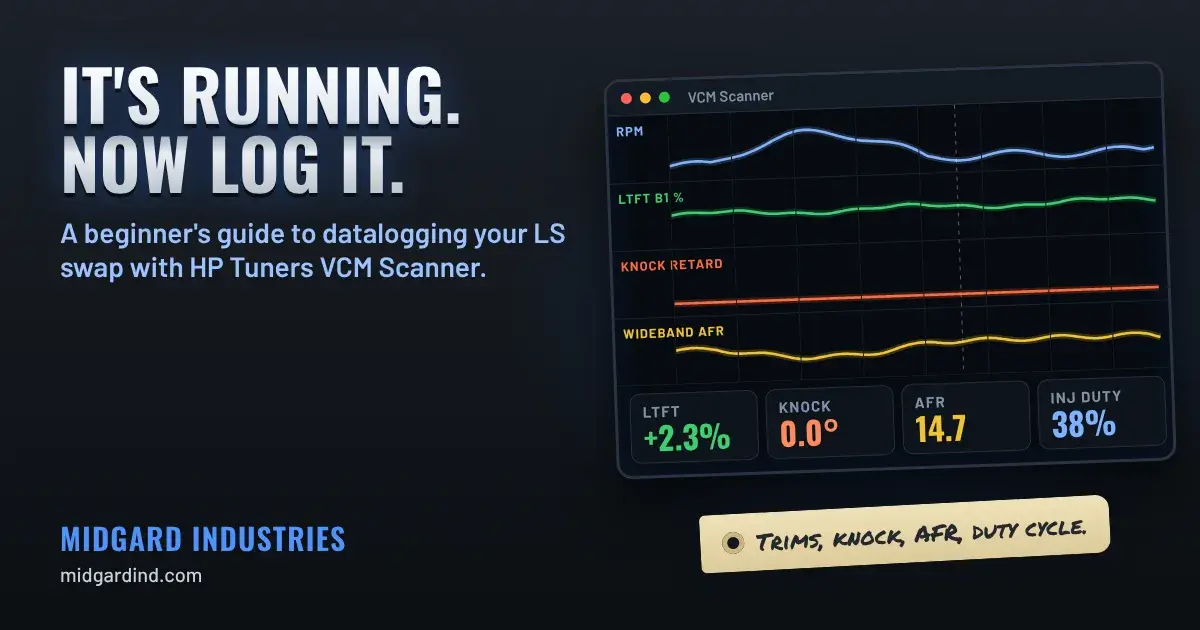
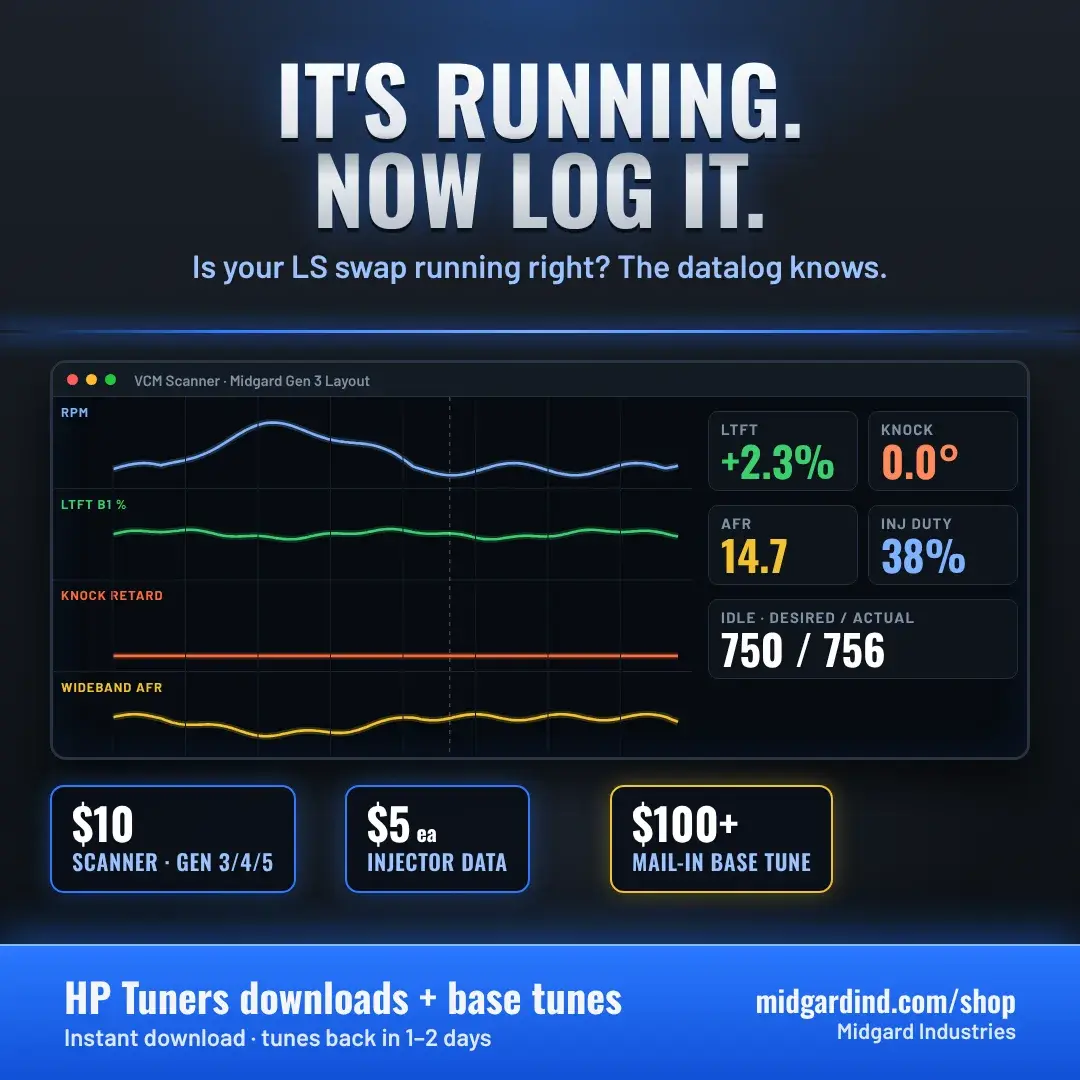
Your LS swap starts, idles, and drives. Now what? The best way to know whether it’s actually running right is to datalog it. A datalog records what the engine and PCM are doing while you drive, like fuel trims, timing, knock, and idle speed, so you can see problems before you feel them.
Here’s how to get started with HP Tuners VCM Scanner, what to look at, and what the numbers mean.
What You Need
- An HP Tuners interface (MPVI) and a laptop
- HP Tuners VCM Suite, which includes VCM Scanner
- A wideband O2 sensor (optional, but highly recommended). It shows your actual air/fuel ratio, which the factory narrowband sensors can’t do.
- A scanner layout with the right channels and gauges for your engine
That last one is where most people get stuck. VCM Scanner can log hundreds of parameters, and building a useful layout from scratch takes time. Our GM Gen 3, Gen 4, and Gen 5 VCM Scanner packages are the same layouts and math we use in our own shop. Each one includes AEM 30-0300 wideband setups and a short guide.
How to Take a Good Log
One long, organized log is more useful than ten random ones. Try to capture:
- A cold start. Start the engine cold and let it idle until it reaches operating temperature.
- Warm idle, in Park or Neutral, and in Drive if it’s an automatic.
- Steady cruising at a few different speeds.
- Light and moderate acceleration.
- Coming to a stop and idling again.
Only log what’s safe and legal where you are, and have a passenger watch the laptop if possible.
What to Look At
Engine coolant temp (ECT). Make sure the engine reaches normal operating temperature and stays there. If it reads cold when the engine is warm, your idle and fueling will be off. (See Why Is My LS Swap Idling High?)
Idle speed: desired vs. actual. The actual idle should stay close to what the PCM is asking for. Big swings or a constant gap point to a vacuum leak or idle airflow that needs adjusting.
Fuel trims (STFT and LTFT). Fuel trims show how much the PCM is adding or removing fuel to hit its target.
- Long-term trims within about ±5% are a great sign.
- Consistently beyond about ±10% means the fueling needs work. That could be a vacuum leak, fuel pressure, injector data, or the tune itself.
- Compare trims at idle, cruise, and under load. A problem in only one area tells you a lot.
Knock retard (KR). This shows when the PCM pulls timing because it detects knock. Ideally it stays at zero. Occasional small blips can happen, but repeated knock retard in the same area is a reason to stop and look closer.
Air/fuel ratio (with a wideband). At cruise, the engine should be near stoichiometric (about 14.7:1 on gasoline). Under heavier load, it should go richer. If it’s lean under load, back off and find out why.
Injector duty cycle. This is how much of the available time the injectors are open. If it’s getting very high under load, your injectors may be running out of room. That’s a sign it’s time for bigger injectors.
When the Logs Say “Bigger Injectors”
One of the most common upgrades for Gen 3 LS swaps is a set of factory Gen 4 injectors. They’re easy to find, they’re affordable, and they come in sizes that fit cammed and built engines.
The catch is that the injector data has to be correct in the tune. Gen 4 injector data isn’t laid out the same way as the Gen 3 tables in HP Tuners, so it has to be converted to work in a P01 or P59 tune. Our Gen 4 to Gen 3 injector data has already done that conversion for popular factory Gen 4 injectors, from 29 lb/hr up to 52 lb/hr, with each one sold individually or all nine in a bundle.
Not sure what size you need? Try the LS Injector Size Calculator.
When the Logs Say “You Need More Than a Base Tune”
A base tune is built to get your swap started and driving. If your logs show trims that won’t settle, repeated knock, or a cam that still won’t idle right, it may be time for a custom tune. (See LS Swap Base Tune vs. Custom Tune.)
Everything You Need, in One Place
Mail-in base tunes
| Gen 3 P01 / P59 | Gen 4 E38 | |
|---|---|---|
| Stock / Near-Stock Base Tune | $100 | $200 |
| Cammed / Modified Base Tune | $150 | $250 |
Plus $10 return shipping. Typical turnaround is 1–2 business days. Order a base tune →
HP Tuners digital downloads
| Product | Price |
|---|---|
| GM Gen 3, Gen 4, or Gen 5 VCM Scanner Package | $10 each |
| GM Gen 3, 4 & 5 VCM Scanner Bundle (all three) | $20 |
| Gen 4 to Gen 3 Injector Data (single injector) | $5 each |
| Gen 4 to Gen 3 Injector Data Bundle (9 workbooks) | $30 |
Instant digital download. Shop the downloads →
Follow Midgard Industries
Don't want to tune it yourself?
Mail in your P01/P59 or E38 and get a VATS-deleted, swap-ready base tune. P01/P59 from $100, E38 from $200. Typical turnaround is 1-2 business days after the ECU is received.