Why Is My LS Swap Idling High? The Most Common Causes and How to Fix Them
You finally got your LS swap running, but it’s idling at 1,200, 1,500, or even higher, and it won’t come down. It’s one of the most common complaints after a swap, and the good news is it’s usually something simple.
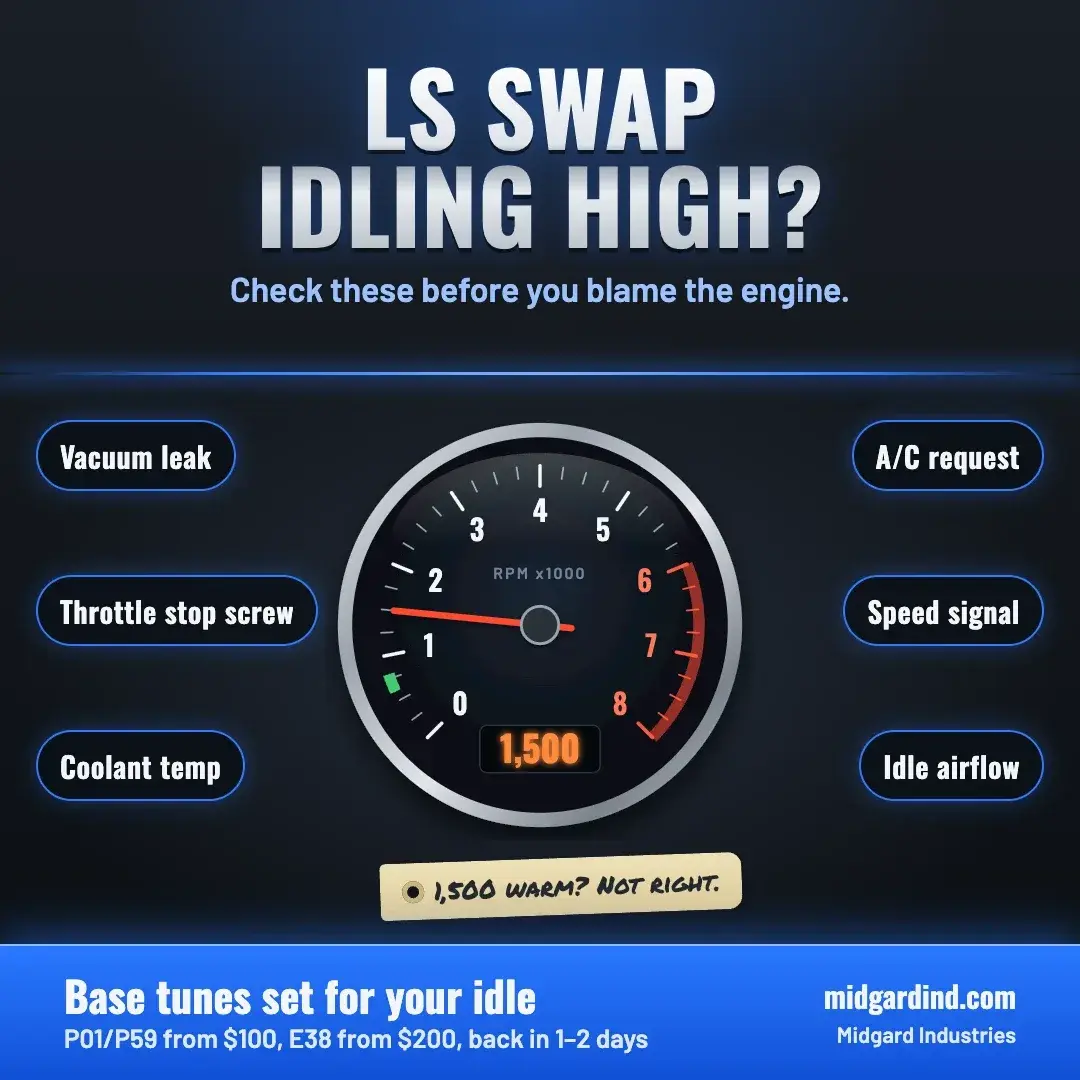
Here are the most common causes of a high idle in an LS swap, starting with the ones we see most.
First: Is It Actually Too High?
A cold LS idles high on purpose for the first minute or so after a cold start, then slowly settles as it warms up. That’s normal.
Once it’s fully warmed up, a stock or near-stock LS usually idles somewhere around 600–800 RPM. Cammed engines are often set a little higher so they idle smoothly. If yours is well above that after it’s fully warm, keep reading.
1. Vacuum Leaks
This is the number one cause of a high idle in an LS swap. Any air that gets into the engine without going through the throttle body raises the idle, and the PCM can’t pull it back down.
Common places to check:
- Unplugged vacuum ports on the intake, especially the brake booster, PCV, and EVAP purge ports. Swaps often leave one open.
- Intake manifold gaskets that are damaged or reused
- Cracked or loose vacuum hoses and PCV lines
- The throttle body gasket
- The brake booster and its check valve
A smoke test is the fastest way to find a leak. If you don’t have a smoke machine, listen for hissing with the engine running and check every port on the intake.
2. Someone Adjusted the Throttle Stop Screw
On drive-by-cable throttle bodies (P01 setups), there’s a throttle stop screw that sets how far the throttle blade is closed. It’s set at the factory, and it’s not an idle speed adjustment.
A common mistake is turning that screw to “fix” an idle problem. The PCM controls idle with the idle air control (IAC), and when the blade is held open by the stop screw, the IAC can’t bring the RPM down.
If the screw has been touched, or you bought a used throttle body, the blade may be open too far. Reset it to the factory position, or replace the throttle body if you’re not sure.
3. The PCM Thinks the Engine Is Cold
The PCM uses the coolant temperature sensor to decide the idle speed. If it thinks the engine is still cold, it keeps the idle high, even when the engine is fully warm.
Check:
- Coolant temp reading on a scan tool. Does it match the real engine temperature?
- The sensor and its wiring, especially if you modified the harness
- Air in the cooling system. LS engines are known for trapping air, and an air pocket around the sensor can give bad readings. (See our electric fan article for bleeding tips.)
4. The A/C Request Is Stuck On
When the A/C is turned on, the PCM bumps the idle to handle the extra load. If the A/C request wire is wired wrong or shorted, the PCM may think the A/C is always on and keep the idle up.
Check whether the PCM sees an A/C request on a scan tool with the A/C turned off.
5. The PCM Thinks the Vehicle Is Moving
The PCM uses a different idle strategy when the vehicle is rolling than when it’s stopped. A bad or noisy speed signal can make it think the vehicle is moving and hold the idle higher than it should. If your speedometer acts strange or reads speed while parked, check your speed signal setup.
6. The Tune Has Too Much Idle Airflow
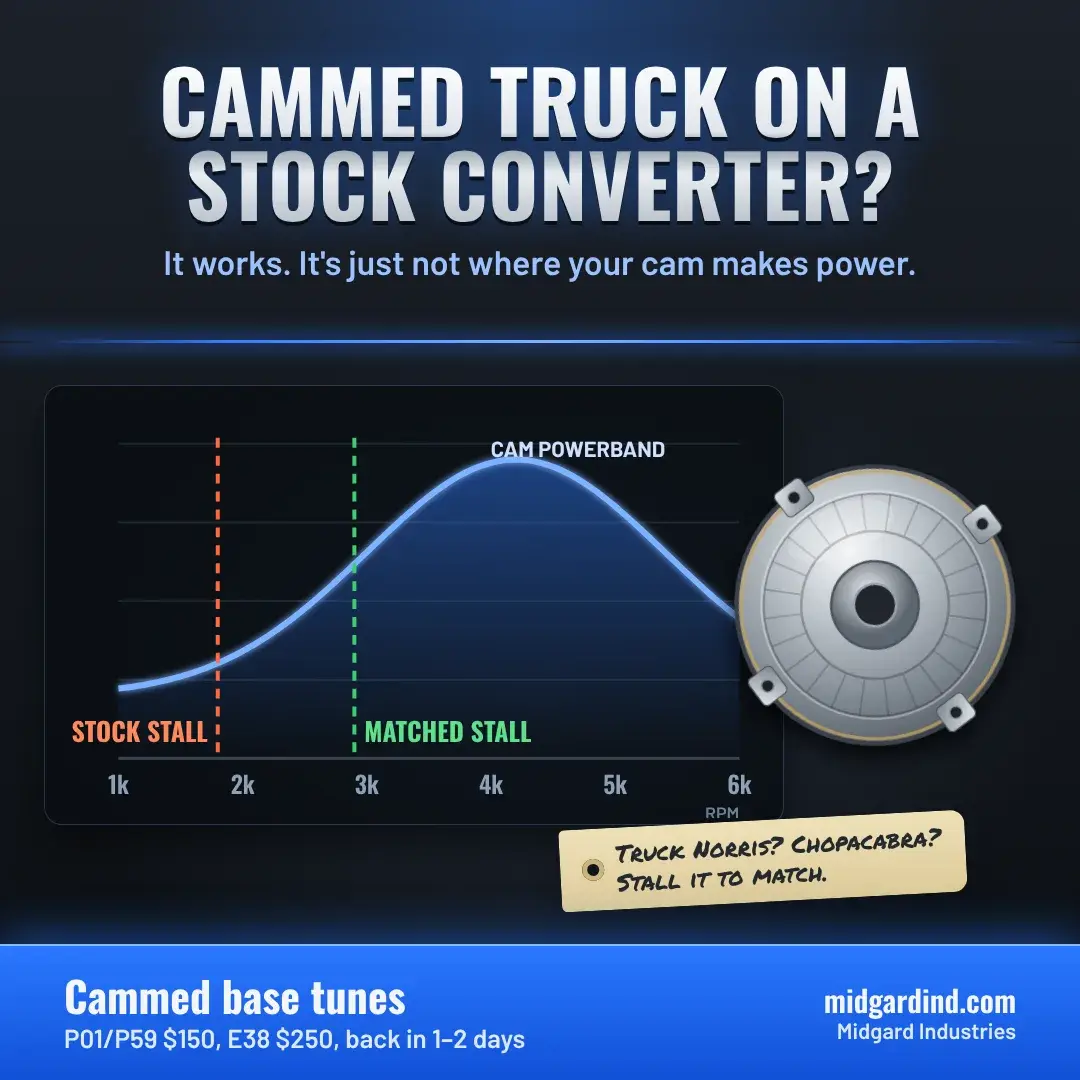
If you’ve ruled out everything above, the tune itself may be the cause. A tune from a different setup, or one that was copied from another vehicle, can have idle airflow and idle speed targets that don’t match your engine. This is especially common with cammed engines, where the idle airflow has to be set for the cam.
A base tune made for your exact combination sets the idle airflow and idle targets for your engine, cam, injectors, and transmission.
7. The Idle Needs to Relearn
After you disconnect the battery, replace or clean the throttle body, or flash a new tune, the PCM needs some time to relearn the idle. Let the engine idle until it’s fully warm, with all accessories off, and give it a few drive cycles before deciding there’s a real problem.
Quick Checklist
- Let the engine fully warm up before judging idle.
- Check every vacuum port and hose, or smoke test the intake.
- Make sure the throttle stop screw hasn’t been touched (cable throttle).
- Check the coolant temp reading against the real temperature.
- Make sure the A/C request isn’t stuck on.
- Make sure the speed signal reads 0 when parked.
- If everything checks out, look at the tune.
Still stuck? Our LS Swap Startup Checklist covers more of the basics. If your RPM hangs between shifts on a manual, see LS Swap With a Manual Transmission.
Get a Base Tune Made for Your Swap
Our base tunes set the idle airflow and idle targets for your exact engine, cam, and transmission, so your swap idles where it should.
| Gen 3 P01 / P59 | Gen 4 E38 | |
|---|---|---|
| Stock / Near-Stock Base Tune | $100 | $200 |
| Cammed / Modified Base Tune | $150 | $250 |
E38 tunes include TCM programming for 4L60E/4L80E swaps. Plus $10 return shipping. Typical turnaround is 1–2 business days after we receive your ECU.
Order your mail-in LS swap base tune here →
Questions about your idle? Contact us or call (430) 215-4536.
Follow Midgard Industries
Don't want to tune it yourself?
Mail in your P01/P59 or E38 and get a VATS-deleted, swap-ready base tune. P01/P59 from $100, E38 from $200. Typical turnaround is 1-2 business days after the ECU is received.