Check Engine Light After an LS Swap? The Most Common Codes and What They Mean
Your LS swap is running, but the check engine light is on. Before you start replacing parts, read the code. In a swap, a check engine light usually means one of two things:
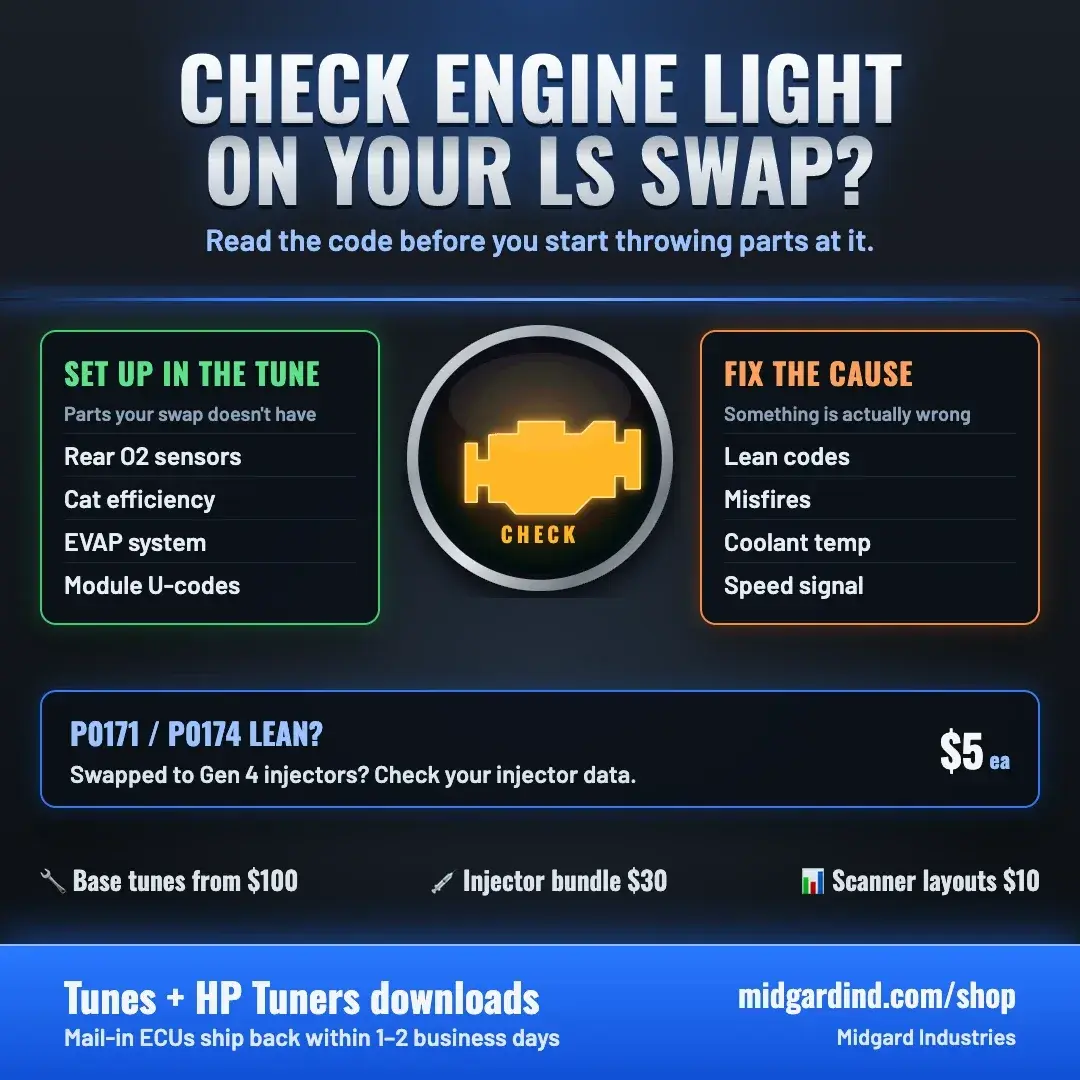
- The PCM is looking for a part your swap doesn’t have. The computer came out of a truck with rear O2 sensors, an EVAP system, and other modules your swap may not have. These codes are expected, and the tune should be set up for them.
- Something is actually wrong. Lean codes, misfires, and sensor problems are the PCM warning you. These should be fixed, not turned off.
The trick is knowing which is which.
How to Read the Codes
You need a scan tool. A basic code reader works, but HP Tuners VCM Scanner shows the codes and lets you log what the engine was doing when the code set, so you can find the cause. Our VCM Scanner packages for GM Gen 3, 4, and 5 come with layouts already set up for idle, fueling, and load review.
Write down every code before you clear anything. Clearing codes without fixing the cause just means they’ll come back.
Codes for Parts Your Swap Doesn’t Have
These are the most common “expected” codes in an LS swap. If you’re not using the part, the tune should be set up so the PCM stops looking for it.
Rear O2 sensor codes (such as P0137, P0138, P0157, P0158)
Most swaps don’t keep the rear (post-cat) O2 sensors. Without them, the PCM sets rear O2 codes.
Catalytic converter efficiency (P0420, P0430)
Set when the PCM can’t verify the catalytic converters are working, often because there are no cats or no rear O2 sensors.
EVAP system codes (such as P0442, P0446, P0455)
Many swaps don’t have the factory charcoal canister and EVAP system.
Communication codes (U-codes)
The PCM expects to talk to modules that were in the donor vehicle, like the body control module or instrument cluster. In a swap, those modules often aren’t there. These are more common on Gen 4 E38 swaps.
Theft deterrent / VATS (such as P1631)
If the anti-theft system wasn’t turned off in the tune, the engine usually starts and then dies. (See Why a VATS Delete Alone Is Not a Complete LS Swap Tune.)
All of these are handled in a properly set-up base tune. Removing emissions equipment is only legal for off-road, competition, or emissions-exempt vehicles, so check your local laws.
Codes That Mean Something Is Actually Wrong
Don’t turn these off. Find the cause.
System lean (P0171, P0174)
The PCM is adding a lot of fuel to make up for a lean condition. Common causes in a swap:
- Vacuum leaks, especially unplugged ports on the intake
- Low fuel pressure (see LS Swap Fuel Pressure)
- Wrong injector data. This is a big one after an injector swap. If you installed Gen 4 injectors in a Gen 3 engine and the tune still has the old injector data, it will run lean or rich. Our Gen 4 to Gen 3 injector data is already converted for P01 and P59 tunes in HP Tuners.
- MAF problems, like a dirty sensor or an air leak after the MAF
Misfires (P0300, P0301–P0308)
Check the basics first: plugs, plug gaps, coils, coil grounds, and plug wires. On cammed engines, a rough idle can also set misfire codes if the tune isn’t set up for the cam.
MAF sensor (P0101, P0102, P0103)
Check the connector, wiring, and intake tube for leaks. If you’ve removed the MAF, the tune has to be set up to run without it. (See LS Speed Density Tuning.)
Coolant temperature below thermostat temp (P0128)
Usually a thermostat stuck open or a bad coolant temp reading. This also matters for idle, since a PCM that thinks the engine is cold will keep the idle high.
Vehicle speed sensor (P0500, P0502)
No speed signal, or a bad one. Check the sensor, wiring, and your speed signal setup. This affects shifting, converter lockup, and idle.
Throttle body / pedal codes (such as P2101, P2135)
On drive-by-wire swaps, these usually point to wiring, a mismatched throttle body or pedal, or a bad connection. Make sure your pedal and throttle body match your PCM.
System voltage (P0562, P0563)
Charging system or wiring problem. Check the alternator, battery, and grounds. Low voltage can cause all kinds of strange problems.
Crank or cam sensor (P0335, P0340)
These often cause a no-start or stalling. Check the sensor, connector, and wiring. Also make sure your PCM matches your engine: Gen 3 and Gen 4 use different crank reluctors.
Quick Rule of Thumb
- The code is for a part your swap doesn’t have? It should be set up in the tune.
- The code is for something that’s actually on your engine? Find and fix the cause.
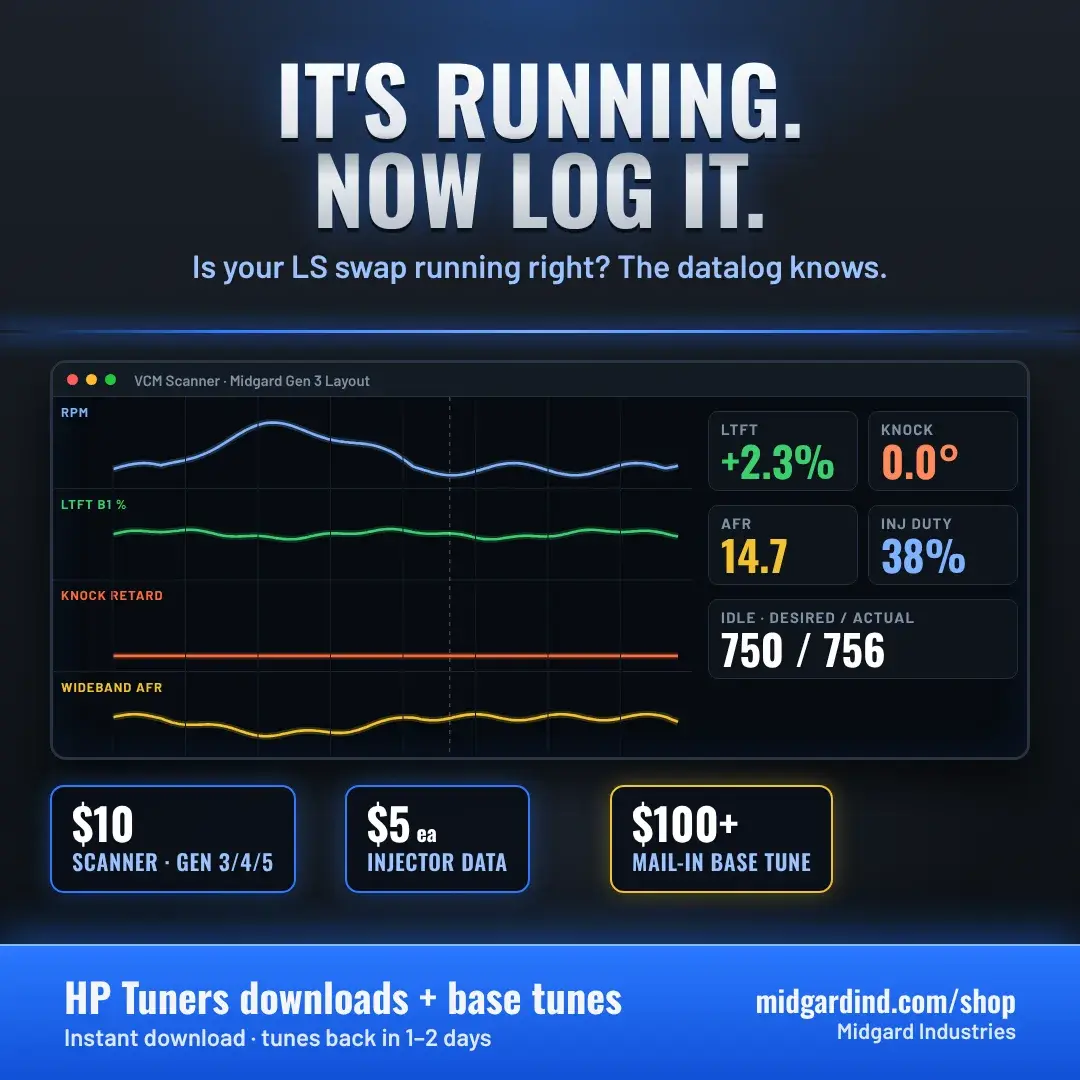
If you’re not sure, log it. A datalog shows what the engine was doing when the code set. (See Your LS Swap Is Running. Now Log It.)
Get It Set Up Right
Mail-in base tunes: Swap-related codes are set up for your build as part of every base tune.
| Gen 3 P01 / P59 | Gen 4 E38 | |
|---|---|---|
| Stock / Near-Stock | $100 | $200 |
| Cammed / Modified | $150 | $250 |
Plus $10 return shipping. Your ECU ships back within 1–2 business days after we receive it.
HP Tuners downloads:
- GM Gen 3, 4, or 5 VCM Scanner package: $10, or all three for $20
- Gen 4 to Gen 3 injector data: $5 each, or all nine for $30
Follow Midgard Industries
Don't want to tune it yourself?
Mail in your P01/P59 or E38 and get a VATS-deleted, swap-ready base tune. P01/P59 from $100, E38 from $200. Typical turnaround is 1-2 business days after the ECU is received.