Why a VATS Delete Alone Is Not a Complete LS Swap Tune
One of the first things many LS swap builders hear is:
“Just get VATS deleted and it will run.”
There is some truth to that—but it leaves out a big part of the story.
Disabling Vehicle Anti-Theft System, or VATS, may be necessary when installing a GM LS engine into a vehicle that no longer uses the original factory security system. However, a VATS delete LS tune is not the same thing as properly configuring the PCM for the new vehicle.
VATS removal solves one specific problem.
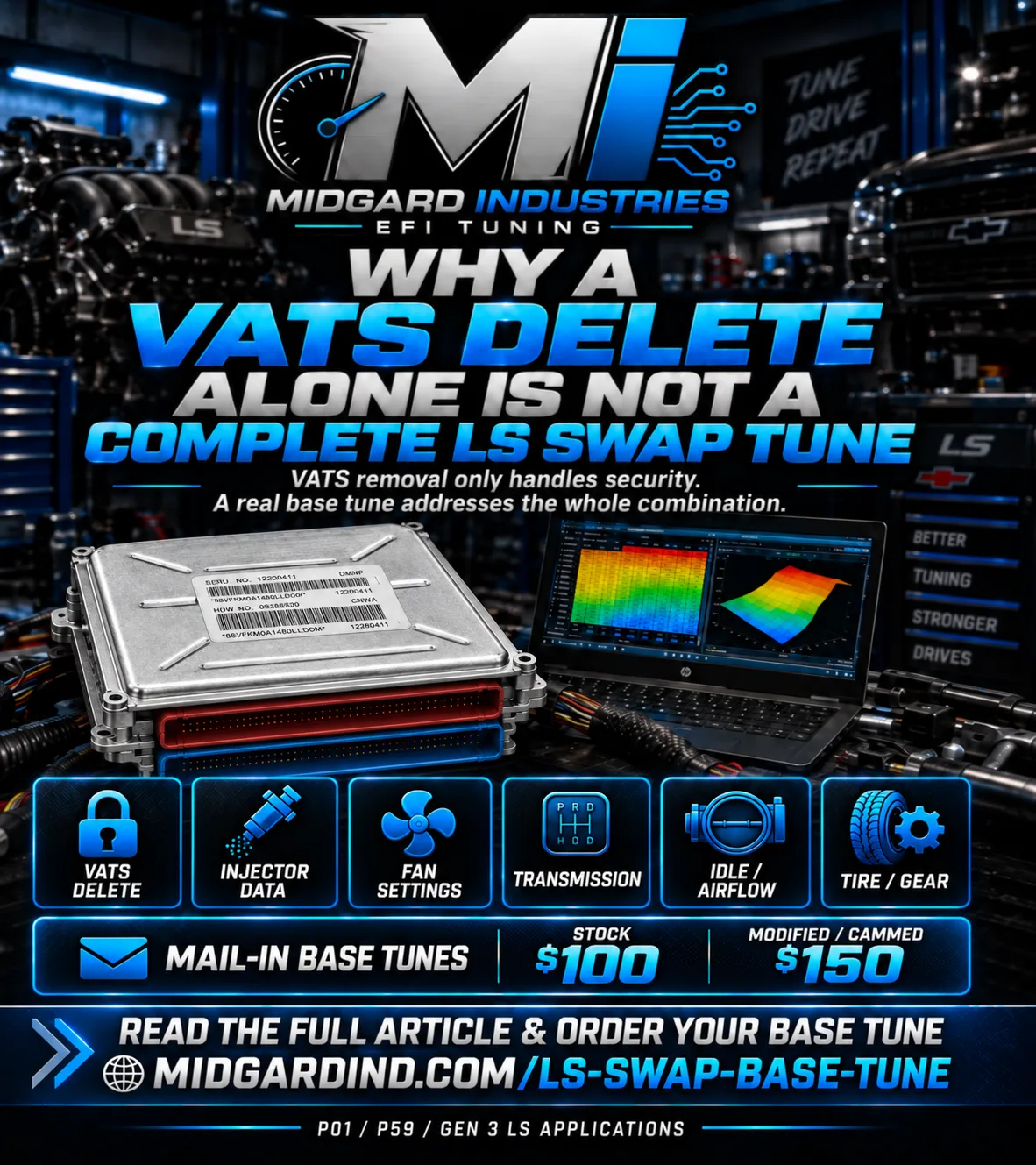
It does not automatically correct the transmission configuration, injector data, engine displacement, cooling fan settings, tire size, gear ratio, idle airflow, camshaft-related changes, or other parts of the calibration.
That is why two LS swap PCMs can both have VATS disabled, yet one runs well enough for startup while the other struggles with idle, fueling, fans, transmission operation, or drivability.
What Does VATS Actually Do?
VATS stands for Vehicle Anti-Theft System.
In the original GM vehicle, the PCM communicates with other modules to determine whether the vehicle has been properly authorized to start.
When the engine and PCM are moved into an older vehicle, hot rod, C10, S10, G-body, muscle car, or other standalone application, those original security modules often are not present.
If the PCM still expects security authorization, a common symptom is:
The engine starts normally, runs for a second or two, and then shuts off.
Changing the appropriate VATS configuration allows the PCM to operate without the original vehicle's anti-theft system.
That's important—but that is essentially where the VATS portion of the job ends.
A VATS Delete Does Not Tell the PCM What Engine You Built
The PCM still contains a calibration based on the donor vehicle.
Imagine a PCM that originally came from a 5.3L Silverado with:
- A stock 5.3 engine
- Factory injectors
- 4L60E transmission
- Factory tire size
- Factory rear gears
- Factory cooling strategy
- Stock camshaft
- Original MAF and MAP sensors
Now that PCM is installed in a swap using:
- 6.0L engine
- Larger injectors
- Performance camshaft
- 4L80E
- Electric fans
- Different tire size
- Different rear gears
- Headers
- Different intake
Disabling VATS does not magically change any of those other parameters.
The PCM may now allow the engine to stay running, but it is still calibrated around hardware that may no longer exist.
Engine Displacement Matters
If the calibration was originally built for a 4.8L or 5.3L and is now controlling a 6.0L engine, the engine displacement information should be reviewed.
The PCM uses cylinder volume and airflow information in calculations related to engine load.
A proper LS swap base calibration should reflect the engine that is actually installed—not simply whatever engine happened to be attached to the donor PCM.
Injector Data Can Make or Break the Tune
Injectors are another major difference between a simple VATS delete LS tune and a calibration built around the actual combination.
If the engine still uses the injectors for which the original calibration was created, the factory data may be appropriate.
But many swaps use different injectors.
The PCM may need accurate information for things such as injector flow rate, voltage offset, short-pulse behavior, and other characterization data supported by the operating system.
This is also why an injector part number is much more useful than simply saying:
“It has 50-pound injectors.”
Two injectors with similar advertised flow rates can behave differently.
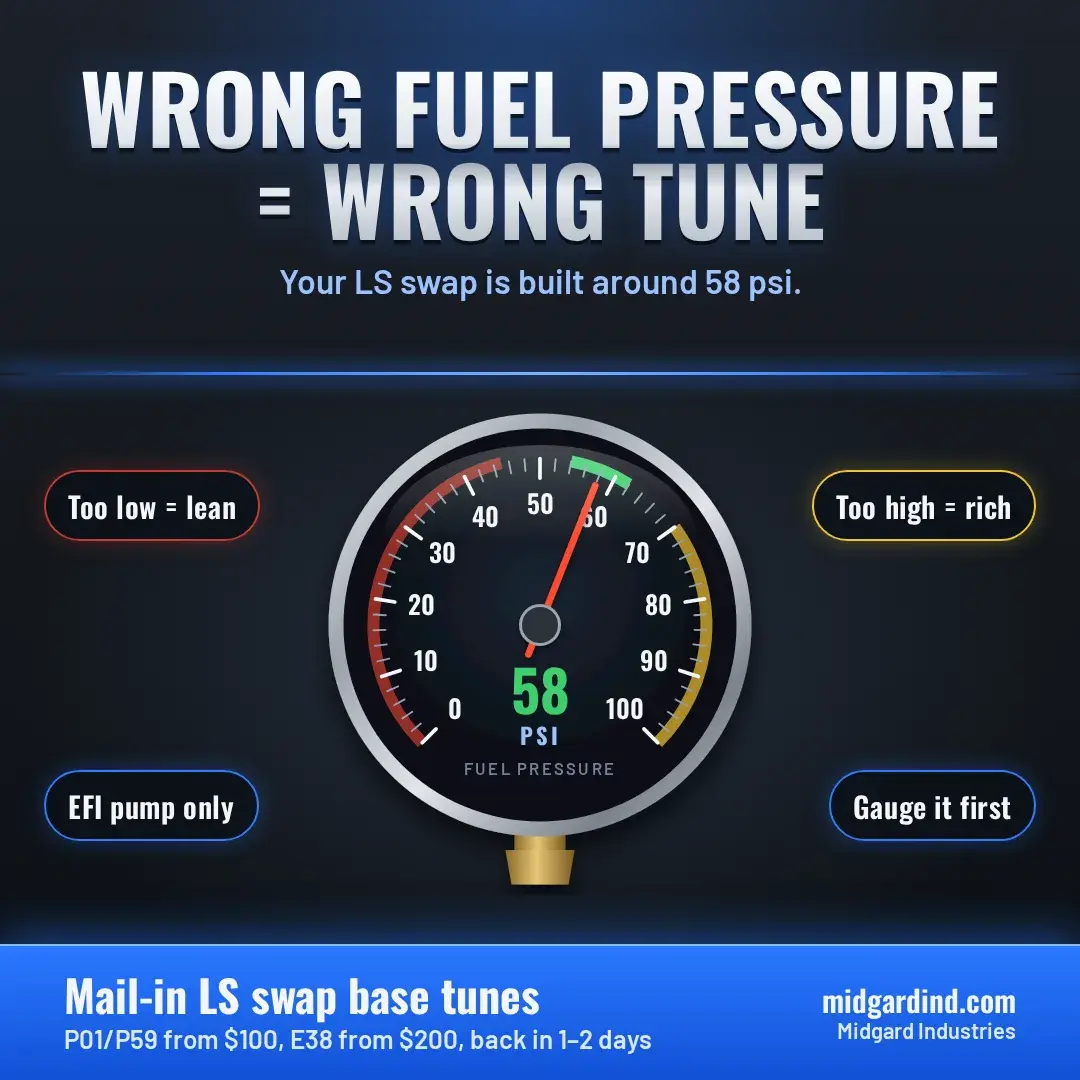
Fuel pressure matters as well. An injector operated at 58 psi does not necessarily flow the same amount of fuel as it does at the pressure where it was originally rated.
VATS removal does nothing to correct injector calibration.
A 4L80E Swap Needs More Than VATS Removal
Transmission configuration is another major reason not to treat every LS swap PCM the same.
If the donor calibration was configured for a 4L60E but the vehicle now uses a 4L80E, the transmission portion of the calibration needs to match the hardware.
Depending on the PCM and operating system, this can involve the proper transmission configuration or segment setup.
The PCM may control:
- Shift scheduling
- Line pressure
- Torque converter clutch operation
- Transmission diagnostics
- Torque management behavior
Simply disabling VATS does not convert a 4L60E calibration into a properly configured 4L80E calibration.
The same principle applies when using a TH350, TH400, Powerglide, manual transmission, or another transmission the PCM is not controlling.
Electric Fan Settings Need to Match the Swap
Many LS swaps use electric cooling fans that are completely different from the donor vehicle's cooling setup.
The PCM can often control those fans, but the appropriate fan logic and temperatures need to be configured for the new vehicle.
A swap using a different thermostat and radiator may require fan settings that make sense for that cooling system.
A PCM can have VATS disabled and still never command the fans the way the builder expects.
That isn't a VATS problem.
It's a calibration problem.
Tire Size and Rear Gear Ratio Can Matter
If the PCM is calculating vehicle speed, the tire diameter and rear axle ratio should also be considered.
Incorrect speed calculations may affect more than the speedometer.
Depending on the operating system and transmission, vehicle speed can influence:
- Shift points
- Torque converter lockup
- Deceleration behavior
- Idle control
- Throttle cracker operation
- Other vehicle-speed-based functions
Again, none of this gets corrected by a basic VATS delete.
A Cammed LS Needs Even More Attention
This is where the difference becomes especially noticeable.
A stock engine may tolerate a donor calibration reasonably well after the basic swap configuration is corrected.
A cammed engine can be much less forgiving.
A performance camshaft can change:
- Idle vacuum
- Idle MAP
- Required idle airflow
- Startup airflow requirements
- Desired idle RPM
- Low-RPM cylinder filling
- Idle spark requirements
- Deceleration behavior
A cammed engine may start after VATS is removed but still surge, stall, hang at high RPM, require throttle to stay running, or die when placed in gear.
A VATS delete LS tune does not automatically address those problems.
A modified base tune needs to be built around the fact that the engine no longer behaves like the stock combination.
VATS Removal Does Not Fix Idle Airflow
Idle airflow is one of the biggest areas that separates a modified base tune from a security-only change.
A cammed LS often needs more airflow at idle than the stock engine did.
If commanded airflow is too low, the PCM may constantly struggle to catch the engine.
Symptoms can include:
- Starts and then stalls
- RPM falls too far after revving
- Stalls when placed in gear
- Stalls when pushing in the clutch
- Requires throttle during cold start
- Surging or unstable idle
Proper startup and base airflow settings give the PCM a much better starting point.
Sensor Configuration Has to Match Too
The PCM needs to know what sensors are actually installed.
That is especially important if the swap uses a MAP sensor that is different from the original calibration.
A 1-bar, 2-bar, 3-bar, or other MAP sensor cannot simply be swapped without ensuring the PCM is scaled appropriately for it.
MAF configuration also needs to match the actual hardware and tuning strategy.
VATS removal has nothing to do with either one.
What Should an LS Swap Base Tune Address?
The exact changes depend on the combination, but a proper base calibration may require reviewing areas such as:
- VATS configuration
- Engine displacement
- Transmission type
- Injector data
- Fuel pressure
- Cooling fan configuration
- Tire diameter
- Rear gear ratio
- MAP sensor
- MAF configuration
- Desired idle speed
- Startup airflow
- Base running airflow
- Camshaft-related idle changes
- Vehicle-speed-related settings
- Appropriate diagnostics for the actual configuration
Not every vehicle needs every item changed.
The point is that the calibration should be based on the actual combination rather than treating every LS swap PCM as identical.
Why Cheap VATS-Only Programming Can Become Expensive
A VATS-only service can look attractive because it is inexpensive.
But if the PCM comes back and the engine still doesn't idle correctly, the fans don't operate properly, the transmission configuration is wrong, or the injectors are not properly represented, you may end up paying someone again to redo the calibration.
Worse, builders sometimes start changing mechanical parts because they assume the PCM has already been “tuned.”
They may chase fuel pressure, vacuum leaks, sensors, wiring, throttle bodies, or other components when part of the problem is simply that the calibration does not match the combination.
There is nothing inherently wrong with a VATS-only service when that is genuinely all the vehicle needs.
The problem is calling a VATS delete a complete LS swap tune when it isn't.
Base Tune vs Final Tune
There is another important distinction.
A good LS swap base tune is still not the same thing as a final dyno or street calibration.
The purpose of a base calibration is to configure the PCM around the known hardware and give the engine a reasonable starting point for startup and initial operation.
Final tuning should use data from the actual vehicle.
That may include:
- Wideband AFR or lambda
- Fuel trims
- MAP
- MAF airflow
- Cylinder airmass
- Spark advance
- Knock retard
- Idle airflow
- Coolant temperature
- Transmission data
A mail-in tuner cannot know exactly how every engine will behave without data from that engine.
But there is a big difference between starting with a calibration built around the correct combination and starting with a completely unrelated stock donor file that only had VATS disabled.
What Information Should You Give Your Tuner?
When ordering an LS swap base tune, provide as much accurate information as possible.
Useful information includes:
- Engine size
- Engine year
- PCM type
- PCM service number
- Camshaft part number/specifications
- Injector part number
- Fuel pressure
- Intake manifold
- Throttle body
- MAF setup
- MAP sensor
- Transmission
- Converter stall speed
- Tire size
- Rear gear ratio
- Cooling fan setup
- Thermostat temperature
- Major engine modifications
The more accurate the information, the better the starting calibration can be.
Midgard Industries LS Swap Base Programming
Midgard Industries offers mail-in base programming for common Gen 3 LS P01 and P59 applications.
Mail in your existing PCM
Stock LS swap base tune — $100
Modified / cammed LS swap base tune — $150
Rather than simply switching off VATS, the calibration is built around the information you provide about the engine and swap combination.
Need an ECU supplied?
Stock tune + ECU — $150
Modified / cammed tune + ECU — $200
👉 Order your LS swap base tune:
https://midgardind.com/ls-swap-base-tune
Frequently Asked Questions
Is a VATS delete required for every LS swap?
Not necessarily every installation, but many standalone Gen 3 swaps no longer use the donor vehicle's original security system, so the VATS configuration often needs to be addressed.
Why does my LS swap start and then die?
VATS is one possible cause, especially when the engine starts and shuts off shortly afterward. Fuel delivery, wiring, crank/cam signals and other problems can cause similar symptoms, so the issue should be properly diagnosed rather than automatically assuming VATS.
Is a VATS delete the same as an LS swap tune?
No. VATS removal addresses the factory anti-theft function. An LS swap base tune can also involve engine, transmission, injector, cooling fan, sensor, idle and other configuration changes.
Do I need a different tune for a cammed LS?
Usually, yes. A performance cam can change idle vacuum, airflow requirements, startup behavior and low-RPM cylinder filling. Cammed combinations often need additional calibration changes.
Does a 4L80E swap require PCM programming?
If the PCM is controlling the 4L80E, the calibration needs to be properly configured for that transmission.
Do bigger injectors need to be programmed into the PCM?
Yes. The calibration should use accurate injector information for the injectors and operating fuel pressure whenever possible.
Final Thoughts
A VATS delete is often an important part of an LS swap, but it is only one piece of the calibration.
A proper VATS delete LS tune should not be thought of as simply turning off the security system and calling the job finished.
The PCM should match the engine, transmission, injectors, fans, gearing, sensors, camshaft and other important parts of the vehicle it is now controlling.
That gives the swap a much better foundation for startup, initial driving and eventual final tuning.
Need Your LS Swap PCM Programmed?
Mail-in stock base tune — $100
Mail-in modified/cammed base tune — $150
👉 Order online:
https://midgardind.com/ls-swap-base-tune
Midgard Industries EFI Tuning
P01 • P59 • Gen 3 LS Swap Programming
Follow Midgard Industries
Don't want to tune it yourself?
Mail in your P01/P59 and get a VATS-deleted, swap-ready base tune for $100. Typical turnaround is 1-2 business days after the ECU is received.