Works With a Stock Converter” Doesn’t Mean It’s Best: Why Your Truck Norris or Chopacabra Cam Still Wants a Stall Converter
Mild truck cams like the Brian Tooley Racing Truck Norris and the Texas Speed Chopacabra are some of the most popular LS cams around. They sound great, make good power, and are sold as working with a stock torque converter. So a lot of people skip the converter and keep the stock one.
And it does work. The truck will start, idle, and drive. But “works with a stock converter” doesn’t mean it’s the best way to run that cam. Here’s why a stall converter is still one of the best upgrades you can make for a cammed LS swap.
What a Stall Converter Does
On an automatic, the torque converter connects the engine to the transmission through fluid. Its stall speed is roughly the RPM the engine can reach before the converter starts really putting power to the transmission.
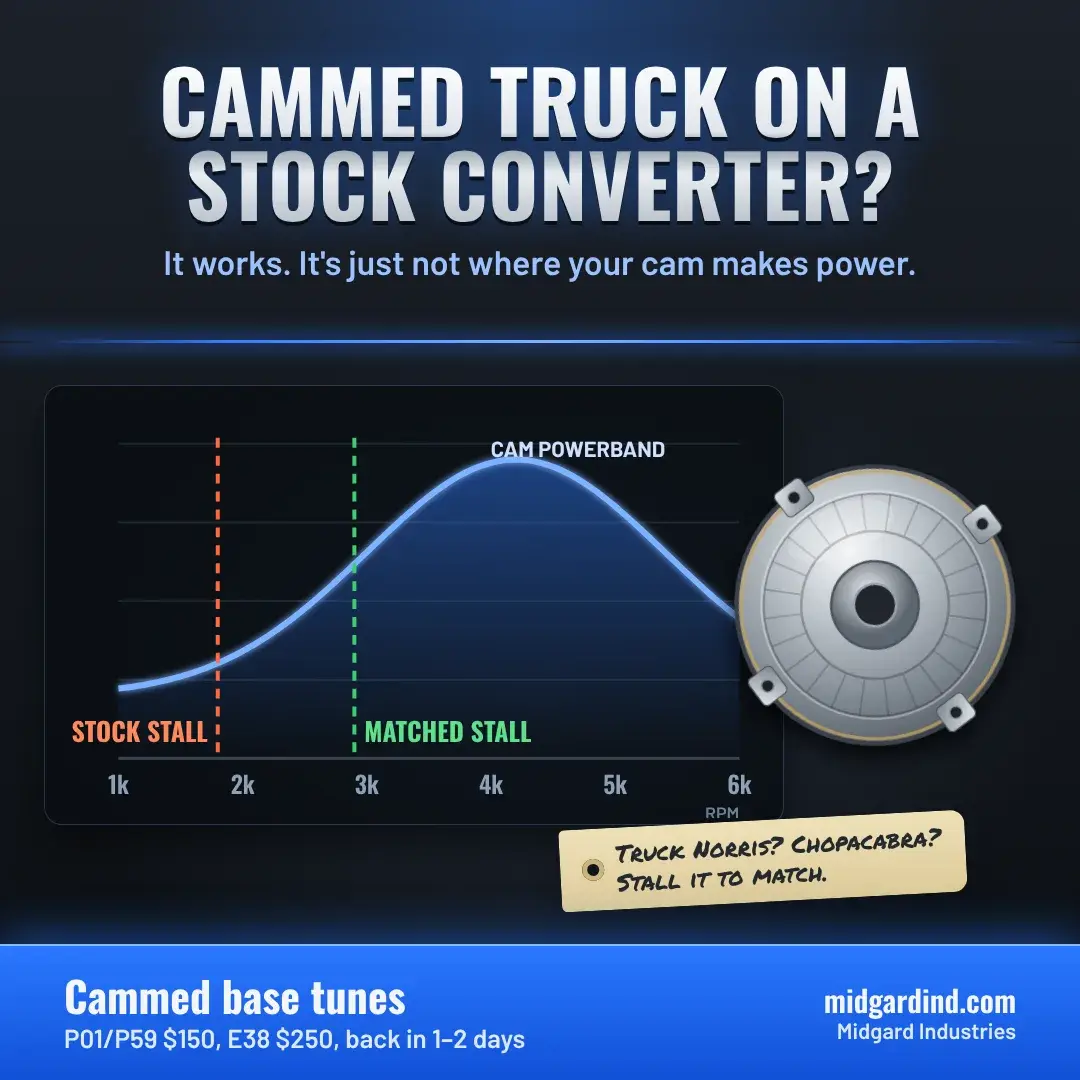
A stock GM truck converter has a fairly low stall speed, because a stock truck engine makes its torque low in the RPM range. A higher stall converter lets the engine rev up further before it’s fully loaded, into the RPM range where a cammed engine makes its power.
What a Cam Changes
A bigger cam moves your engine’s power higher in the RPM range. That’s where the extra horsepower comes from. But it usually costs you some torque down low, the exact RPM range where a stock converter has the engine working.
Even mild truck cams like the Truck Norris and Chopacabra shift the powerband up compared to a stock cam. With a stock converter, the engine has to pull from an RPM where the cam isn’t strong yet.
What You Notice With a Stock Converter
- It feels soft off the line. You press the gas, and the truck takes a moment before it really pulls, because the engine is starting below where the cam makes its power.
- It needs more throttle around town to get moving.
- The idle is rougher in gear. Sitting at a stop in Drive puts more load on a cammed engine with a tight converter, so it can shake, lope harder, or dip in RPM.
- It can stall or nearly stall when you come to a stop, especially before the tune is dialed in.
- Brake feel can change. Cams reduce idle vacuum, and more load at idle in gear can reduce it further, which some trucks feel in the brake pedal.
None of these make the truck undrivable. But they’re the difference between a cam that’s “fine” and a cam that feels like it’s supposed to.
What a Stall Converter Fixes
With a converter matched to your cam, the engine can reach the RPM where the cam starts working before the truck starts moving. That means:
- Stronger launches and better pull from a stop
- A smoother idle in gear, since the engine isn’t fighting the converter at a stop
- Less chance of stalling when coming to a stop
- Better use of the power you paid for, instead of leaving it on the table at low RPM
Some of the cam makers say the same thing. Texas Speed lists its 6.0 Chopacabra as stock-converter compatible, but 2600+ stall recommended for peak performance. dynamicraceworks
Picking a Stall Speed
The right stall speed depends on your cam, engine size, vehicle weight, rear gear, and tire size. For mild truck cams in the Truck Norris and Chopacabra range, many builders run something a few hundred to around a thousand RPM above stock.
Your best bet is to call the converter manufacturer with your cam specs, engine, vehicle weight, gear ratio, and tire size. A good converter company will match the converter to your setup. Don’t just pick the biggest number.
What About Highway Driving?
Modern lockup converters lock at cruising speed, so a well-matched stall converter usually doesn’t hurt highway driving much. A higher stall converter can make more heat in stop-and-go driving or when towing, so a transmission cooler is a smart addition.
Your Tune Needs to Know About Your Converter
Whether you keep the stock converter or upgrade, the tune has to match:
- Idle airflow in gear, so the engine doesn’t stall or shake at a stop
- Torque converter lockup settings, so it locks and unlocks smoothly
- Shift points and firmness for your cam, gear ratio, and tire size
When you order, tell us your cam (brand, name, or specs), your converter (stock, or the brand and stall speed), your transmission, your rear gear ratio, and your tire size. If you plan to add a converter later, let us know that too.
Order Your Cammed Base Tune
Our cammed/modified base tune includes injector data, idle airflow, and idle and spark setup made for cammed engines, including popular truck cams like the Truck Norris and Chopacabra.
| Gen 3 P01 / P59 | Gen 4 E38 | |
|---|---|---|
| Stock / Near-Stock Base Tune | $100 | $200 |
| Cammed / Modified Base Tune | $150 | $250 |
E38 tunes include TCM programming for 4L60E/4L80E swaps. Plus $10 return shipping. Typical turnaround is 1–2 business days after we receive your ECU.
Order your mail-in LS swap base tune here →
More on cams: Does a Cammed LS Need a Different Base Tune? Questions about your cam and converter? Contact us or call (430) 215-4536.
Follow Midgard Industries
Don't want to tune it yourself?
Mail in your P01/P59 and get a VATS-deleted, swap-ready base tune for $100. Typical turnaround is 1-2 business days after the ECU is received.