LS Swap Wiring Harness: Stock vs. Standalone, and What It Means for Your Tune
The wiring harness is the part of an LS swap that scares people the most. A factory truck harness looks like a bowl of spaghetti, and a standalone harness can cost more than the engine. But the harness is more than just wires. It has to match your PCM, your transmission, your throttle, and your tune. If they don’t match, you can end up with a no-start, a dead tach, or check engine lights that won’t go away.
Here’s how to choose a harness and what it means for your tune.
Option 1: Modify the Factory Harness
If your engine came with its harness, you can strip it down for your swap. That means removing the circuits that went to the original vehicle’s body and keeping what the engine, PCM, and transmission need.
Pros: It’s the cheapest option, and the connectors already match your engine.
Cons: It takes time, you need a wiring diagram for your exact donor vehicle, and one mistake can mean hours of troubleshooting. Older junkyard harnesses can also have brittle wires and corroded connectors.
Best for: People who are comfortable with wiring and want to save money.
Option 2: A Standalone Harness
A standalone harness is built just for swaps. It comes with only what the engine needs, plus a few labeled wires to connect to your vehicle.
Pros: It’s mostly plug-and-play, it’s new wire and connectors, and it’s much easier to troubleshoot.
Cons: It costs more, and you have to order the right one for your exact setup.
Best for: Most swappers, especially first-timers.
Your Harness Has to Match Your Setup
Whichever way you go, the harness has to match:
- Your engine generation: Gen 3 and Gen 4 engines use different sensors and connectors.
- Your PCM: A harness built for a P01 is different from one built for a P59 or E38. Tell your harness builder exactly which computer you’re running.
- Your throttle: Drive-by-cable or drive-by-wire. Drive-by-wire needs the pedal and throttle body wiring, and on some setups a separate throttle control module.
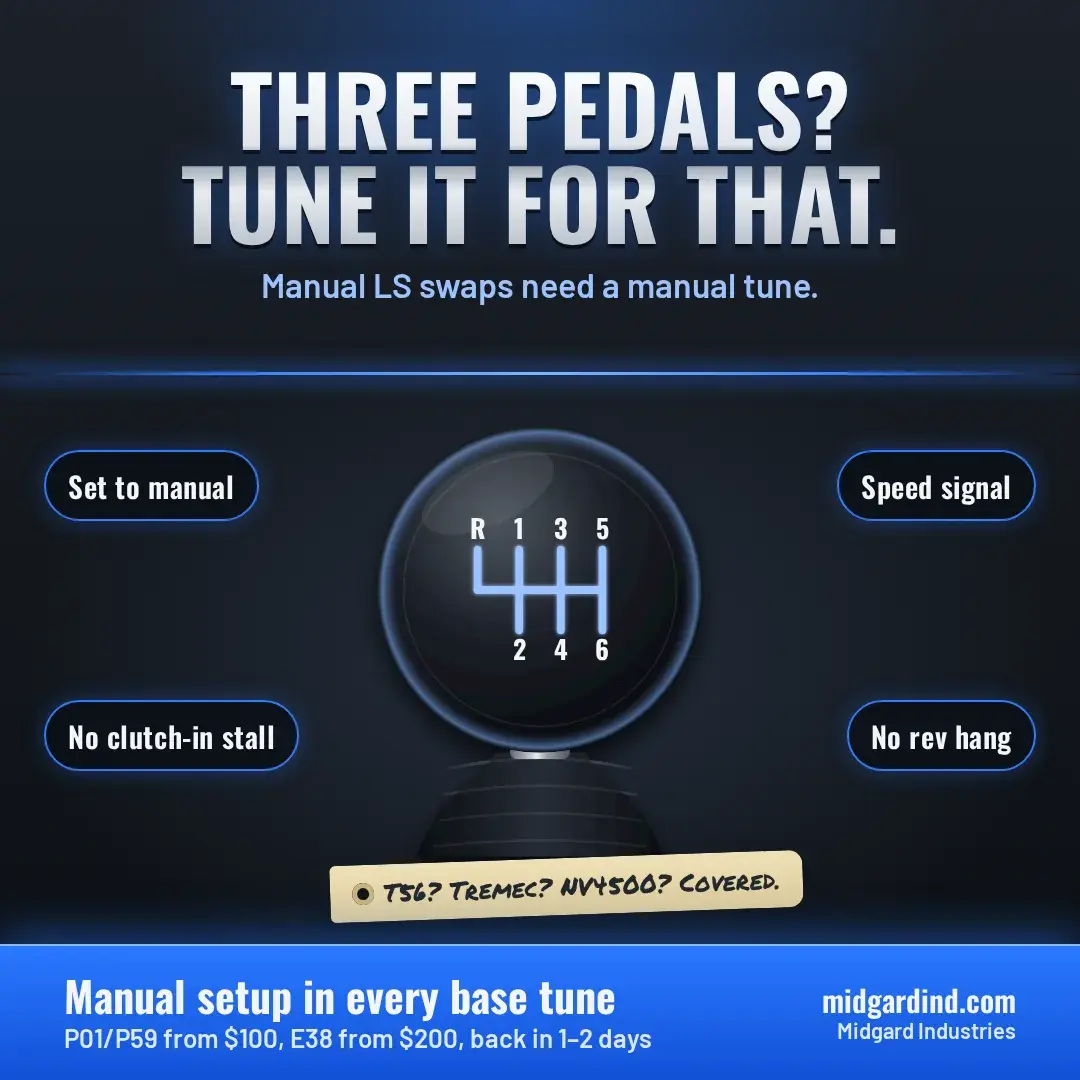
- Your transmission: A 4L60E, a 4L80E, and a manual all need different wiring.
- Your sensors: Whether you’re running a MAF, and your O2 sensor setup.
Your tune has to match all the same things. When the harness and the tune match, the engine starts and runs right. When they don’t, you can chase problems for weeks.
The Connections Every LS Swap Needs
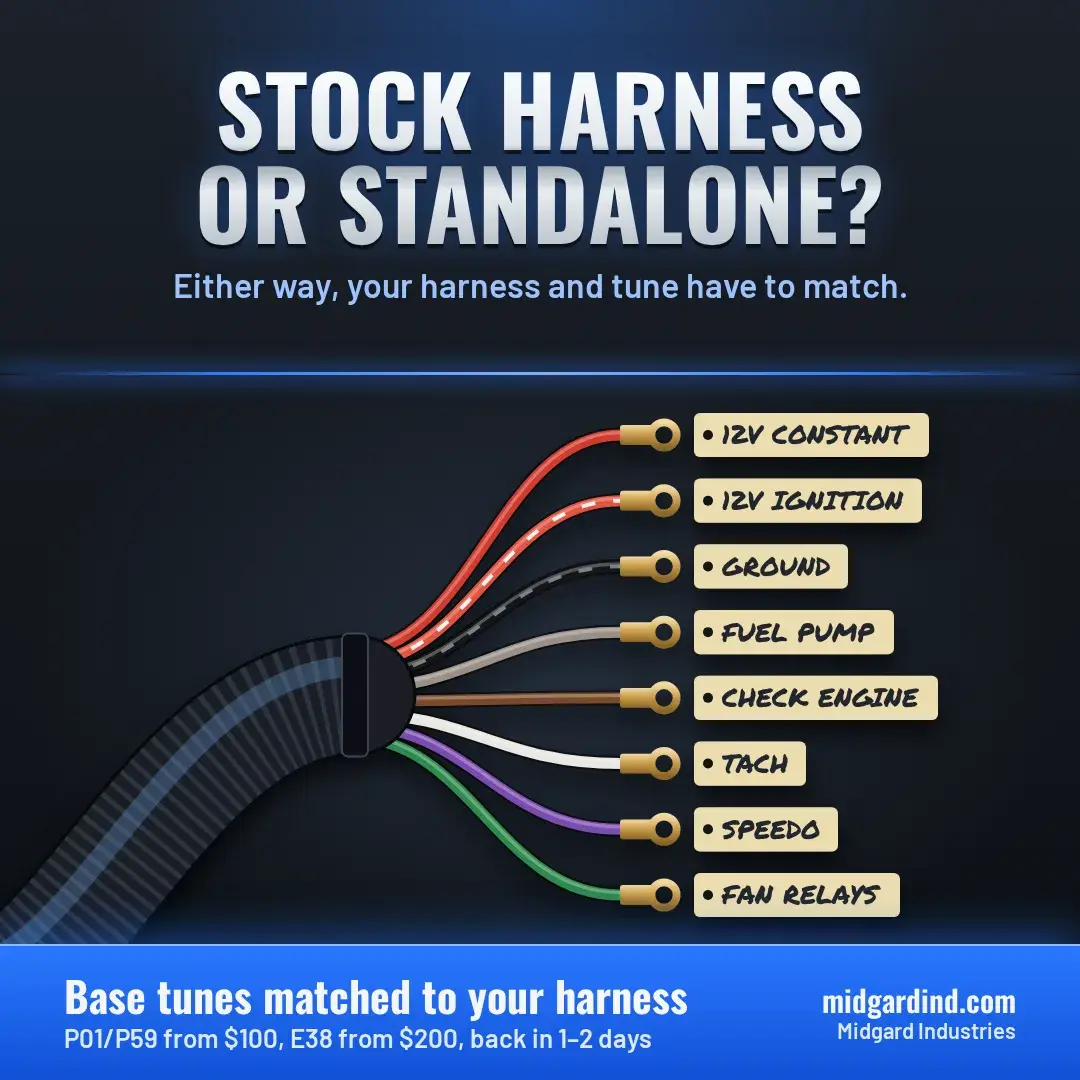
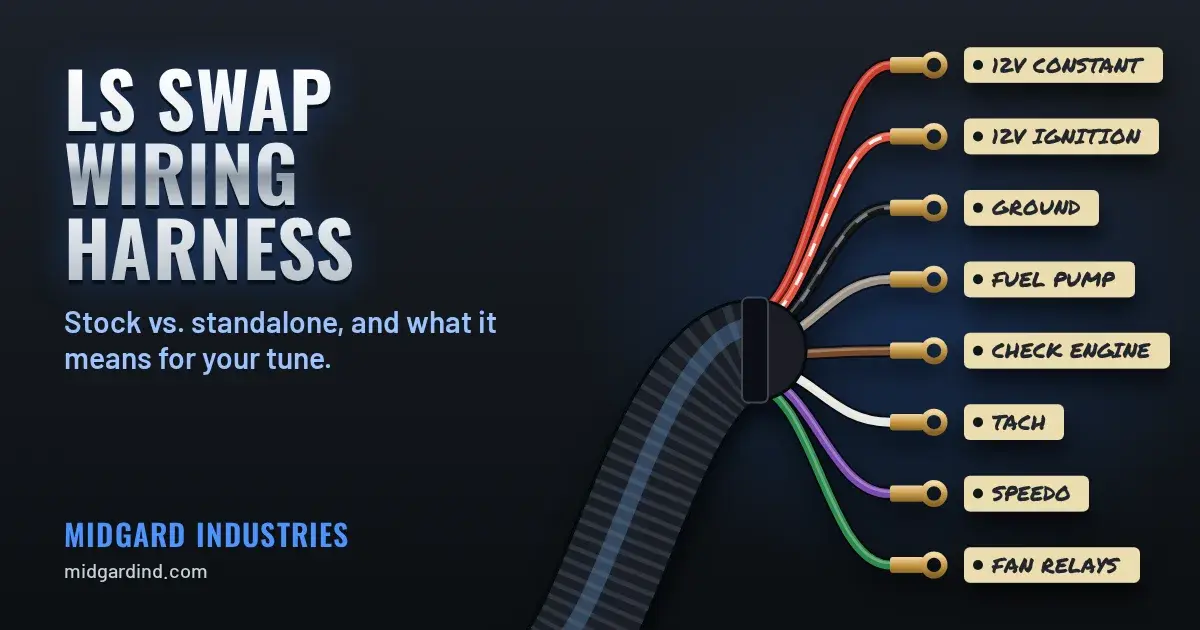
A standalone harness, or a properly stripped factory harness, usually comes down to a handful of connections to your vehicle:
- Constant 12V power from the battery
- Switched 12V from the ignition
- Ground, with good grounds from the engine to the battery and frame
- Fuel pump relay output to run the pump
- Check engine light output
- Tachometer output
- Speedometer output, if you’re running an electronic speedometer
- Electric fan relay outputs, if the PCM is controlling your fans
Where the Harness and the Tune Meet
Several of those connections only work right if the tune is set up for them:
- Tachometer: Many older and aftermarket tachs need to be set to 4-cylinder mode to read correctly with an LS signal. Check your tach’s instructions.
- Speedometer: For your speedometer to read right, the tune needs the correct speed signal setup, gear ratio, and tire size, and your gauge has to be calibrated to match.
- Electric fans: The fan relay wires do nothing unless fan control is turned on in the tune. (See LS Swap Electric Fans.)
- Transmission: The tune has to match the transmission your harness is wired for, whether that’s a 4L60E, 4L80E, or manual. (See LS Swap With a Manual Transmission.)
- Sensors: If your harness has no MAF connection, the tune has to be set up to run without one. (See LS Speed Density Tuning.)
Don’t Skip the Grounds
Bad grounds are one of the most common causes of strange LS swap problems: a no-start, a rough idle, jumpy gauges, or sensors reading wrong. Make sure you have solid grounds from the engine to the battery, the engine to the frame, and the body to the battery. Clean bare metal under every ground.
If your swap is having odd problems, check grounds before anything else. Then go through our LS Swap Startup Checklist.
Tell Us About Your Harness When You Order
When you order a base tune, let us know:
- Factory harness or standalone, and the brand if it’s standalone
- Your throttle type and transmission
- Whether you’re running a MAF
- Whether the PCM is controlling your fans
- What tach and speedometer you’re running
We’ll set up the tune so it works with your harness from the first start.
Order Your Base Tune
| Gen 3 P01 / P59 | Gen 4 E38 | |
|---|---|---|
| Stock / Near-Stock Base Tune | $100 | $200 |
| Cammed / Modified Base Tune | $150 | $250 |
E38 tunes include TCM programming for 4L60E/4L80E swaps. Plus $10 return shipping. Typical turnaround is 1–2 business days after we receive your ECU.
Order your mail-in LS swap base tune here →
Questions about your harness setup? Contact us or call (430) 215-4536.
Follow Midgard Industries
Don't want to tune it yourself?
Mail in your P01/P59 and get a VATS-deleted, swap-ready base tune for $100. Typical turnaround is 1-2 business days after the ECU is received.