LS Swap With a Manual Transmission: What Has to Change in the Tune
There’s nothing like an LS with three pedals. But if your engine came out of a truck with an automatic, its computer is still expecting that automatic. Bolt a manual transmission behind it without changing the tune, and you can end up with check engine lights, a dead speedometer, stalling when you push in the clutch, or RPM that hangs between shifts.
Here’s what needs to change in the tune for a manual LS swap.
1. The PCM Has to Know There’s No Automatic
A computer from a truck with an automatic transmission expects to control that transmission: shift solenoids, line pressure, and torque converter lockup. With a manual, none of that is there.
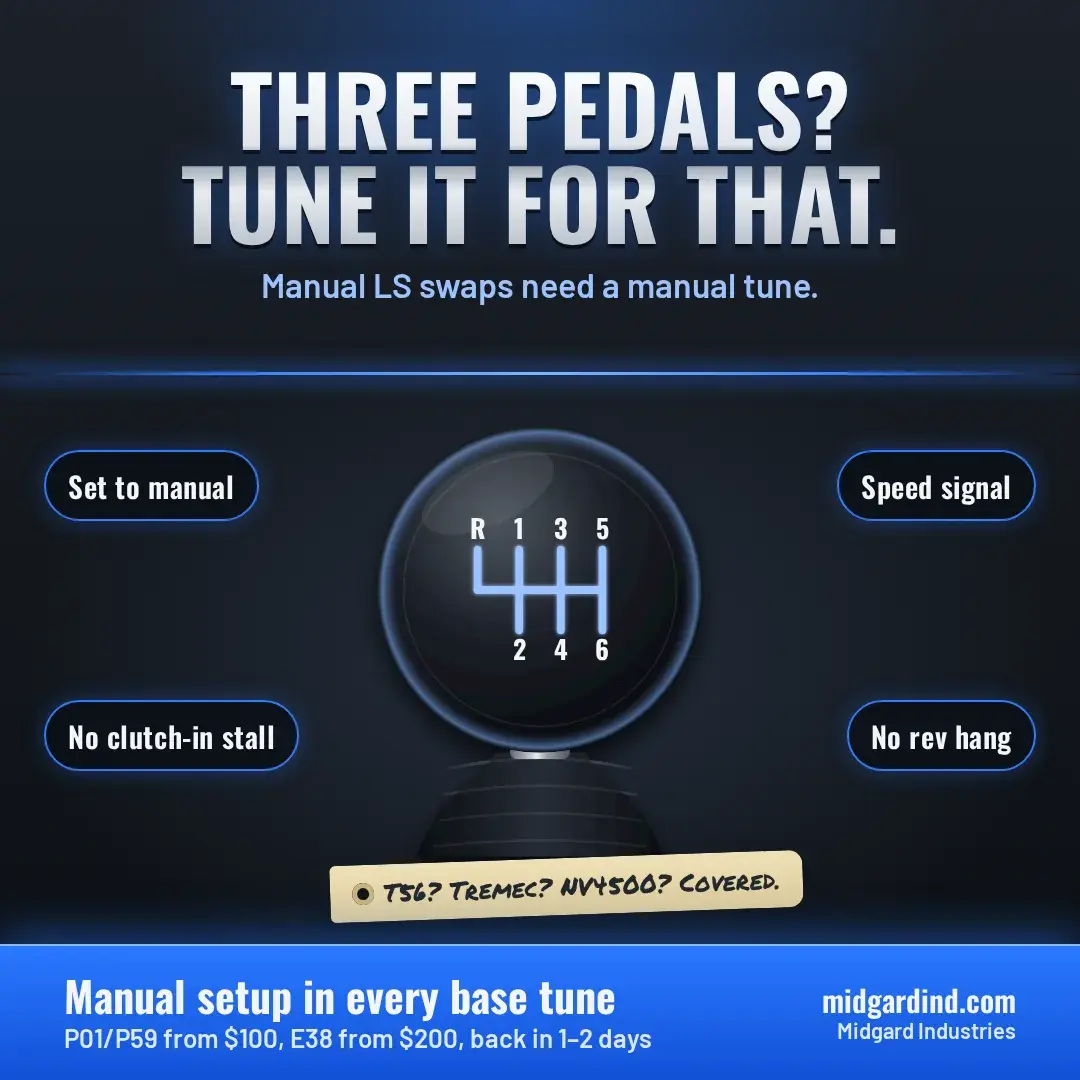
The tune needs to be set to manual transmission so the PCM stops trying to control an automatic and doesn’t set transmission codes for parts that aren’t there.
2. Speed Signal and Speedometer
With an automatic, the PCM usually reads vehicle speed from a sensor in the transmission. With a manual, your speed signal can come from different places depending on your setup:
- A speed sensor in the manual transmission, like on many T56 and Tremec units
- A sensor at the rear end or somewhere else on the driveline
- A GPS speed sensor or signal converter when there’s no usable speed sensor
The tune needs the right speed signal setup, plus your rear gear ratio and tire size, for the speedometer and vehicle speed to read right. Vehicle speed also affects idle and other functions, so getting it right matters for more than just the gauge.
3. Stalling When You Push in the Clutch
This is one of the most common complaints in manual LS swaps. You’re slowing down, you push in the clutch, and the RPM drops so fast the engine stalls or nearly stalls.
When you push in the clutch, the engine suddenly has nothing slowing the RPM drop except its own idle control. The tune needs the right idle airflow and throttle follower settings so the RPM comes down smoothly and settles at idle. This matters even more with a bigger cam.
4. Rev Hang Between Shifts
The opposite problem is just as annoying: you push in the clutch to shift, and the RPM hangs up instead of dropping. That slows down your shifts and feels sluggish.
Rev hang is usually caused by idle airflow and throttle follower settings that let too much air in as you come off the throttle. It’s a balance. Too little causes stalling, and too much causes rev hang. A good manual base tune starts with settings that work for a manual instead of carryover settings from an automatic truck.
5. Skip Shift (T56s From F-Bodies and Corvettes)
Many T56 transmissions from Camaros, Firebirds, and Corvettes have a skip shift solenoid that forces a 1st-to-4th shift under light throttle. Most swappers eliminate it. If yours is still in place, tell us when you order so we can account for it.
6. Rev Limiter
With a manual, it’s up to your foot to protect the engine. Make sure your rev limiter is set where you want it for your engine and valvetrain. If you have a cam with valve springs rated for higher RPM, tell us your redline.
What to Tell Us When You Order
- Your transmission, such as T56, T56 Magnum, Tremec TKX/TKO, NV4500, or something else
- Where your speed signal comes from, whether that’s the transmission, the rear end, or a GPS/converter
- Your rear gear ratio and tire size
- Your cam specs, since a bigger cam affects clutch-in idle behavior
- Whether you’re running skip shift
- Your preferred redline
Manual Setup Is Included
Manual transmission configuration is included in every base tune, for Gen 3 P01 and P59 PCMs and Gen 4 E38 ECUs.

Plus $10 return shipping. Typical turnaround is 1–2 business days after we receive your ECU.
Order your mail-in LS swap base tune here →
Running a bigger cam? The cammed package includes idle airflow and spark adjustments that help with clutch-in behavior. See Does a Cammed LS Need a Different Base Tune? Questions about your setup? Contact us or call (430) 215-4536.
Follow Midgard Industries
Don't want to tune it yourself?
Mail in your P01/P59 and get a VATS-deleted, swap-ready base tune for $100. Typical turnaround is 1-2 business days after the ECU is received.