LS Swap Fuel Pressure: Why 58 PSI Matters for Your Base Tune
You can have the right PCM, the right tune, and a perfect harness, and your LS swap can still crank forever, idle rough, or die at stoplights. One of the most common causes we see isn’t the tune at all. It’s the fuel system.
Here’s why fuel pressure matters so much in an LS swap and how to get it right before your first start.
Why Fuel Pressure Matters for the Tune
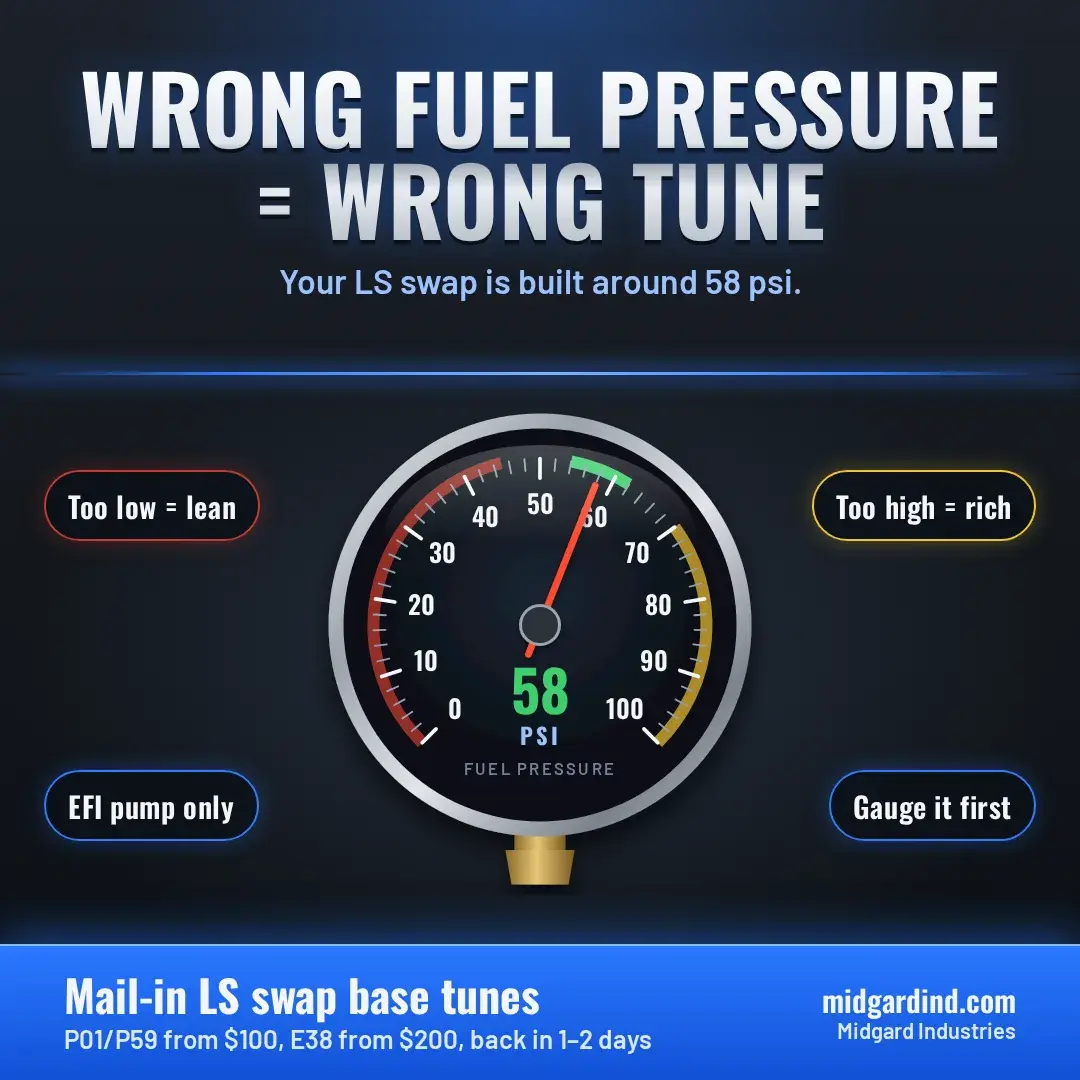
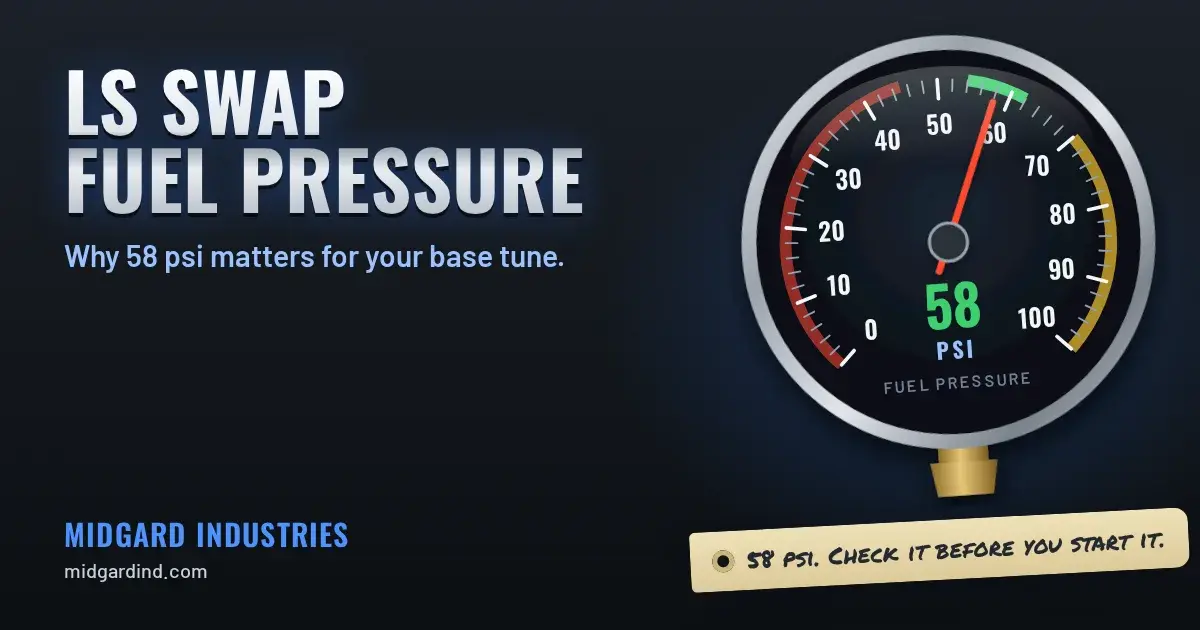
Your tune tells the injectors how long to open, based on injector data for a specific fuel pressure. Factory Gen 3 and Gen 4 LS engines run a returnless fuel system at about 58 psi, and the injector data in a base tune assumes about that much.
If your fuel pressure is off, the engine gets the wrong amount of fuel even if the tune is perfect:
- Too low: The engine runs lean. You’ll see hard starts, stumbling, stalling, and lean codes.
- Too high: The engine runs rich. You’ll see a rough idle, a fuel smell, black smoke, and poor fuel economy.
- Unstable: Pressure that drops when the engine is working hard can cause dangerous lean conditions under load.
The Simple Setup: A Filter Regulator
The easiest way to get the right pressure in most swaps is a Corvette-style filter regulator. It’s a fuel filter with a built-in 58 psi regulator. Fuel from the pump goes in, 58 psi goes to the engine, and extra fuel returns to the tank.
That gives you factory-style pressure with one return line back to the tank, and nothing to adjust.
Using an Adjustable Regulator
If you’re running an adjustable return-style regulator:
- Set it to about 58 psi with the engine running, unless you’ve told us a different pressure when ordering.
- Watch the vacuum reference. The LS tune assumes the pressure stays the same no matter the vacuum level. If your regulator is vacuum-referenced, the pressure will drop at idle and rise under load. Leave the vacuum port unconnected for a factory-style setup, or let us know your setup so we can account for it.
Choosing a Fuel Pump
The pump needs to hold 58 psi at the fuel flow your engine needs, not just at idle.
- Carburetor pumps won’t work. They’re built for 5–9 psi, not 58.
- Use a pump made for EFI. For many stock and mildly built LS engines, a 255 lph in-tank pump is a common choice. Bigger builds need more.
- Wire it right. Use a relay, a proper fuse, and a heavy enough power and ground. A pump that’s short on voltage won’t make full pressure.
Not sure about your injector size? Use our LS Injector Size Calculator.
Check Your Pressure Before You Blame the Tune
Install a fuel pressure gauge before your first start, even a temporary one. Then check:
- At key-on prime: Pressure should come right up to about 58 psi.
- At idle: It should hold steady.
- Under load: If you can watch it while driving, pressure shouldn’t drop.
- After shutdown: If pressure bleeds off quickly, you may have a leaking injector, regulator, or pump check valve. That can cause hard hot starts.
If you’re having startup trouble, see Why Does My LS Swap Start and Then Die? and our LS Swap Startup Checklist.
Tell Us About Your Fuel System When You Order
When you order a base tune, let us know your fuel setup, including pump, regulator type, fuel pressure, and injectors. If you’re running anything other than a factory-style 58 psi system, we’ll make sure your injector data matches.
Order Your Base Tune
| Gen 3 P01 / P59 | Gen 4 E38 | |
|---|---|---|
| Stock / Near-Stock Base Tune | $100 | $200 |
| Cammed / Modified Base Tune | $150 | $250 |
E38 tunes include TCM programming for 4L60E/4L80E swaps. Plus $10 return shipping. Typical turnaround is 1–2 business days after we receive your ECU.
Order your mail-in LS swap base tune here →
Questions about your fuel setup? Contact us or call (430) 215-4536.
Follow Midgard Industries
Don't want to tune it yourself?
Mail in your P01/P59 and get a VATS-deleted, swap-ready base tune for $100. Typical turnaround is 1-2 business days after the ECU is received.