Why Does My LS Swap Start and Then Die?
One of the most frustrating problems during an LS swap is when the engine fires immediately, sounds like it is going to run, and then shuts off.
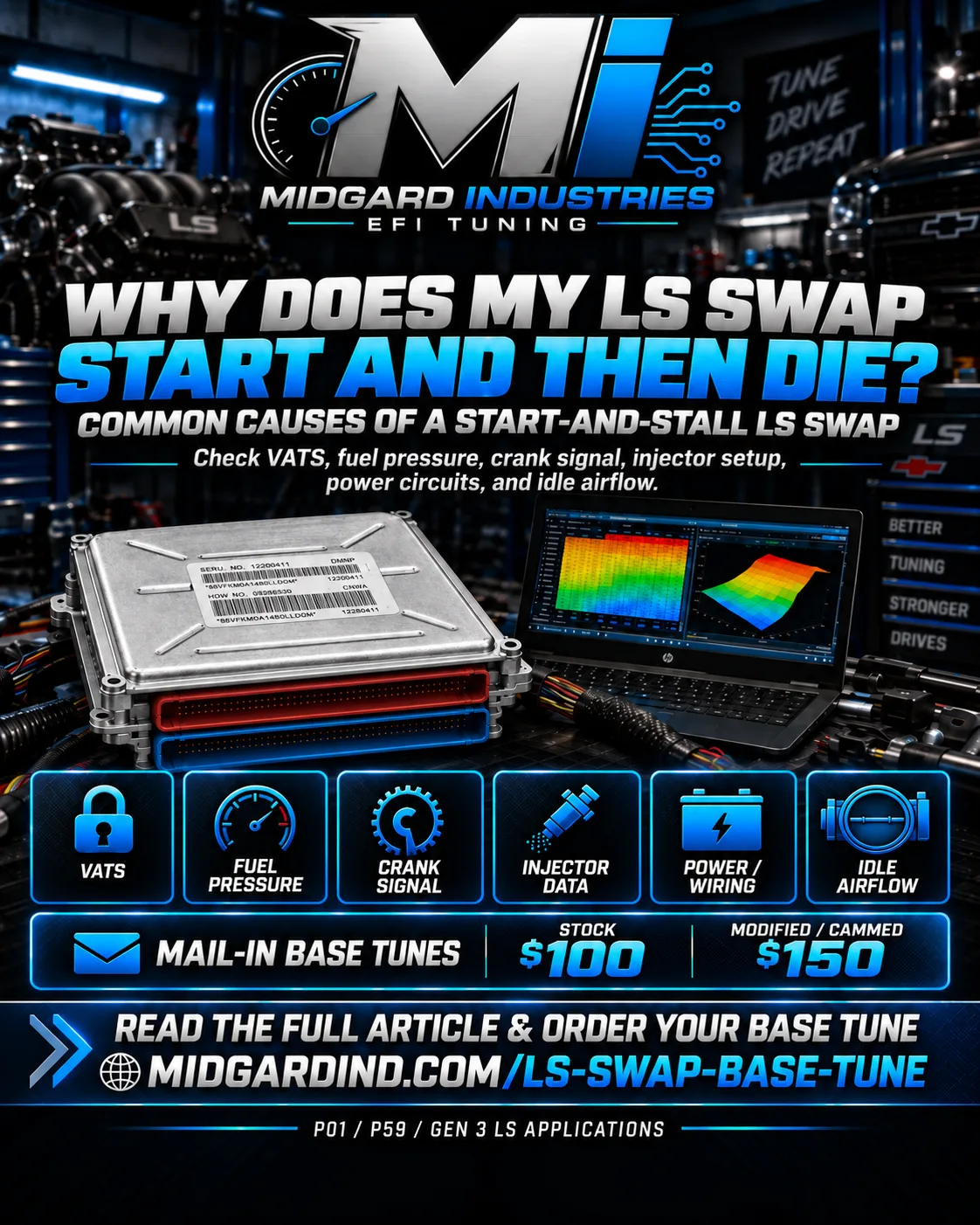
If your LS swap starts then dies, don't immediately assume the engine has a major mechanical problem. On a Gen 3 LS swap, the cause is often something in the security system, fuel delivery, wiring, sensor signals, injector setup, idle airflow, or PCM calibration.
The exact way the engine dies can provide some valuable clues.
An engine that runs cleanly for one or two seconds and abruptly shuts off points you in a different direction than one that starts, struggles at 400 RPM, surges, and finally stalls.
Here are the areas I would check first.
1. VATS Is One of the First Things to Check
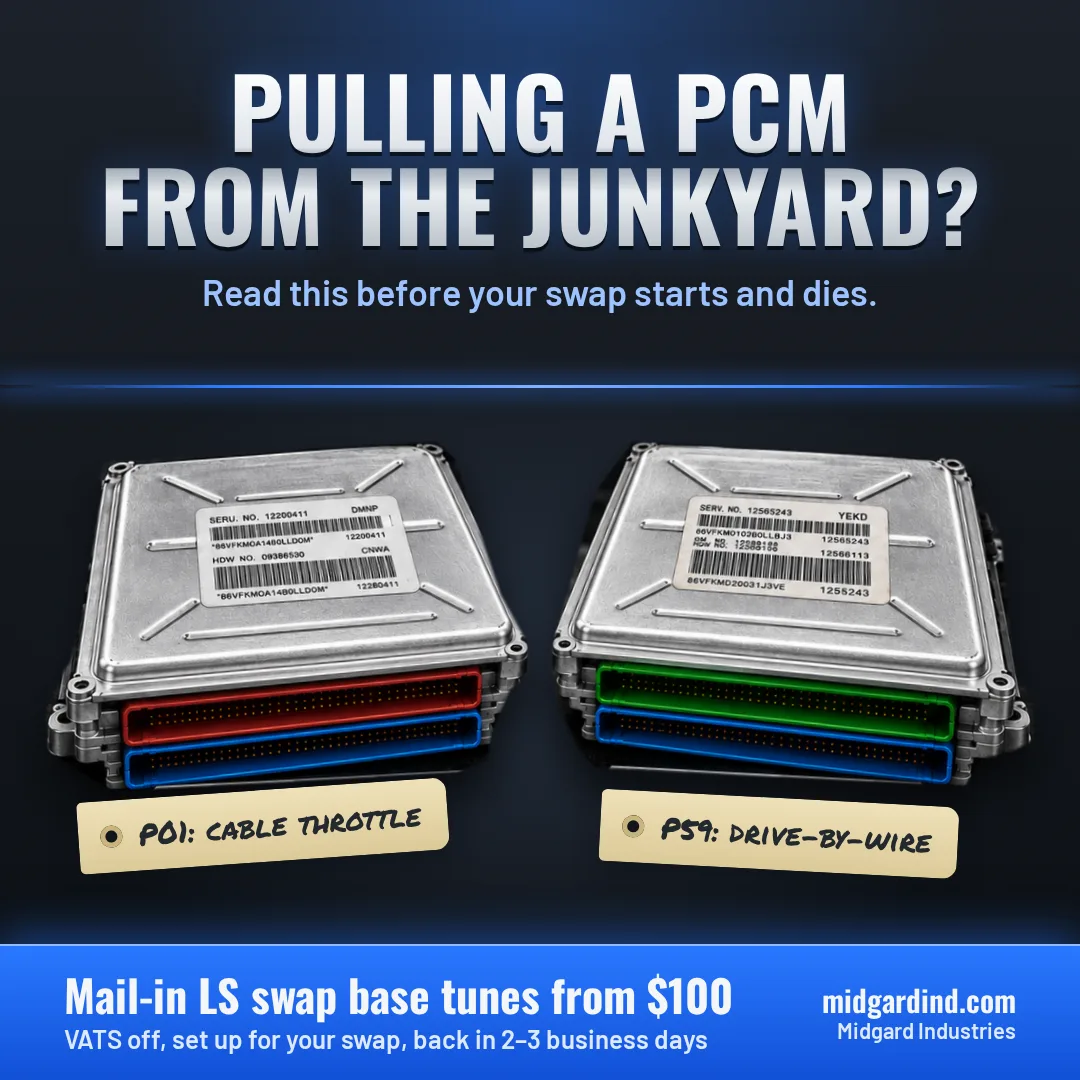
For a Gen 3 LS swap using a P01 or P59 PCM, Vehicle Anti-Theft System—or VATS—is one of the most common reasons an otherwise healthy engine will start and immediately shut off.
In the original vehicle, the PCM worked with the factory security system.
When that engine and PCM are installed in an older truck, muscle car, hot rod, S10, C10, G-body, or another standalone application, those original security modules are usually gone.
If the PCM is still expecting security authorization, the engine may:
Start normally → run briefly → shut off.
The shutdown is often very clean rather than a slow stumble.
That makes VATS one of the first PCM settings to verify when an LS swap starts and dies almost immediately.
But VATS Isn't the Only Possibility
A common mistake is assuming every start-and-die problem is VATS.
Fuel pressure can disappear.
The fuel pump may only run during prime.
Injector power can be lost.
The PCM can lose an RPM signal.
The engine may not have enough idle airflow to stay running.
Diagnose the symptom instead of automatically disabling things until the engine runs.
2. Check Fuel Pressure While the Engine Is Dying
Don't just check whether fuel pressure exists before startup.
Watch what the pressure does while the engine starts and stalls.
A fuel system can build pressure during the initial key-on prime and then lose it as soon as the engine starts.
Possible causes include:
- Fuel pump relay wiring
- Pump power circuit problems
- Weak fuel pump
- Bad ground
- Restricted fuel filter
- Incorrect regulator setup
- Fuel pressure regulator failure
- Incorrect return or returnless fuel-system plumbing
If you see 58 psi before cranking but pressure drops rapidly after the engine fires, that is an important clue.
Fuel Pump Prime Can Fool You
Most GM systems command the pump for a short period when the key is turned on.
That can give you enough fuel pressure to start the engine.
If the pump is not being powered correctly after startup, the engine burns the fuel available in the rails and shuts off.
That can look surprisingly similar to a PCM security issue.
3. Verify Injector Power
The injectors normally need switched 12-volt power on one side, with the PCM controlling the other side.
If injector power comes from the wrong circuit, the engine can start during cranking and then lose injector power when the ignition switch returns to the RUN position.
This is especially worth checking on custom LS swap harnesses.
Use a meter or test light and verify injector power with the key:
- In RUN
- During CRANK
- Immediately after the key returns from CRANK to RUN
The same concept applies to other ignition-switched circuits.
A wiring circuit that is powered only during cranking can create a perfect start-and-die condition.
4. Check the Ignition Switch Wiring
Older vehicles can have separate ignition-switch circuits for RUN and START.
This can cause trouble during an LS conversion.
If the PCM, injectors, coils, or other critical circuits are powered from a terminal that goes dead when the key is released from START, the engine can fire during cranking and immediately shut off.
If your LS swap starts then dies exactly when you release the key, ignition-switch wiring deserves a close look.
The PCM and necessary engine circuits need uninterrupted power through the transition from CRANK to RUN.
5. Watch Engine RPM in the Scanner
If you have HP Tuners, another scan tool, or appropriate diagnostic software, watch engine RPM while cranking and while the engine is running.
A stable RPM signal tells you that the PCM is receiving crankshaft position information.
If RPM suddenly falls to zero before the engine physically stops rotating, investigate the crank signal and its wiring.
Possible causes include:
- Crankshaft position sensor
- Incorrect crank sensor
- Damaged wiring
- Poor connector contact
- Sensor power or ground issue
- Harness problem
- PCM connection issue
The PCM needs a reliable crankshaft position signal to control spark and fuel.
6. Don't Forget the Cam Sensor
The crank sensor is the primary signal used to determine engine position, but the camshaft position sensor is also important for synchronization and sequential operation.
A cam signal problem does not always produce a simple start-and-die symptom, but it should still be checked if there are synchronization codes or strange startup behavior.
Verify that the correct cam sensor, harness, timing cover configuration, and PCM strategy are being used for the engine generation.
Gen 3 and Gen 4 combinations can create problems when parts are mixed without accounting for the differences.
7. Check Grounds Carefully
Poor grounds create some of the strangest LS swap problems.
An engine may crank and even briefly start while still having inadequate grounds for proper PCM, injector, coil, or sensor operation.
Make sure you have good connections between:
- Battery negative and engine
- Engine and chassis
- PCM grounds and engine
- Cylinder heads and chassis where appropriate
Ground connections should be clean, tight, and attached to bare metal—not paint, powder coat, rust, or a questionable bracket.
Voltage drop testing is much more useful than simply looking at the ground cable and deciding it appears good.
8. Incorrect Injector Data Can Make the Engine Stall
If the engine has aftermarket injectors, make sure the calibration actually matches them.
A PCM that is still configured for small factory injectors while the engine has much larger injectors can command far too much fuel.
Likewise, incorrect fuel pressure assumptions can make the injector data wrong even if the advertised injector size looks correct.
Accurate injector setup may involve:
- Injector flow rate
- Voltage offset
- Short-pulse behavior
- Minimum pulsewidth
- Correct operating fuel pressure
An engine that starts extremely rich, loads up, and dies is different from a VATS shutdown.
Look at the spark plugs, wideband if available, fuel trims when possible, injector pulsewidth, and exhaust behavior.
Use Injector Part Numbers
“50 lb injectors” is not enough information for a good calibration.
Whenever possible, provide the actual injector part number and fuel pressure.
That gives the tuner a much better chance of entering correct data instead of guessing.
9. A Cammed LS May Simply Not Have Enough Idle Airflow
If your engine has a performance camshaft, a stock idle calibration may not provide enough airflow to keep it running.
This usually looks different from a clean VATS shutdown.
A cammed engine with insufficient airflow may:
- Start and flare
- Drop rapidly in RPM
- Surge
- Shake
- Struggle at very low RPM
- Die unless you hold the throttle open
If giving the engine a small amount of throttle keeps it running, idle airflow becomes much more suspicious.
A cammed LS can need changes to:
- Base running airflow
- Startup airflow
- Desired idle speed
- Idle spark
- VE in the idle area
- Throttle follower
- Throttle cracker
- Other idle-control parameters
A simple VATS delete does not address any of those areas.
10. The Throttle Body and Idle Control Need to Match the Calibration
Drive-by-cable and drive-by-wire systems require different hardware and calibration strategies.
On a drive-by-cable combination, make sure the IAC system is working and has enough authority to control idle.
On a drive-by-wire setup, verify the throttle body, pedal assembly, TAC strategy where applicable, and PCM calibration are compatible.
An incorrect throttle body or unsupported combination can create startup and idle problems that look like a fueling issue.
11. Check for Major Vacuum Leaks
A large vacuum leak can prevent the engine from maintaining a stable idle.
Check:
- Brake booster hose
- PCV plumbing
- Intake manifold seals
- MAP sensor port
- EVAP ports
- Vacuum fittings
- Intake manifold plugs
- Throttle-body gasket
A small leak may affect fuel trims.
A very large leak can make the engine extremely difficult to idle.
12. Verify MAP and MAF Configuration
The PCM needs to understand the sensors that are actually installed.
If a different MAP sensor has been fitted but the PCM still uses the calibration for the original sensor, calculated manifold pressure can be wrong.
This becomes especially important with 2-bar and 3-bar sensors on boosted combinations.
If the MAF configuration is wrong, the PCM can also calculate airflow incorrectly.
If the vehicle is intentionally being run in speed density, the calibration needs to be configured accordingly rather than simply unplugging the MAF and hoping the PCM handles it correctly.
13. Look for Useful DTCs
Don't disable every diagnostic trouble code before you've diagnosed the swap.
Codes can tell you a lot during first startup.
Pay attention to codes involving:
- Crankshaft position
- Camshaft position
- MAF
- MAP
- Throttle position
- Electronic throttle control
- Injector circuits
- Ignition circuits
- PCM power
- Transmission configuration
- Security-related systems
Some codes are expected because the donor vehicle's equipment is no longer installed.
Others point directly toward the reason the engine won't stay running.
14. Verify the PCM Calibration Matches the Actual Engine
A junkyard PCM may physically plug into your harness and still contain a calibration meant for a completely different combination.
For example, you may have:
PCM calibration:
5.3L
Stock injectors
4L60E
Stock cam
Original fans
Actual swap:
6.0L
50 lb injectors
4L80E
Truck cam
Aftermarket electric fans
Turning off VATS only corrects one item in that mismatch.
A proper LS swap base calibration should be reviewed for the engine and hardware actually being used.
A Quick Way to Narrow Down an LS That Starts and Dies
The exact behavior can point you toward different areas:
Starts cleanly, runs about 1–2 seconds, then abruptly shuts off:
Check VATS/security configuration early in the diagnosis.
Starts while cranking but dies immediately when the key is released:
Check ignition-switch RUN/START power circuits.
Starts normally and slowly loses RPM as fuel pressure falls:
Check fuel-pump power, relay operation, regulator, pump, and fuel delivery.
Starts very rich, smells heavily of fuel, fouls plugs, then dies:
Verify injector data, fuel pressure, MAP/MAF data, and fueling calibration.
Starts, RPM falls low, surges, and dies unless you open the throttle:
Check idle airflow, especially on a cammed engine.
Scanner RPM disappears unexpectedly:
Investigate crank signal, sensor wiring, PCM power, and grounds.
That distinction can save hours of randomly replacing parts.
Why PCM Programming Matters
PCM programming won't repair a bad fuel pump, broken crank-sensor wire, poor ground, or vacuum leak.
But the PCM still needs to be configured for the combination.
A proper base tune can address items such as:
- VATS configuration
- Engine displacement
- Injector data
- Transmission type
- Fan configuration
- MAP/MAF setup
- Tire and gear information
- Idle settings
- Camshaft-related startup and airflow changes
This gives you a much better starting point for troubleshooting because you aren't trying to diagnose mechanical and wiring issues while the PCM is also configured for the wrong vehicle.
A Base Tune Is Not the Final Tune
A mail-in base tune is designed to get the PCM configured around the known engine combination and provide a reasonable starting point for startup and initial operation.
It is not a replacement for final tuning.
Once the vehicle is running, final calibration should be based on actual data from the engine.
That may include:
- Wideband AFR or lambda
- Short- and long-term fuel trims
- MAP
- MAF airflow
- Injector pulsewidth
- Spark timing
- Knock retard
- Idle airflow
- Coolant temperature
- Transmission data
The goal of the base tune is to start in the right neighborhood instead of trying to tune from an unrelated donor calibration.
LS Swap Base Programming From Midgard Industries
If your PCM still contains the donor vehicle's calibration, Midgard Industries offers mail-in base programming for common P01 and P59 Gen 3 LS applications.
Mail in your existing PCM
Stock / near-stock LS swap base tune — $100
Modified / cammed LS swap base tune — $150
Base programming can be configured around the information you provide, including engine size, injectors, transmission, fans, camshaft, MAP/MAF setup, gear ratio, tire size, and other common swap requirements.
Need an ECU supplied?
Stock tune + ECU — $150
Modified / cammed tune + ECU — $200
👉 Order an LS swap base tune:
https://midgardind.com/ls-swap-base-tune
Frequently Asked Questions
Why does my LS swap start and shut off after two seconds?
VATS is one of the first things to verify if the engine starts normally and then shuts down cleanly after a short period. Fuel delivery, ignition-switch wiring, injector power, and PCM power can produce similar symptoms, so they should also be checked.
Will disabling VATS fix an LS that starts and dies?
It will only fix the problem if VATS is actually causing the shutdown. It will not repair fuel-pressure problems, wiring faults, incorrect injector data, crank-sensor issues, or insufficient idle airflow.
Why does my LS only run if I hold the throttle open?
That points more toward an idle-airflow, fueling, vacuum-leak, or calibration problem than a classic VATS shutdown. Cammed engines commonly require more startup and base idle airflow.
How much fuel pressure does a Gen 3 LS need?
Many common Gen 3 LS applications operate around 58 psi, but the correct pressure depends on the injectors and fuel-system configuration. The calibration and injector data need to match the actual pressure being used.
Can incorrect injectors make an LS start and die?
Yes. If the injector data is substantially wrong, the engine can be excessively rich or lean and may not stay running.
Can a bad crank sensor cause a start-and-die problem?
A crank signal problem can cause loss of spark and injection control. Watching engine RPM and relevant scanner channels during the event can help identify a signal loss.
Final Thoughts
When an LS swap starts then dies, pay attention to exactly how it dies.
A clean shutdown after a second or two can point toward VATS.
An engine that loses fuel pressure needs fuel-system diagnosis.
An engine that dies when the ignition key returns to RUN may have a wiring problem.
A cammed engine that only stays alive with throttle may need considerably more idle airflow and calibration work.
And if the PCM still contains a donor calibration that doesn't match your engine, injectors, transmission, sensors, and fans, getting the base programming correct removes one major variable from the troubleshooting process.
Need your Gen 3 LS PCM configured for your swap?
👉 https://midgardind.com/ls-swap-base-tune
Midgard Industries EFI Tuning
P01 • P59 • Gen 3 LS Swap Programming
Follow Midgard Industries
Don't want to tune it yourself?
Mail in your P01/P59 and get a VATS-deleted, swap-ready base tune for $100. Typical turnaround is 1-2 business days after the ECU is received.