LS Swap Base Tune vs. Custom Tune: What You Get and When You Need More
One of the most common questions we get is, "Do I need a base tune or a custom tune?" The honest answer is that most LS swaps start with a base tune, and some need a custom tune after that. Here's how to tell which one you need.
What a Base Tune Does
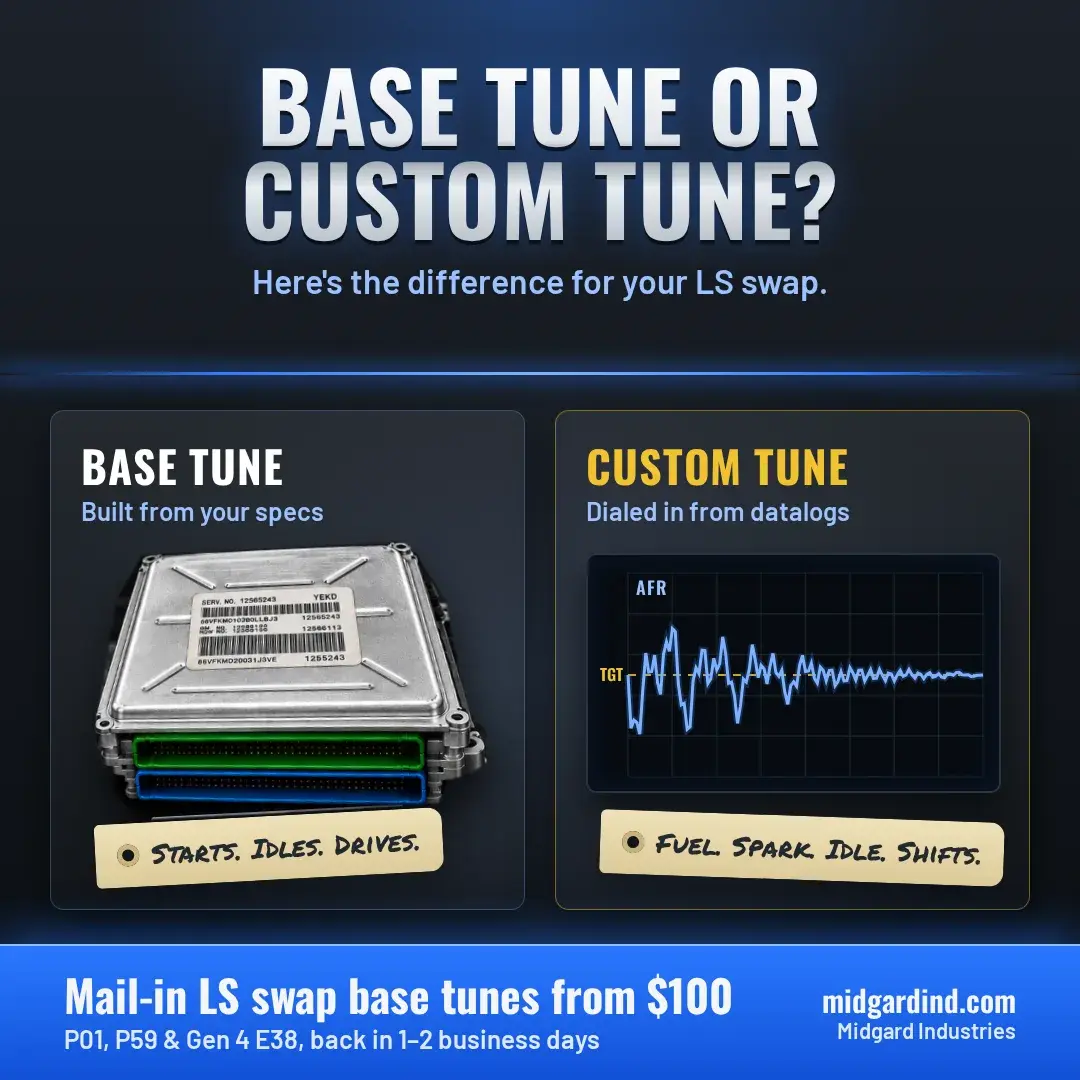
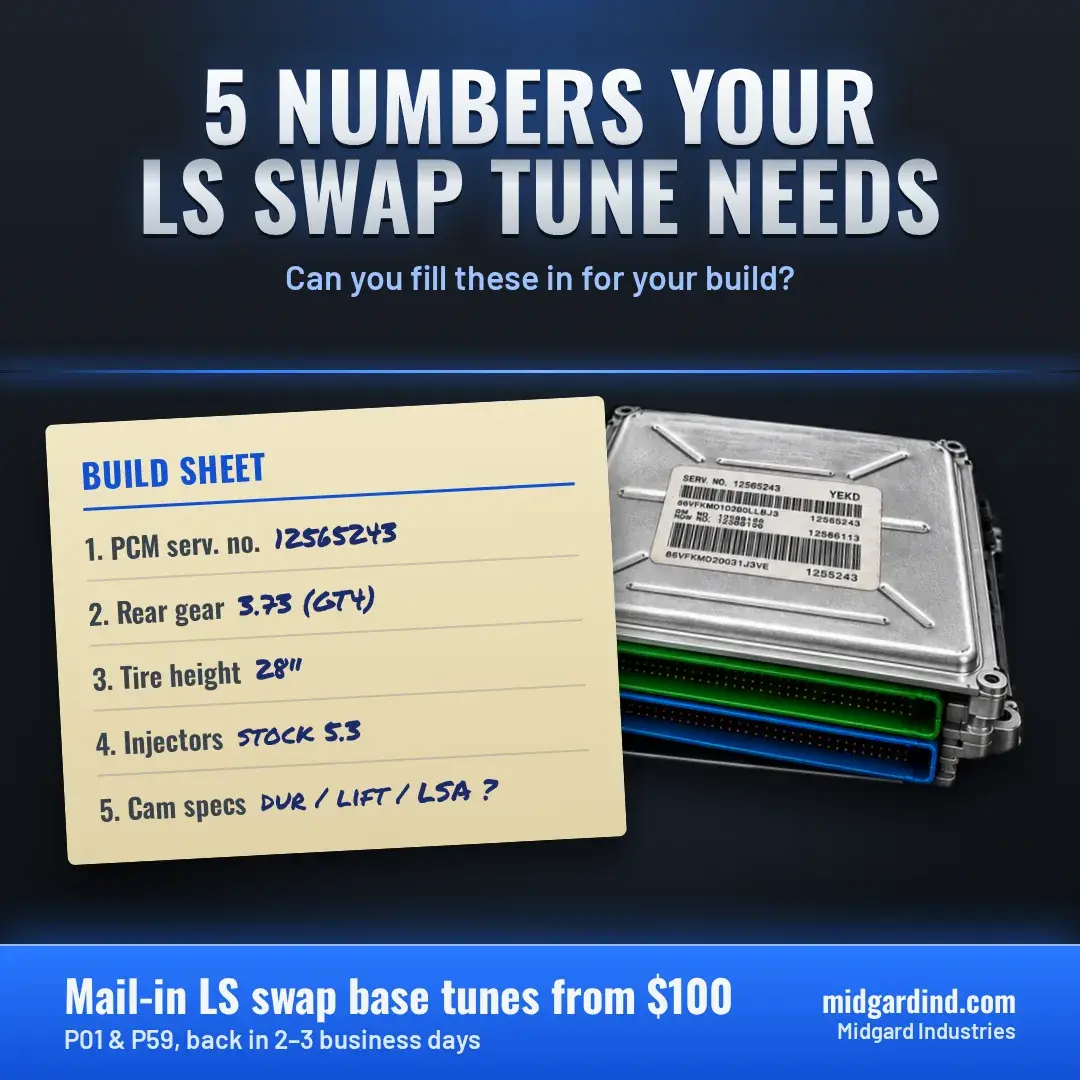
A base tune, sometimes called a startup tune, takes a PCM that was set up for the vehicle it came out of and sets it up for your swap. It's built from the info you give us about your engine, transmission, gears, tires, injectors, and cam.
A base tune covers:
- VATS removal, so the engine doesn't start and then die from the anti-theft system
- Engine and transmission setup, including displacement, 4L60E/4L80E or manual, and gear and tire size so your speedometer and shift points are right
- Fan and sensor setup for your electric fans and your MAF and MAP sensors
- Startup calibration, so the engine fires, idles, and drives
On cammed or modified engines, it also includes injector data, a cam-based starting VE table, and idle and spark adjustments made for a bigger cam.
The goal of a base tune is a swap that starts, idles, and drives safely, so you can finish the build and get it on the road.
Gen 3 and Gen 4: P01, P59, and E38
We now do base tunes for Gen 4 LS engines using the E38 ECU, in addition to Gen 3 P01 and P59 PCMs.
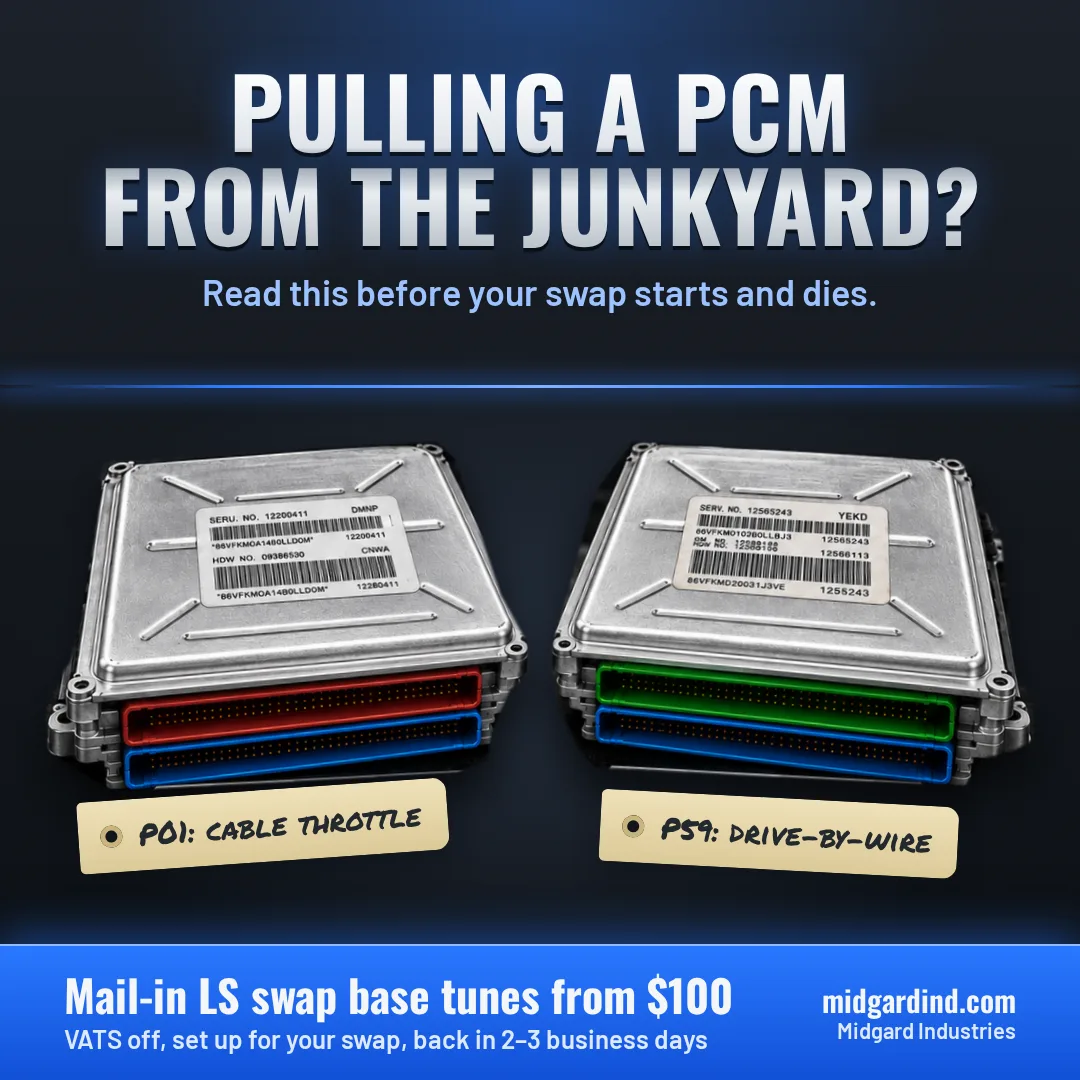
- P01 (Gen 3): Drive-by-cable, red and blue connectors
- P59 (Gen 3): Drive-by-wire, green and blue connectors
- E38 (Gen 4): Drive-by-wire, found on many 2007-and-up Gen 4 LS engines
In most cases, use the computer that matches your engine. Gen 3 engines use a 24-tooth crank reluctor, while Gen 4 engines use a 58-tooth reluctor, and the ECU has to match. Not sure which you have? Send us your engine info and we'll help you sort it out.
What a Base Tune Doesn't Do
A base tune is a solid starting point, but it's built from your specs, not from your engine running. It isn't verified with a wideband O2 sensor, datalogs, or a dyno. That means:
- Fueling is set up from your specs but isn't fine-tuned to how your engine actually runs.
- Spark timing is set on the safe side, not tuned for maximum power.
- Part-throttle drivability may need refinement, especially on bigger cams.
- Shift firmness and torque converter behavior are set up, not fine-tuned to how you drive.
For a lot of stock and mild swaps, that's all they'll ever need. For others, it's step one.
What a Custom Tune Adds
A custom tune starts with your engine actually running. We use datalogs and a wideband O2 sensor to see what the engine is doing, then adjust the tune to fit your exact combination. That includes:
- Fueling dialed in across idle, cruise, and wide-open throttle
- Spark timing optimized for power and safety
- A smoother idle and better part-throttle drivability on cammed engines
- Shift points and firmness adjusted to how you drive
Signs Your Swap Needs More Than a Base Tune
Your base tune may be all you need if your engine is stock or close to it and runs and drives well. Consider a custom tune if:
- You have a big cam, heads, an intake, or other major changes
- Your idle surges, hunts, or stalls after it's warmed up
- Your fuel trims stay off. If long-term fuel trims are consistently more than about ±10%, the fueling needs work
- You have a check engine light for running lean or rich
- It runs okay but feels flat, or you want to get all the power out of your build
The Best Path for Most Swaps
- Start with a mail-in base tune so the engine can be started, broken in, and driven.
- Drive it and see how it runs. Many stock and mild swaps stop here.
- If it needs more, move to a custom tune to dial it in. Your base tune gives us a clean starting point, so the custom tune goes faster.
Get Your Swap Started
If your engine is in and you need the computer set up, a base tune is where to start.
- Stock / Near-Stock Base Tune: $100
- Cammed / Modified Base Tune: $150
Plus $10 return shipping. Supports Gen 3 P01 and P59 PCMs and Gen 4 E38 ECUs, with a typical turnaround of 1–2 business days after we receive your ECU.
Order your mail-in LS swap base tune here →
Already running and need it dialed in? Contact us about custom tuning, or call (430) 215-4536.
Follow Midgard Industries
Don't want to tune it yourself?
Mail in your P01/P59 and get a VATS-deleted, swap-ready base tune for $100. Typical turnaround is 1-2 business days after the ECU is received.