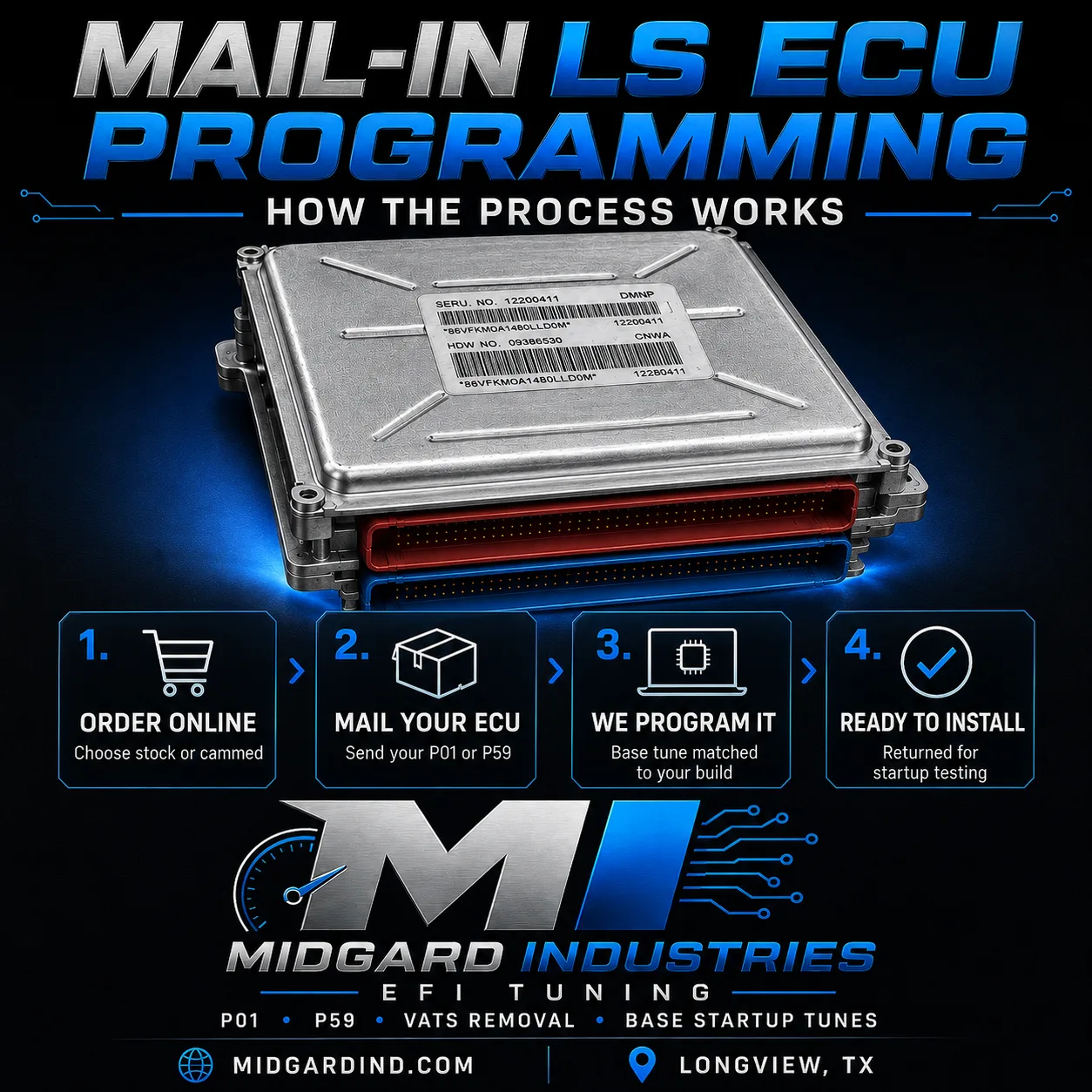
Mail-In LS ECU Programming: How the Process Works
Building an LS swap and need the factory ECU programmed before the engine is ready to start?
Midgard Industries offers mail-in Gen 3 LS ECU programming and base startup tunes for customers who already have their own P01 or P59 PCM.
Instead of trying to start the engine with an unknown stock calibration, you send us your ECU and complete build information. We configure the calibration around your engine, transmission, sensors, and modifications, then return the ECU ready to install and begin startup testing.
You can order a mail-in LS swap base tune here:
Order Your Mail-In LS Swap Base Tune
What Is a Mail-In LS ECU Base Tune?
A mail-in base tune is a starting calibration prepared for your specific LS swap before the vehicle is running.
It is designed to handle the major ECU configuration changes required when a Gen 3 LS engine is installed into another vehicle.
Depending on the combination, that can include:
- VATS/security removal
- Correct engine displacement
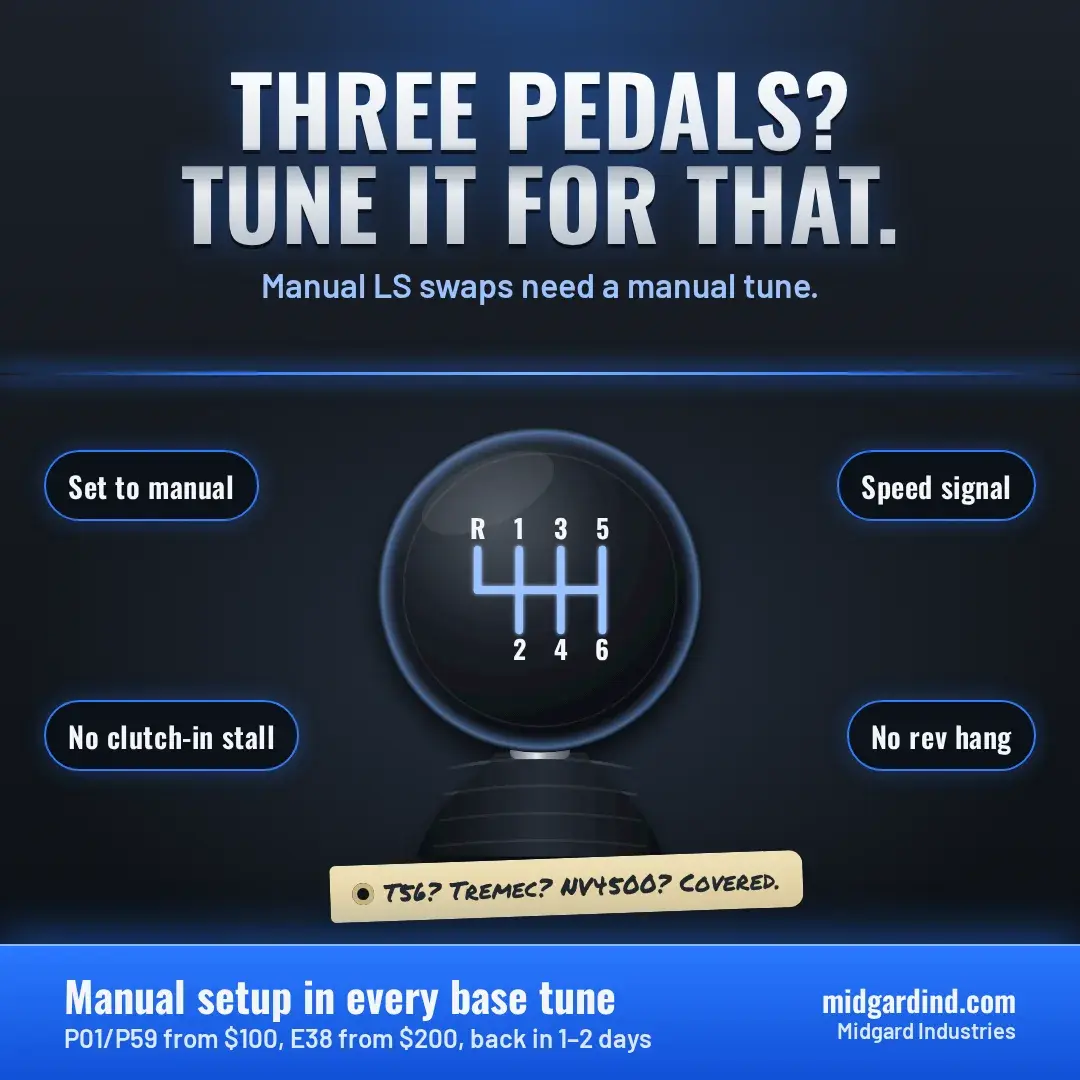
- Transmission configuration
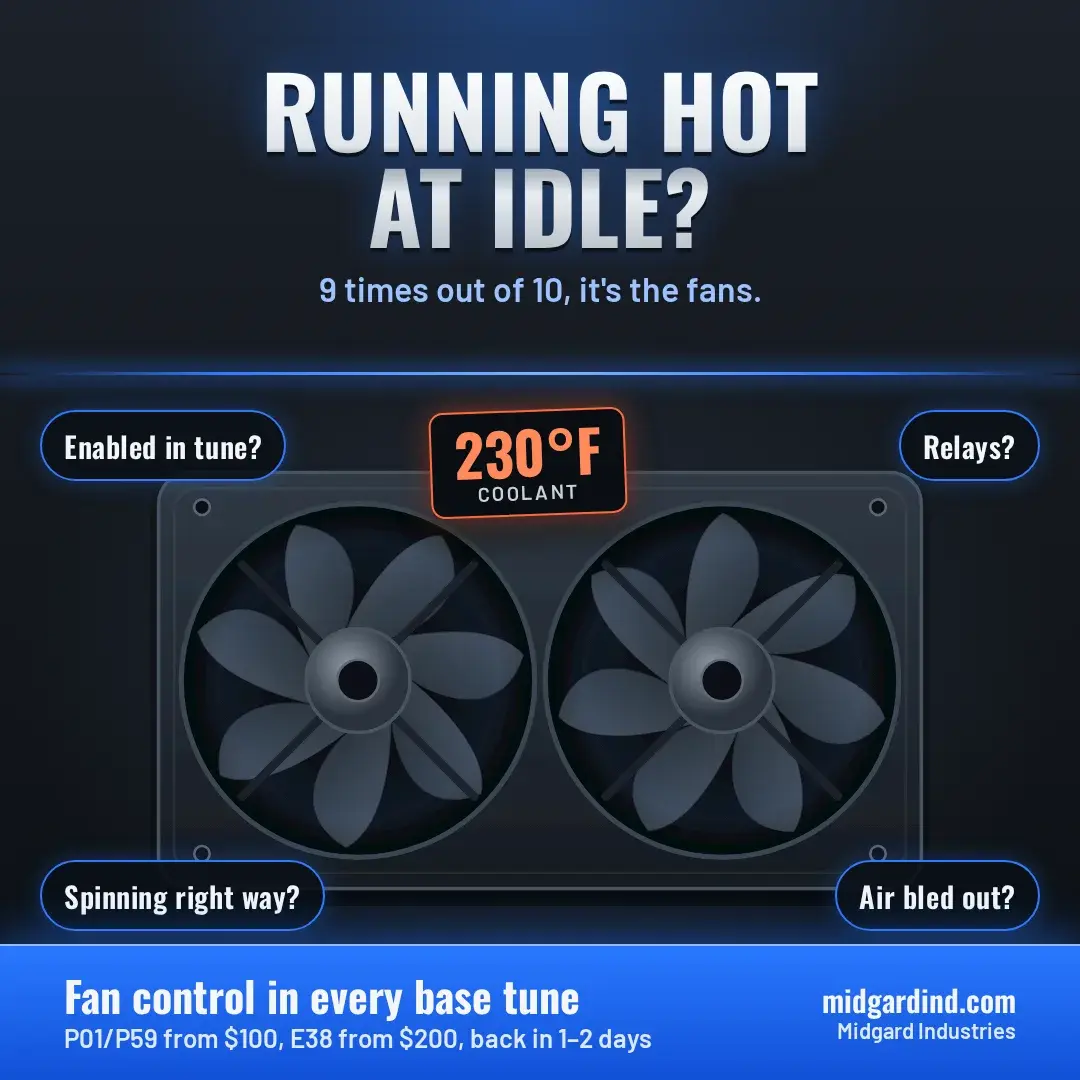
- Electric fan setup
- MAP and MAF sensor configuration
- Injector configuration when applicable
- Tire-size and gear-ratio correction
- Speedometer calibration
- Power-enrichment adjustments
- Torque-management adjustments
- Startup and idle-related calibration
- Applicable swap-related diagnostic settings
The goal is to provide a calibration that matches the major components in the vehicle instead of trying to run a modified combination on an unrelated factory tune.
Step 1: Choose the Correct Tune Package
Midgard Industries currently offers two mail-in LS swap base-tune packages.
Stock / Near-Stock Base Tune — $100
This package is intended for stock or mostly stock Gen 3 LS engines being installed into another vehicle.
Typical setup can include:
- VATS removal
- Engine displacement setup
- Automatic or manual transmission configuration
- 4L60E or 4L80E setup where supported
- Electric fan controls
- MAP and MAF sensor configuration
- Tire-size and rear-gear correction
- Speedometer setup
- Power-enrichment adjustments
- Torque-management adjustments
- Base startup calibration
- Applicable swap-related diagnostic configuration
This is a good choice for an engine that still uses factory-style injectors, camshaft, intake, and other major engine components.
Cammed / Modified Base Tune — $150
The cammed or modified package includes the basic swap configuration plus additional calibration for engines that no longer closely match the factory combination.
Depending on the build, this may include:
- Injector flow-rate setup
- Camshaft-based VE starting calibration
- Idle-airflow adjustments
- Desired idle-speed changes
- Camshaft-related idle calibration
- Startup fueling changes
- Additional startup and low-speed airflow adjustments
This package is intended for combinations with modifications such as:
- Aftermarket camshaft
- Larger injectors
- Intake changes
- Different MAP or MAF setup
- Other modifications that significantly affect airflow or fueling
Not sure which package your combination needs?
Send us your build information before ordering and we can help determine the appropriate starting point.
Step 2: Submit Your Build Information
One of the most important parts of a base tune is knowing exactly what is installed in the vehicle.
The more accurate the information, the better the starting calibration can match the combination.
Be prepared to provide information such as:
- Engine year
- Engine displacement
- ECU type
- ECU service number
- P01 or P59
- Drive-by-cable or drive-by-wire
- Transmission type
- Camshaft manufacturer and specifications
- Injector part number
- Injector flow rate
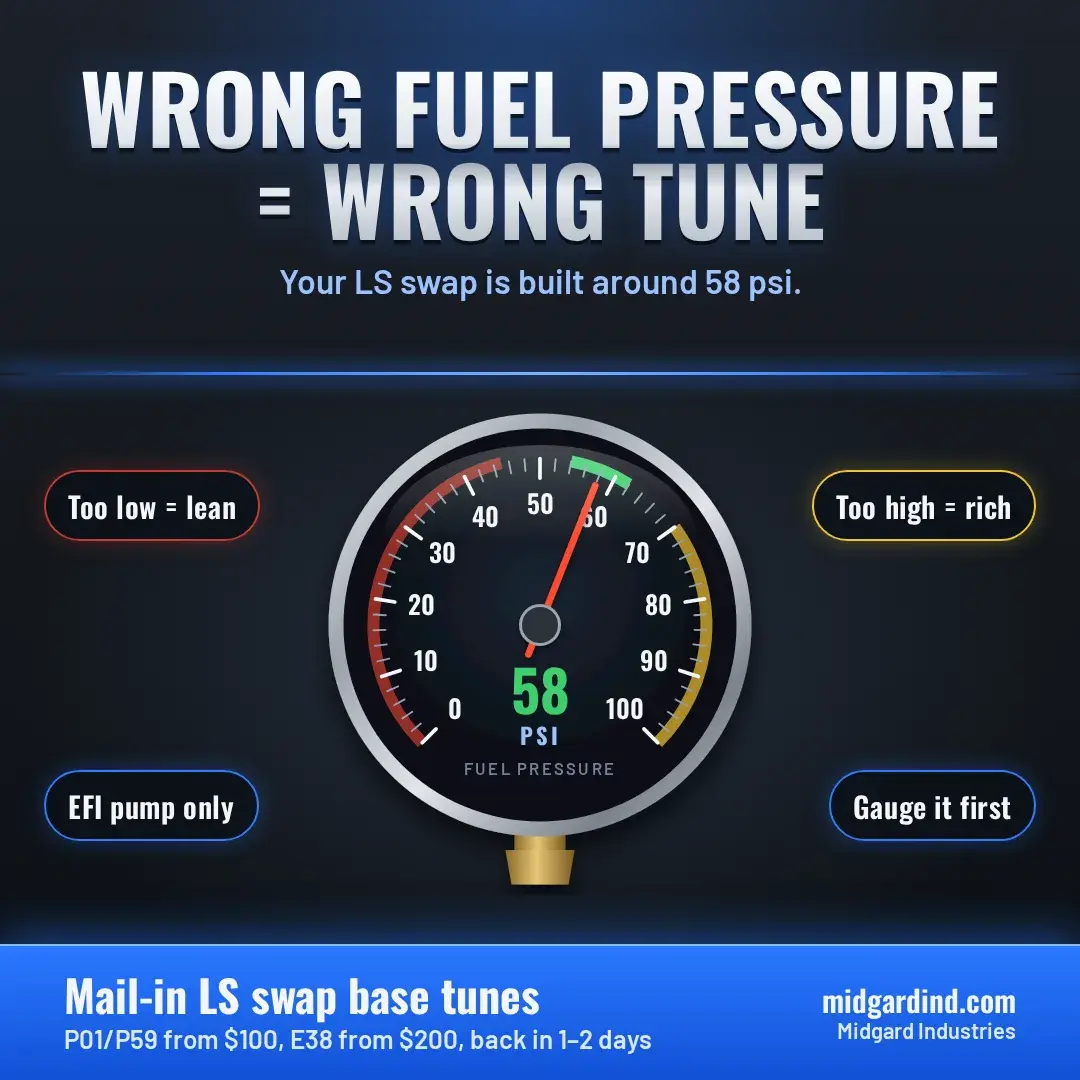
- Fuel pressure
- MAF sensor information
- MAP sensor information
- Fuel type
- Rear gear ratio
- Tire size
- Desired fan temperatures
- Complete modification list
For modified engines, actual part numbers are especially important.
For example, simply saying you have “50 lb injectors” does not provide enough information to correctly model the injector. Different injectors with the same advertised flow rate can require completely different calibration data.
The same applies to camshafts.
“Stage 2 cam” is not nearly as useful as the actual duration, lift, lobe separation angle, and part number.
Step 3: Mail Us Your ECU
After placing your order, securely package your ECU and ship it to Midgard Industries.
We recommend:
- Protecting the ECU connectors
- Using plenty of padding
- Using a sturdy shipping box
- Including your name and order number inside the package
- Using tracking
- Purchasing shipping insurance
Do not send unnecessary brackets, harnesses, or other components unless we have requested them.
Your order number makes it easier to match the ECU with the build information you submitted online.
Step 4: We Identify and Read the ECU
Once the ECU arrives, we verify the PCM and its existing calibration.
Depending on the ECU and application, we may check:
- ECU service number
- Hardware identification
- Operating system
- Existing calibration
- Transmission configuration
- Current engine configuration
- Existing modifications to the file
This step is important because two ECUs that look identical externally can contain different operating systems and calibrations.
The tune needs to be built from a compatible foundation.
Step 5: VATS Is Removed
One of the most common changes required for an LS swap is VATS removal.
VATS is GM's factory Vehicle Anti-Theft System.
In the original donor vehicle, the ECU receives authorization from the matching security system before allowing normal engine operation.
During an LS swap, those original security components are usually no longer present.
With VATS still active, the engine may:
- Crank but not start
- Start and immediately stall
- Have injector operation disabled
Removing VATS tells the ECU that it no longer needs the original factory security authorization.
However, VATS removal by itself is not the same as a complete LS swap base tune.
The ECU still needs to be configured for the actual engine and drivetrain.
Step 6: The ECU Is Configured for the Swap
Next, the calibration is adjusted for the information supplied with the order.
For a stock or near-stock swap, this might include correcting:
- Engine displacement
- Transmission type
- Fan controls
- MAF and MAP configuration
- Vehicle-speed information
- Tire size
- Gear ratio
- Power enrichment
- Torque management
- Applicable swap-related diagnostics
For a cammed or modified engine, additional work may be required.
Step 7: Cammed Engines Receive Additional Starting Calibration
A larger camshaft changes the way an LS engine breathes, especially at idle and low RPM.
It commonly changes:
- Idle vacuum
- Idle MAP
- Airflow requirements
- Startup behavior
- VE
- Spark requirements
- In-gear idle stability
That is why a cammed LS usually needs more than a VATS delete.
For a modified combination, the starting calibration may include changes to:
- Base running airflow
- Startup airflow
- Desired idle speed
- Idle-related spark settings
- VE starting values
- Startup fueling
- Injector configuration
These settings provide a better starting point for the actual engine combination.
Step 8: The ECU Is Programmed and Returned
Once the calibration is prepared, it is written to the ECU and the unit is prepared for return shipping.
Typical turnaround for supported mail-in ECU programming is generally 1–2 business days after the ECU and all required build information are received, although unusual ECUs or missing information can extend turnaround time.
Once returned, the ECU can be installed into the vehicle and startup testing can begin.
What Happens When You Get the ECU Back?
Install the ECU and verify the basics before attempting startup.
Make sure you have:
- Proper ECU power
- Proper grounds
- Correct fuel pressure
- Correct injector wiring
- Working crank and cam sensors
- Correct MAF/MAP wiring
- Proper throttle-body wiring
- Correct transmission wiring
- No major vacuum leaks
- Proper mechanical timing
A calibration cannot correct a wiring or mechanical problem.
If the engine does not behave correctly, gather information before making random tune changes.
Useful information includes:
- Diagnostic trouble codes
- Fuel pressure
- Idle MAP
- RPM
- Coolant temperature
- Spark timing
- Injector pulse width
- Fuel trims
- Wideband AFR
- Scanner data log
That information makes troubleshooting much faster.
Is a Base Startup Tune a Finished Tune?
No.
This is one of the most important things to understand.
A base startup tune is designed to get the combination running with a calibration reasonably matched to the supplied build information.
It is not automatically a completed street tune or dyno tune.
A final tune uses data from the actual running vehicle to refine areas such as:
- VE calibration
- MAF calibration
- Fuel trims
- Wideband AFR
- Spark timing
- Power enrichment
- Hot and cold starts
- Idle quality
- Deceleration
- Throttle response
- Transmission shifts
- TCC behavior
- Overall drivability
The easiest way to explain it is:
A base startup tune gets the combination running.
A final street or dyno tune gets the combination dialed in.
Why Not Just Use a Stock ECU File?
Sometimes a stock engine will start and run using a donor calibration with only minimal changes.
The problem is that many LS swaps are not actually stock donor combinations.
The vehicle may have:
- Different tire size
- Different rear gears
- Different transmission
- Electric fans
- Different fuel system
- Different injectors
- Larger camshaft
- Different intake
- Different MAF
- Different MAP sensor
- Different exhaust
Once those components change, the original calibration may no longer accurately represent the engine and vehicle.
A base tune gives you a better starting point.
P01 and P59 Mail-In ECU Programming
Our Gen 3 mail-in tuning service is intended for common GM LS PCMs including:
P01
Commonly identified by:
Red and blue connectors
Frequently used in earlier Gen 3 LS applications and drive-by-cable swaps.
P59
Commonly identified by:
Green and blue connectors
Common in later Gen 3 applications and frequently used with drive-by-wire systems.
Connector color is a useful first check, but the ECU service number and operating system should still be verified before programming.
What If You Are Not Sure What ECU You Have?
Send us:
- Clear picture of the ECU label
- Clear picture of the connectors
- Engine year and size
- Transmission
- Drive-by-cable or drive-by-wire information
We can help identify the ECU and determine whether it is appropriate for the combination.
Who Is This Service For?
Mail-in ECU programming works well for:
- Classic-car LS swaps
- C10 swaps
- S10 swaps
- Hot rods
- Muscle cars
- Older GM trucks
- Jeep LS conversions
- Custom builds
- Cammed Gen 3 LS engines
- 4L60E and 4L80E conversions
- Manual-transmission swaps
- Customers who do not have local tuning access
You do not have to live in East Texas to use the mail-in service.
Ready to Get Your LS Swap ECU Programmed?
If you already have a compatible P01 or P59 ECU, ordering is straightforward:
- Choose your tune package.
- Submit your complete build information.
- Mail your ECU to Midgard Industries.
- We prepare and program the calibration.
- Your ECU is returned ready for installation and startup testing.
Stock / Near-Stock Base Tune — $100
Cammed / Modified Base Tune — $150
Order Your Mail-In LS Swap Base Tune
Not sure which option you need? Send us your build information first and we can help determine the correct package.
Midgard Industries EFI Tuning
Longview, Texas
midgardind.com
Follow Midgard Industries
Don't want to tune it yourself?
Mail in your P01/P59 and get a VATS-deleted, swap-ready base tune for $100. Typical turnaround is 1-2 business days after the ECU is received.