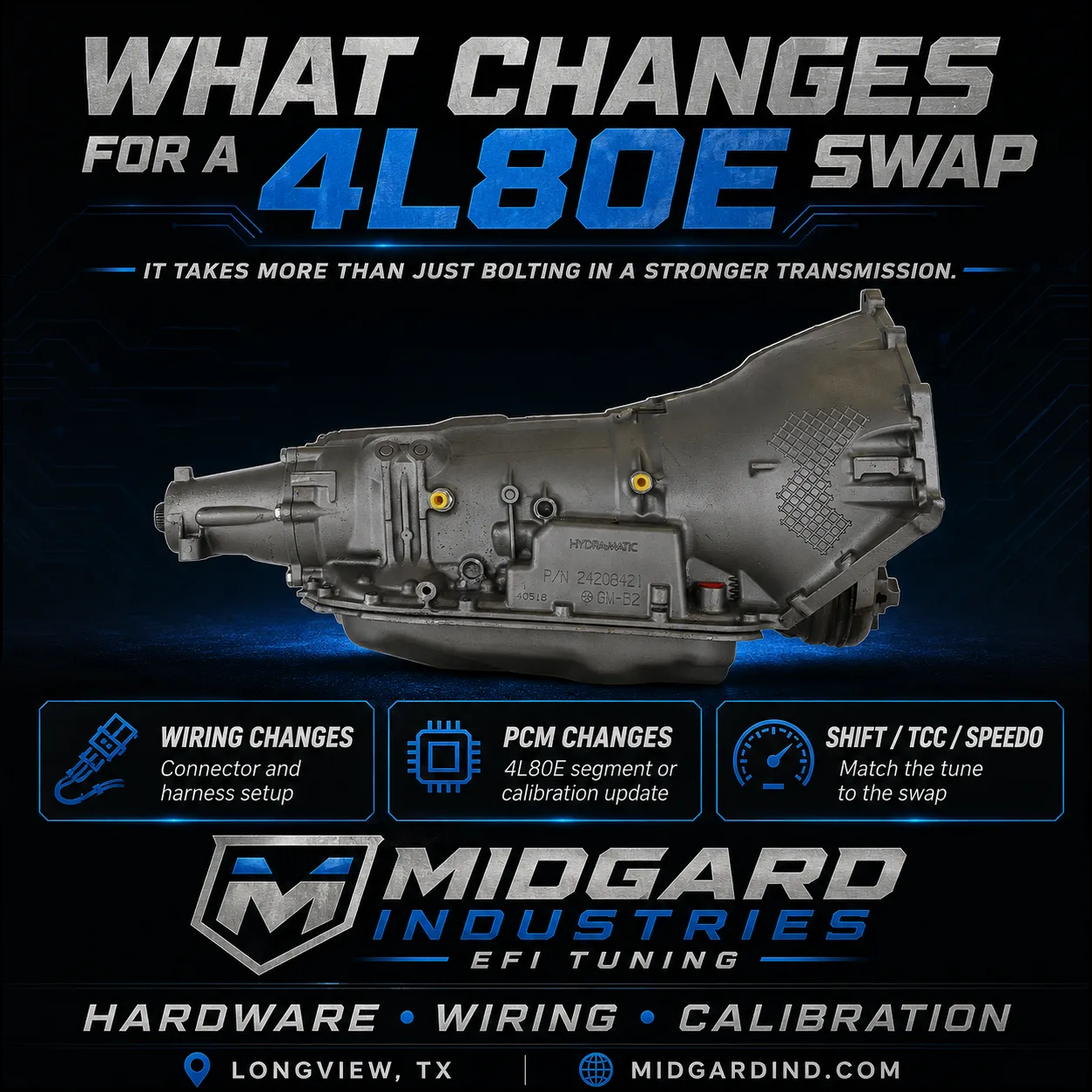
What Changes for a 4L80E Swap?

Swapping from a 4L60E to a 4L80E behind an LS is more than just bolting in a stronger transmission. The mechanical installation, wiring, and ECU calibration all need to match the 4L80E.

If any of those pieces are wrong, you can end up with no shifts, incorrect gear commands, wrong converter operation, transmission codes, or limp mode.

1. The transmission itself is physically different

A 4L80E is larger, heavier, and longer than a 4L60E.

Depending on the vehicle, the swap may require:

  • Different transmission crossmember location
  • Driveshaft modification
  • Different transmission mount
  • Different cooler-line routing
  • Different yoke or slip-yoke setup
  • Additional tunnel clearance
  • Transfer-case or adapter changes on 4WD applications

The 4L80E also uses different gear ratios, so the vehicle will feel different even when the rear axle ratio stays the same.

2. The wiring is different

The 4L60E and 4L80E do not use the exact same internal electrical arrangement.

A proper conversion may require:

  • Transmission connector repinning
  • Correct shift-solenoid wiring
  • Torque-converter-clutch wiring
  • Input and output speed-sensor connections
  • Correct pressure-control wiring
  • Proper ignition power and grounds

Using an adapter harness can simplify the swap, but you still need to make sure the harness matches the ECU, transmission year, and operating system.

3. The ECU needs to know it has a 4L80E

This is one of the most important parts of the swap.

If the ECU calibration is still configured for a 4L60E, simply plugging in a 4L80E does not make it operate correctly.

Depending on the ECU and operating system, the calibration may need:

  • A 4L80E transmission segment
  • Correct transmission type
  • Correct gear ratios
  • Correct shift-solenoid strategy
  • Proper TCC control
  • Correct speed-sensor configuration
  • Appropriate diagnostic settings
  • Updated shift schedules
  • Updated line-pressure tables

On many Gen 3 P01 and P59 applications, a proper 4L80E segment swap is the preferred approach rather than trying to manually change every transmission table.

4. Shift points need to be recalibrated

A 4L80E has different internal ratios than a 4L60E.

That means the tune should be reviewed for:

  • Part-throttle shift speeds
  • Wide-open-throttle shift speeds
  • Desired shift RPM
  • Downshift points
  • Manual-mode behavior
  • Tow or performance requirements

Tire size and rear axle ratio also need to be correct because they affect vehicle-speed calculations and shift scheduling.

5. Converter lockup needs attention

The torque-converter-clutch strategy should be matched to the new transmission and converter.

Things that may need adjustment include:

  • TCC apply speed
  • TCC release speed
  • Throttle position for lockup
  • Gear in which lockup is allowed
  • Apply and release behavior
  • Converter slip targets

A performance converter may need different settings than a stock 4L80E converter.

6. Line pressure and torque management matter

The 4L80E is strong, but that does not mean every pressure table should simply be maxed out.

Proper calibration should balance:

  • Shift firmness
  • Line pressure
  • Torque reduction during shifts
  • Clutch durability
  • Converter behavior
  • Street drivability

Removing all torque management or commanding excessive pressure can make shifts unnecessarily harsh and may not improve reliability.

7. Speedometer and VSS setup may need correction

The ECU uses vehicle-speed information for much more than the speedometer.

Vehicle speed can affect:

  • Shift scheduling
  • TCC operation
  • Idle control
  • Deceleration airflow
  • Throttle follower/cracker behavior
  • Cruise control
  • Some diagnostic functions

If tire size, rear gear ratio, transfer case, or VSS configuration changes during the swap, those settings need to be corrected.

8. 4WD swaps need extra attention

For 4WD applications, make sure the transfer case is compatible with the 4L80E output shaft and adapter.

You may also need to account for:

  • Transfer-case input spline count
  • Adapter length
  • Driveshaft lengths
  • VSS location
  • Low-range behavior
  • Transfer-case type

A transmission that bolts to the engine does not automatically mean the rest of the drivetrain will bolt together.

The bottom line

A successful 4L80E swap requires three things to agree:

The hardware
The wiring
The calibration

The simplest way to put it is:

A 4L80E swap is not complete until the ECU is configured for the transmission that is actually installed.

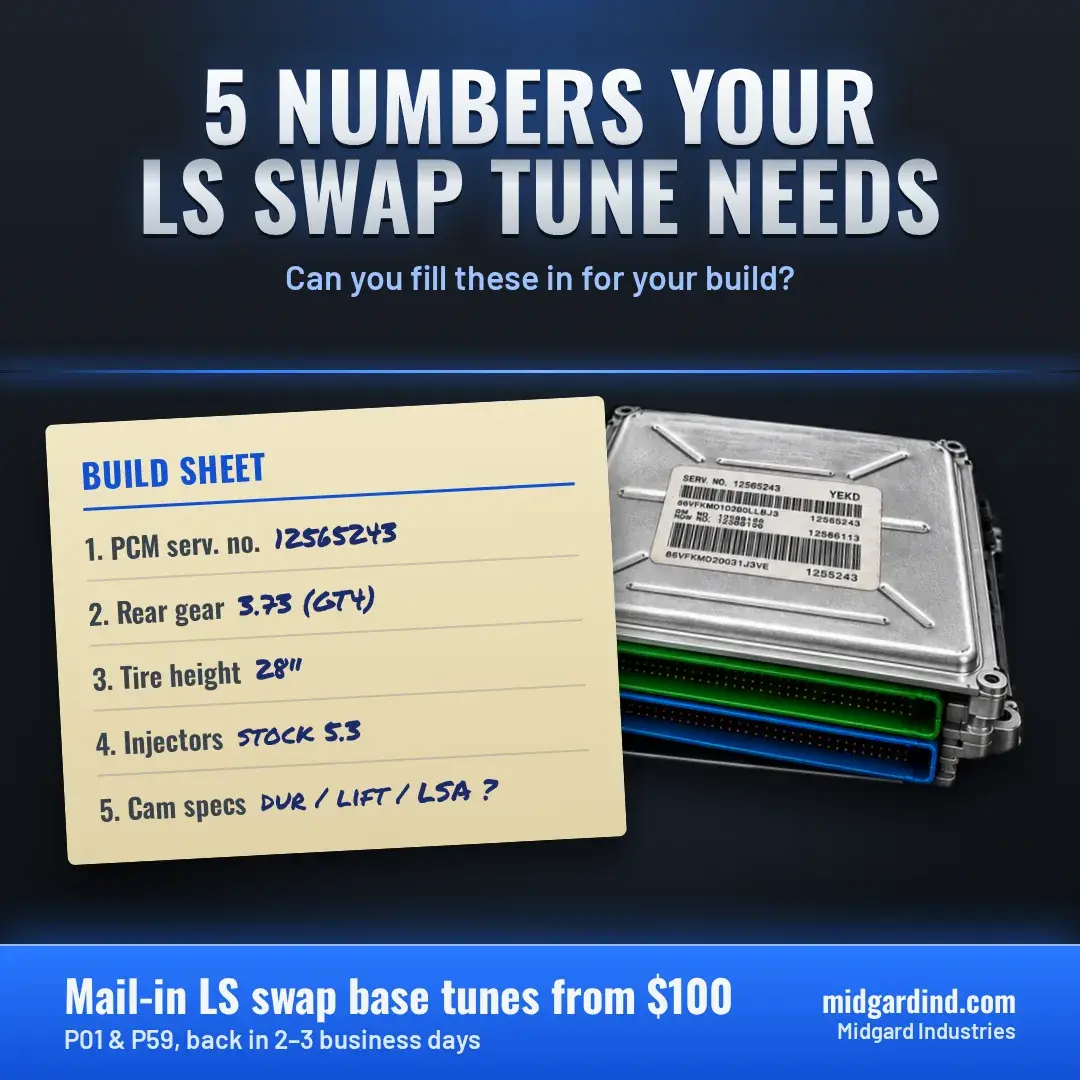
If you're swapping a 4L80E behind a Gen 3 LS, send me your ECU type, operating system, engine, transmission year, tire size, rear gear ratio, converter information, and whether the vehicle is 2WD or 4WD.

Midgard Industries EFI Tuning
Longview, Texas
midgardind.com

#LSSwap #4L80E #4L80ESwap #HPTuners #P01 #P59 #LSTuning #TransmissionTuning #EFITuning