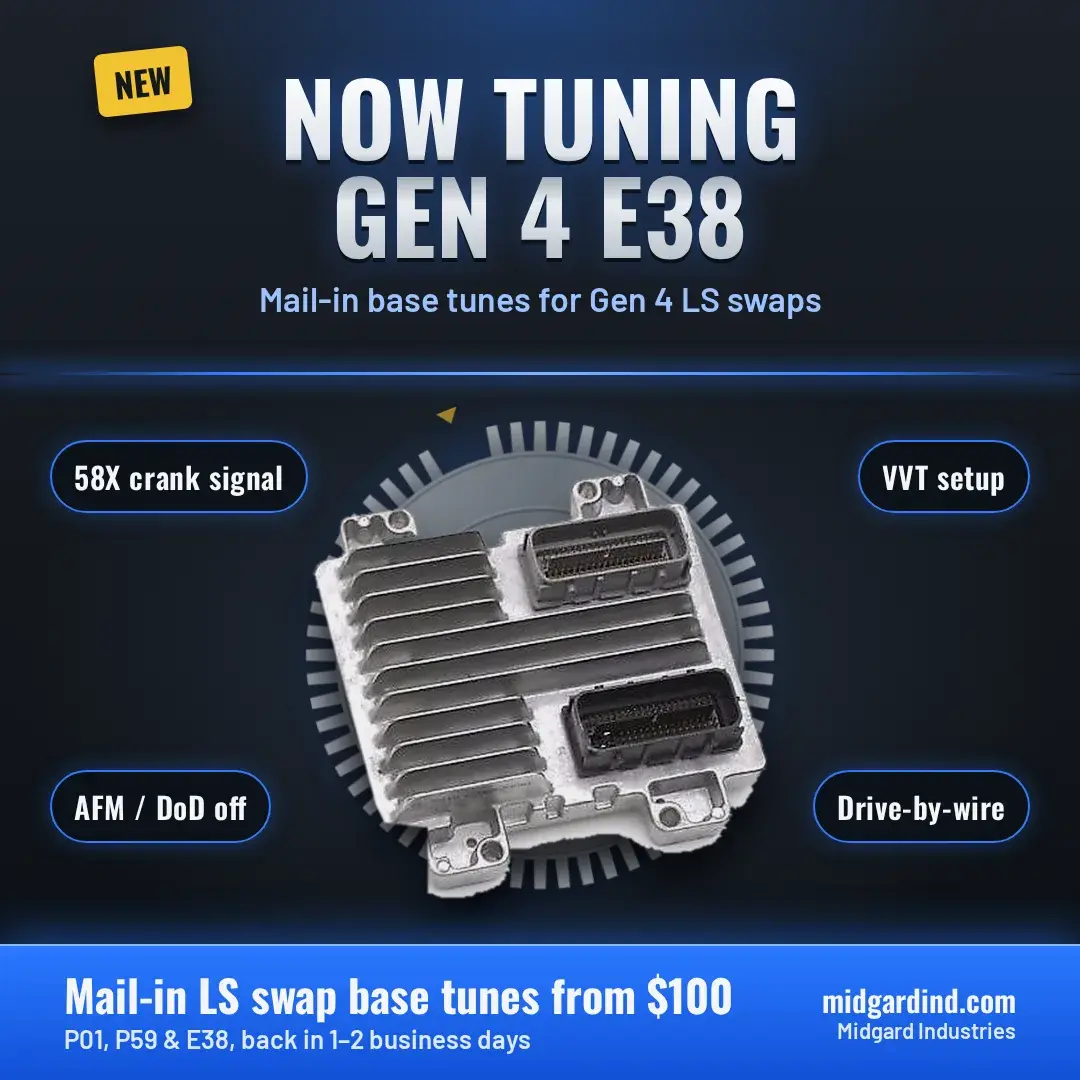
What Needs to Be Changed in an LS Swap PCM?
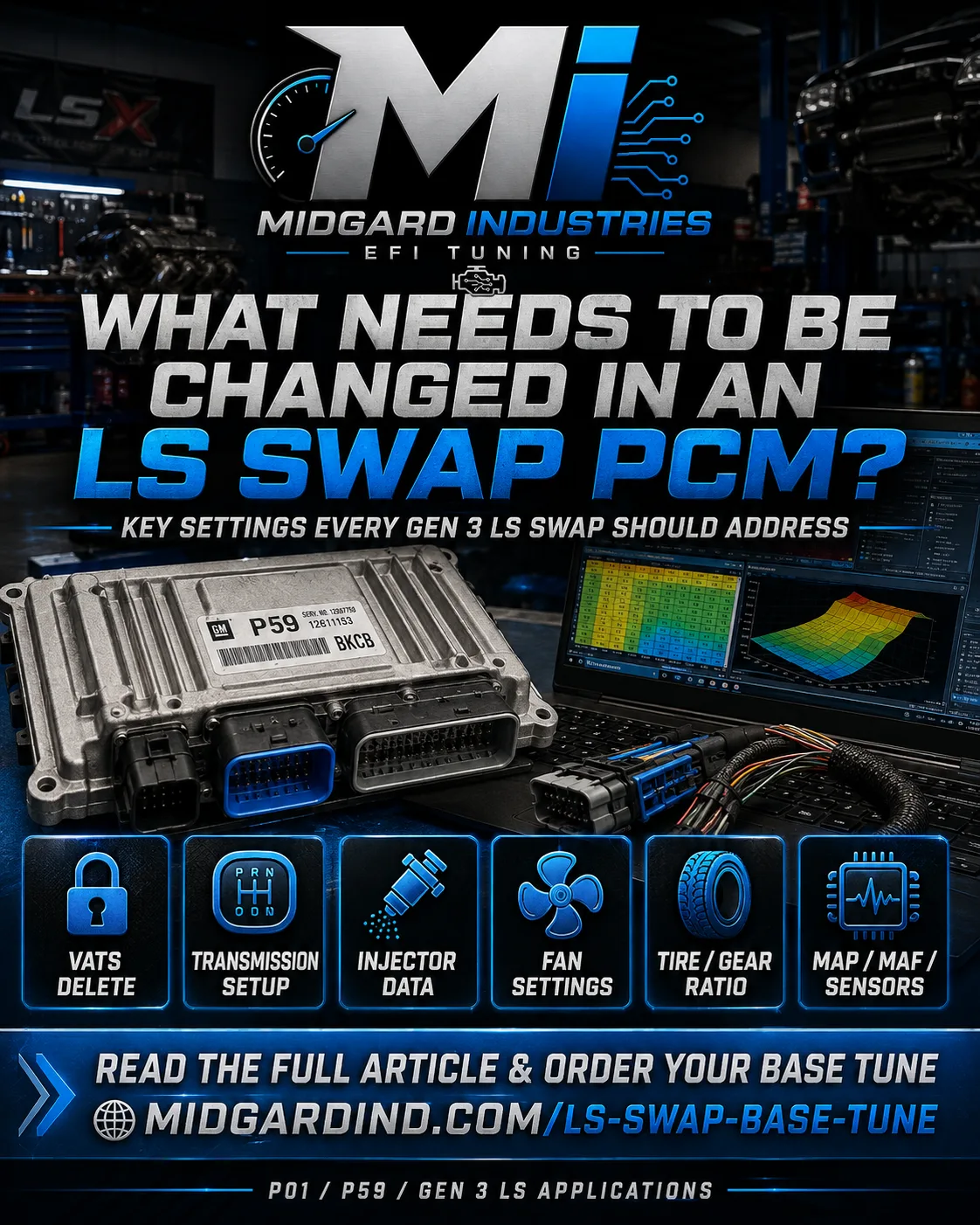
When installing an LS engine into an older vehicle, the factory PCM usually cannot simply be plugged in and expected to work correctly.
The original calibration was designed around the donor vehicle, including its security system, transmission, cooling fans, emissions equipment, tire size, gearing, injectors, engine displacement, and other vehicle-specific hardware.
A proper LS swap PCM programming setup changes the calibration so the PCM better matches the vehicle and engine combination it is being installed into.
For a common Gen 3 LS swap using a P01 or P59 PCM, there are several areas that should be reviewed before the first startup.
Why Does an LS Swap PCM Need to Be Reprogrammed?
The PCM from a Silverado, Tahoe, Express Van, Suburban, or other donor vehicle still expects to see many of the components that were installed in the original vehicle.
When that PCM is moved into a C10, S10, G-body, muscle car, street rod, or other swap vehicle, some of those systems may no longer exist.
The engine itself may also be different from the donor combination.
For example, you could be using a 2002 Silverado PCM with a 6.0L engine, larger injectors, electric fans, a 4L80E transmission, headers, and a performance camshaft.
The PCM needs to be configured around the new combination rather than left as though it were still controlling the original truck.
VATS Must Usually Be Addressed
One of the first things that commonly needs attention is Vehicle Anti-Theft System, or VATS.
In the donor vehicle, the PCM communicates with the factory security system. During a standalone LS swap, those original security components are often no longer present.
If VATS remains active, one of the most common symptoms is:
The engine starts, runs for a second or two, and then shuts off.
For many standalone swaps, VATS needs to be properly configured so the PCM no longer expects authorization from the original vehicle's security system.
VATS removal, however, is only one part of LS swap programming.
A PCM with VATS disabled can still have incorrect injector data, wrong transmission settings, improper fan controls, incorrect displacement, and many other calibration problems.
The Transmission Type Needs to Match the Swap
The PCM needs to know what transmission it is controlling—or whether it is controlling one at all.
A donor calibration designed for a 4L60E should not simply be left unchanged if the swap uses a 4L80E.
Likewise, a vehicle using a TH350, TH400, Powerglide, manual transmission, or another non-electronic transmission may require the automatic transmission-related configuration to be changed.
For a 4L60E-to-4L80E swap, programming can involve more than changing a transmission name. Depending on the PCM and operating system, the proper transmission calibration or segment configuration may be needed so shift control, pressure control, torque-converter lockup, and transmission diagnostics work correctly.
The transmission choice should always be provided when ordering a base tune.
Engine Displacement Should Be Correct
The PCM calibration should match the actual engine displacement.
A calibration originally designed for a 4.8L or 5.3L engine should be reviewed if it is being used on a 6.0L, 6.2L, or another displacement.
Cylinder volume is used by the PCM in calculations related to engine airflow and load.
Using the wrong displacement can affect calculations throughout the calibration.
This is especially important when building a PCM from a donor that does not match the engine being installed.
Injector Data Must Match the Injectors
Injector setup is one of the most important parts of a modified LS calibration.
If the swap uses the original injectors from the calibration, the factory injector information may already be correct.
But if different injectors are installed, the PCM needs accurate injector data.
Depending on the operating system, this can include injector flow rate, voltage offset, short-pulse behavior, minimum pulsewidth, and other injector characterization information.
Simply telling the PCM that a 50 lb/hr injector is installed is not always enough.
Two injectors rated at the same flow rate can have very different electrical and short-pulse characteristics.
Whenever possible, provide the actual injector part number rather than just saying “42 lb injectors” or “50 lb injectors.”
Fuel Pressure Matters Too
Injector flow rate depends on fuel pressure.
An injector rated at one pressure will flow differently when operated at another.
For example, an injector rated at approximately 43.5 psi will flow more fuel when operated at 58 psi.
That means the tuner needs to know both the injector information and the actual fuel pressure used in the swap.
Incorrect fuel pressure information can cause the entire fueling calibration to start from the wrong point.
Electric Fan Settings Need to Be Configured
Many LS swaps use aftermarket electric fans instead of the cooling fan arrangement used by the donor vehicle.
The PCM can often control those fans using its factory fan outputs.
The calibration needs to specify when the fans are commanded on and off.
Fan temperatures should be selected based on the thermostat, radiator, vehicle use, and cooling system.
For example, there is no advantage to installing a 180°F thermostat while leaving fan settings at temperatures intended for a much hotter factory thermostat.
The PCM also needs to be configured correctly for the wiring strategy used to trigger the relays.
Tire Size and Gear Ratio Can Affect the Calibration
If the PCM receives vehicle-speed information and the transmission or speedometer functions depend on it, tire diameter and rear axle ratio should be correct.
Changing from the donor vehicle's tire and gearing combination can cause the calculated vehicle speed to be incorrect.
That can affect more than just the speedometer.
Depending on the application, vehicle speed may influence transmission shifts, torque-converter lockup, idle control, throttle cracker behavior, deceleration airflow, and other functions.
Providing the actual rear gear ratio and tire diameter gives the calibration a better starting point.
The MAF and MAP Sensors Need to Match the Hardware
The PCM needs the correct calibration for the sensors installed on the engine.
This is particularly important if the swap uses a MAP sensor that is different from the original donor calibration.
A stock 1-bar MAP sensor, 2-bar sensor, 3-bar sensor, and other aftermarket sensors all have different scaling.
Incorrect MAP sensor calibration can make the PCM calculate engine load incorrectly.
The same concept applies to the MAF.
If the factory MAF and original housing are retained, its calibration should generally start from the correct factory curve. If the MAF housing or sensor is changed, the airflow calibration may need to be addressed during final tuning.
What Changes If the LS Has a Camshaft?
A cammed engine normally needs additional changes beyond a basic stock LS swap calibration.
A performance camshaft can significantly change idle vacuum, airflow requirements, cylinder filling, and low-RPM behavior.
A cammed LS base tune may require changes to idle speed, base running airflow, startup airflow, idle spark, VE areas, throttle follower, throttle cracker, and other idle-related parameters.
The larger the camshaft, the more important these changes become.
A mild truck cam may need relatively small adjustments, while a large-duration cam may require considerably more work just to produce a stable startup and idle.
That is why a cammed LS should not be treated as though it only needs VATS turned off.
What About Headers, Exhaust and Cold-Air Intakes?
Headers and intake changes normally do not require the same type of hardware configuration changes as injectors or MAP sensors, but they can alter how the engine actually breathes.
That becomes important during final fueling calibration.
A base tune can provide a safe starting point, but VE and MAF calibration should ultimately be verified from actual data.
A wideband oxygen sensor is strongly recommended when performing final fueling adjustments.
Idle Settings May Need to Be Changed
Even a stock engine may need small idle-related changes depending on how the swap is configured.
A cammed engine may need substantially more.
Idle parameters can include commanded RPM, base airflow, startup airflow, idle spark control, throttle follower, throttle cracker, decay rates, and other tables.
Automatic and manual-transmission vehicles may also need different idle behavior.
For example, a manual-transmission swap can experience a rapid RPM drop when the clutch is pushed in. An automatic vehicle may instead need enough airflow to prevent RPM from dropping excessively when placed in gear.
Diagnostic Settings Should Match the Actual Configuration
The donor PCM may contain diagnostics for equipment that is not part of the new vehicle configuration.
The calibration should be reviewed so the PCM is not constantly reacting to equipment that legitimately differs from the donor application.
At the same time, useful diagnostics should not simply be turned off indiscriminately.
A good swap calibration keeps the PCM's ability to identify real engine problems wherever possible.
Any changes involving emissions-controlled equipment also need to comply with the laws that apply to the vehicle and where it is operated.
What Information Should You Give Your Tuner?
The quality of a base calibration depends heavily on the information supplied.
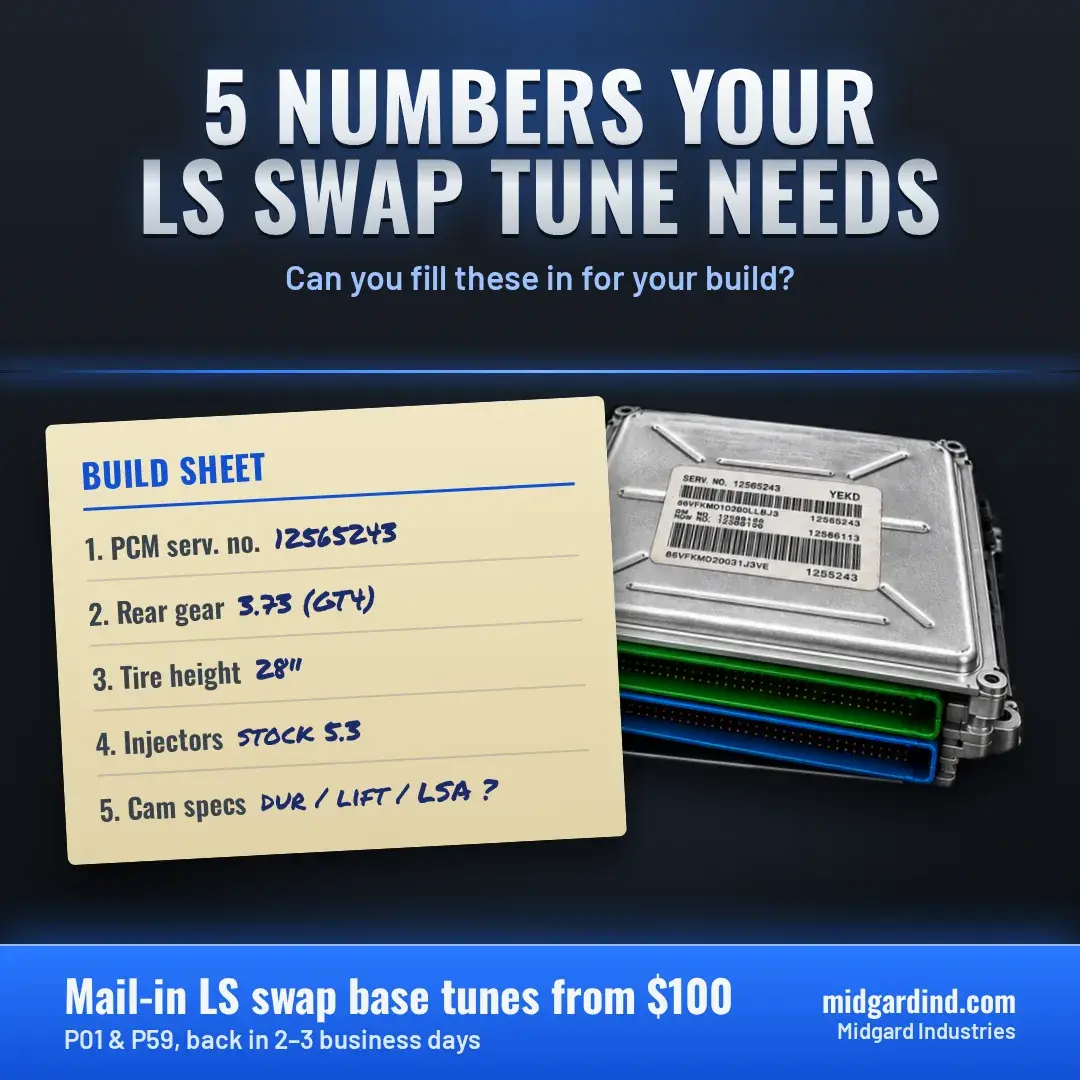
For best results, provide as much accurate information as possible, including:
- Engine year and displacement
- PCM type, such as P01 or P59
- PCM service number if available
- Camshaft manufacturer, part number, and specifications
- Injector part number
- Fuel pressure
- Intake manifold and throttle body
- MAF sensor and housing
- MAP sensor
- Transmission type
- Converter stall speed
- Rear gear ratio
- Tire diameter
- Thermostat temperature
- Electric fan configuration
- Desired idle RPM
- Major engine modifications such as heads, headers, or forced induction
Actual part numbers are particularly helpful.
“50 lb injectors” does not provide nearly as much useful information as the actual injector part number and fuel pressure.
Is an LS Swap Base Tune a Final Tune?
No.
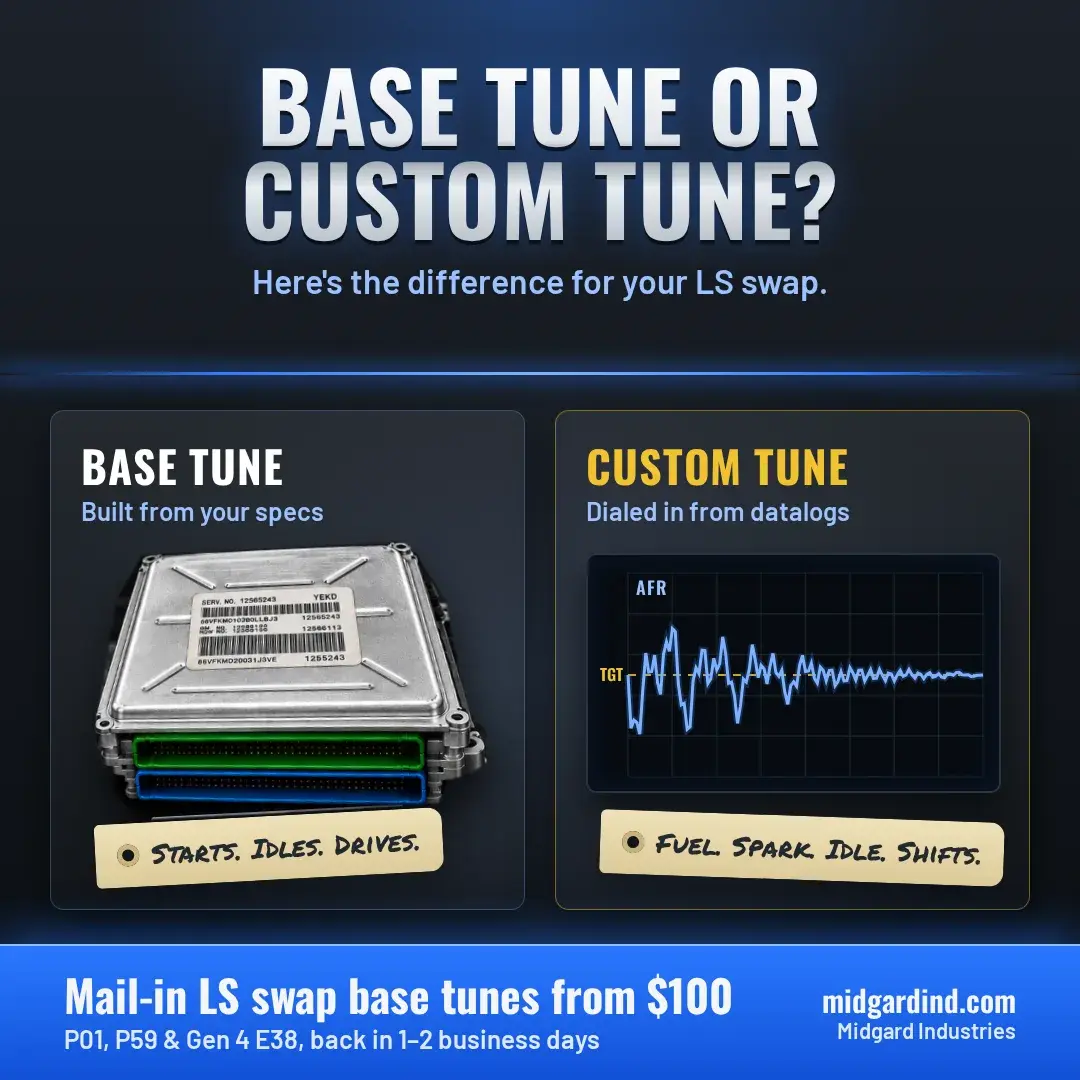
A base tune and a final tune serve different purposes.
A properly built LS swap base calibration is intended to configure the PCM for the new combination and provide a reasonable starting point for startup, idle, and initial operation.
A final calibration should be based on data collected from the actual vehicle.
That may include wideband lambda or AFR, fuel trims, MAP, MAF airflow, cylinder airmass, spark advance, knock retard, idle airflow, coolant temperature, and other parameters.
Two otherwise similar LS swaps can require different final calibration because of differences in exhaust systems, air intakes, injectors, fuel pressure, camshaft installation, engine condition, and vehicle setup.
Can You Program a Junkyard LS PCM for a Swap?
In many cases, yes.
P01 and P59 PCMs are popular for Gen 3 LS swaps because they were used in a wide range of GM vehicles and can be configured for many swap combinations.
The important part is making sure the PCM and operating system are appropriate for the engine, throttle type, transmission, and other hardware being used.
Buying a random PCM and simply disabling VATS is not always the best approach.
Starting with the right PCM and calibration can eliminate a lot of unnecessary problems later.
Mail-In LS Swap PCM Programming
Midgard Industries offers mail-in LS swap base programming for common Gen 3 P01 and P59 applications.
Mail in your existing ECU: Stock LS swap base tune — $100. Modified or cammed LS swap base tune — $150.
If you need an ECU supplied, stock tune + ECU is $150, and modified/cammed tune + ECU is $200.
Base programming can be configured around the information you provide for your engine, injectors, transmission, cooling fans, displacement, camshaft, sensors, and other common swap requirements.
👉 Order your LS swap base tune:
https://midgardind.com/ls-swap-base-tune
Frequently Asked Questions
Do I have to disable VATS for an LS swap?
For many standalone Gen 3 LS swaps, the original vehicle security system is no longer present, so the PCM's VATS configuration normally needs to be addressed. Otherwise the engine may start and immediately shut off.
Can I use a 5.3 PCM on a 6.0 LS swap?
Often, yes, if the PCM and operating system are compatible with the hardware. The calibration should be changed to correctly represent the 6.0L engine and the rest of the combination.
Does a 4L80E swap require PCM programming?
If the PCM is controlling the transmission, yes. A calibration originally configured for another transmission should be set up properly for the 4L80E.
Do larger injectors require tuning?
Yes. The PCM needs accurate injector characterization for the injectors and operating fuel pressure.
Will an LS swap run with only VATS removed?
It may, particularly with an otherwise stock combination, but VATS removal alone does not configure the PCM for different injectors, transmission, fans, gearing, displacement, camshaft, or sensors.
Does a cammed LS need a different tune?
Usually. A performance camshaft changes idle airflow, vacuum, cylinder filling, and startup behavior. Cammed combinations commonly require additional idle, airflow, fueling, and spark changes.
Final Thoughts
Proper LS swap PCM programming involves much more than turning off VATS.
The PCM should be configured around the engine that is actually installed in the vehicle.
That means reviewing the engine displacement, transmission, injectors, fuel pressure, cooling fans, speed calibration, sensors, idle configuration, camshaft, and other important parts of the combination.
Getting those basics correct before the first startup gives you a much better foundation for final tuning.
Need your Gen 3 LS swap PCM programmed?
👉 https://midgardind.com/ls-swap-base-tune
Midgard Industries EFI Tuning
P01 • P59 • Gen 3 LS Swap Programming
#LSSwapPCMProgramming #LSSwapECUProgramming #P01Programming #P59Programming #LSSwapBaseTune #VATSDelete #4L80ESwapProgramming #Gen3LSTuning #MailInLSTune #LSSwapPCMTune
Follow Midgard Industries
Don't want to tune it yourself?
Mail in your P01/P59 and get a VATS-deleted, swap-ready base tune for $100. Typical turnaround is 1-2 business days after the ECU is received.