Why Injector Part Numbers Matter
When someone says they have “50-pound injectors,” that sounds like enough information to build a tune.
Usually, it is not.
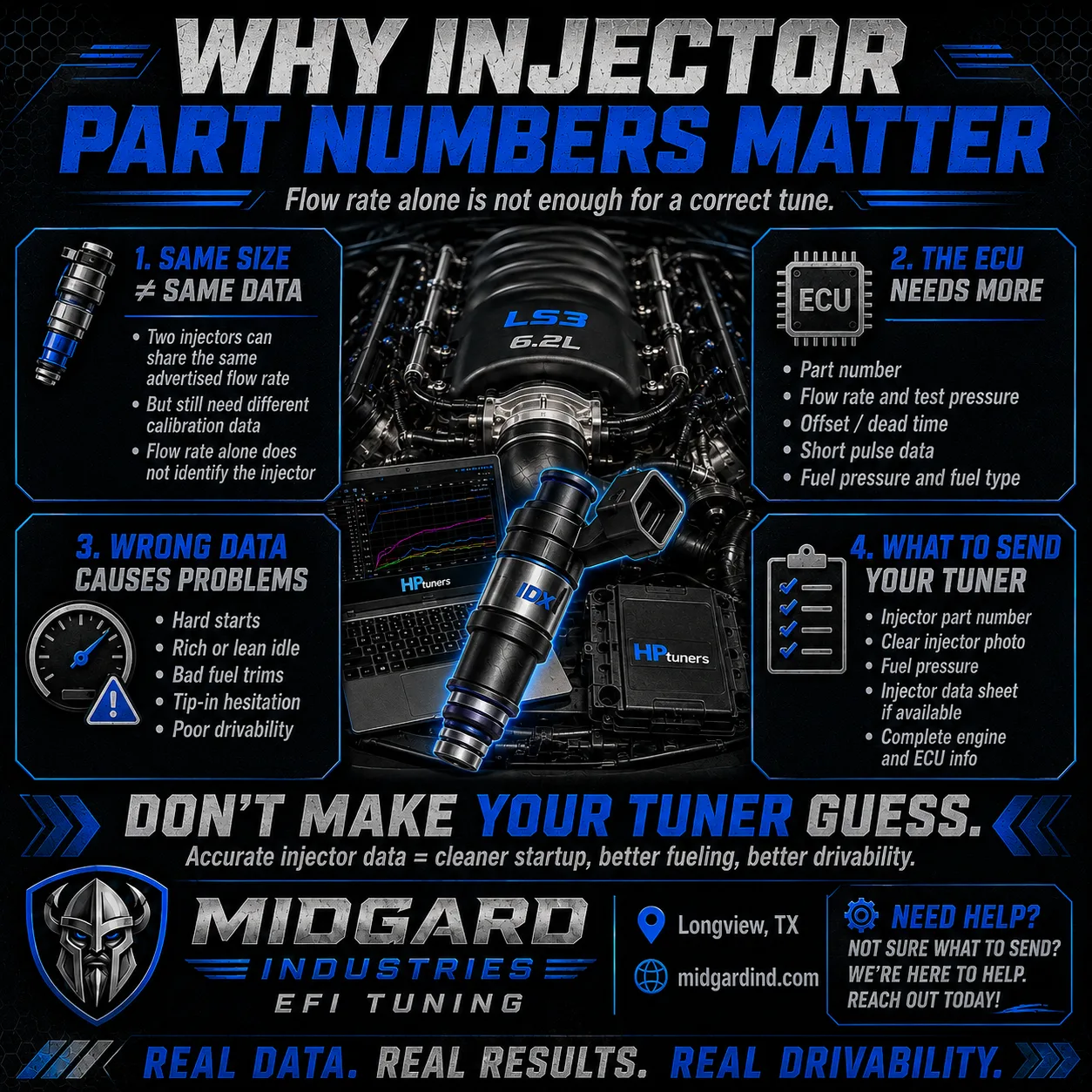
The advertised flow rate is only one part of the injector data the ECU needs. Two injectors can be sold with the same flow rating and still require very different calibration values. That is why your tuner needs the actual injector part number whenever possible.
Flow rate alone does not identify the injector
Injector flow is normally rated at a specific fuel pressure. If the vehicle operates at a different pressure, the injector’s effective flow changes.
For example, an injector rated at one pressure will flow more when used at a higher pressure and less when used at a lower pressure. Without knowing the original rating pressure and the vehicle’s actual fuel pressure, the advertised flow number can be misleading.
Your tuner needs to know:
- Injector part number
- Advertised flow rate
- Pressure used for that rating
- Actual fuel pressure in the vehicle
- Whether the regulator is fixed or vacuum-referenced
- Fuel type
Simply entering “50 lb/hr” into the tune may not accurately represent what the injectors are doing.
The ECU needs more than maximum flow
An injector does not behave the same way at every pulse width, voltage, and fuel-pressure condition.
A complete injector calibration may include:
- Injector flow rate
- Voltage offset or dead time
- Short-pulse adder
- Minimum pulse width
- Small-pulse behavior
- Pressure-reference information
- Break-point or linearity data
These values help the ECU calculate how long to open the injector under different conditions.
At wide-open throttle, a small error may be less obvious because the injectors are open for a longer period. At idle and low load, those same errors can become much more noticeable because injector pulse widths are very short.
That is why incorrect injector data often causes the biggest problems during startup, idle, cruising, and low-speed driving.
What happens when the wrong injector data is used?
Incorrect injector information can contribute to:
- Hard cold starts
- Hard hot starts
- Rich or lean idle
- Fuel trims that are far from normal
- Idle surge
- Stalling when placed in gear
- Poor throttle response
- Tip-in hesitation
- Fuel smell
- Spark-plug fouling
- Inconsistent air-fuel ratio
- Poor fuel economy
- Difficulty tuning the VE or MAF tables
A tuner may try to correct these problems by changing the VE or MAF calibration, but if the injector data is wrong, those airflow tables may end up compensating for an injector-modeling error.
The engine may appear to run better in one area while becoming worse somewhere else.
Matching the flow rate is not enough
Two injectors with the same advertised flow rate may have different:
- Electrical characteristics
- Opening time
- Closing behavior
- Short-pulse response
- Spray pattern
- Fuel-pressure rating
- Physical height
- Connector style
- Intended application
That means data from one injector should not automatically be copied to another just because both are advertised as the same size.
A factory GM injector, an aftermarket injector, and a rebranded injector may all be listed at a similar flow rate but require different calibration information.
Why the part number is so important
The part number gives your tuner a way to identify the exact injector and search for the correct data.
With a valid part number, the tuner may be able to confirm:
- Manufacturer
- Original application
- Injector family
- Flow rating
- Test pressure
- Offset data
- Short-pulse data
- Connector type
- Physical dimensions
- Whether reliable calibration data is available
Without a part number, the tune may have to be built around incomplete or estimated information.
Estimates can sometimes get an engine running, but they are not the same as using verified injector data.
Be careful with used or unidentified injectors
Used injectors are often sold by color, appearance, or an approximate flow rating.
Descriptions such as these are not enough:
- “Blue truck injectors”
- “60-pound LS injectors”
- “Came out of a running car”
- “Seller said they were Bosch”
- “They look like factory injectors”
Many injectors look similar from the outside. Labels may be missing, and some sets may have been reconditioned, modified, or mixed together.
Before installing used injectors, verify the stamped or printed part number on every injector. Ideally, all injectors in the set should match.
What to send your tuner
Before requesting a tune, provide:
- Clear injector part number
- Manufacturer
- Advertised flow rate
- Pressure used for the rating
- Actual fuel pressure
- Return or returnless fuel-system information
- Fixed or vacuum-referenced regulator
- Fuel type
- Injector data sheet, when available
- Clear photos of the injector markings
Do not rely only on the seller’s description.
The bottom line
Your injector part number matters because the ECU needs more than a generic flow rate.
Correct injector data helps the engine:
- Start more consistently
- Idle more smoothly
- Maintain better fuel trims
- Respond more predictably
- Transition cleanly into throttle
- Produce more accurate fueling under load
The best tune starts with accurate information.
Do not make your tuner guess which injectors you have.
Need help identifying your injectors or setting up an LS swap calibration? Send a clear picture of the injector markings, your fuel pressure, engine combination, ECU type, and complete build information.
Midgard Industries EFI Tuning
Longview, Texas
midgardind.com
#LSSwap #LSTuning #FuelInjectors #InjectorData #HPTuners #HolleyEFI #ACESEFI #EFITuning #CammedLS
Follow Midgard Industries
Don't want to tune it yourself?
Mail in your P01/P59 and get a VATS-deleted, swap-ready base tune for $100. Typical turnaround is 1-2 business days after the ECU is received.