Drive-by-Cable vs. Drive-by-Wire: Which Should You Use?
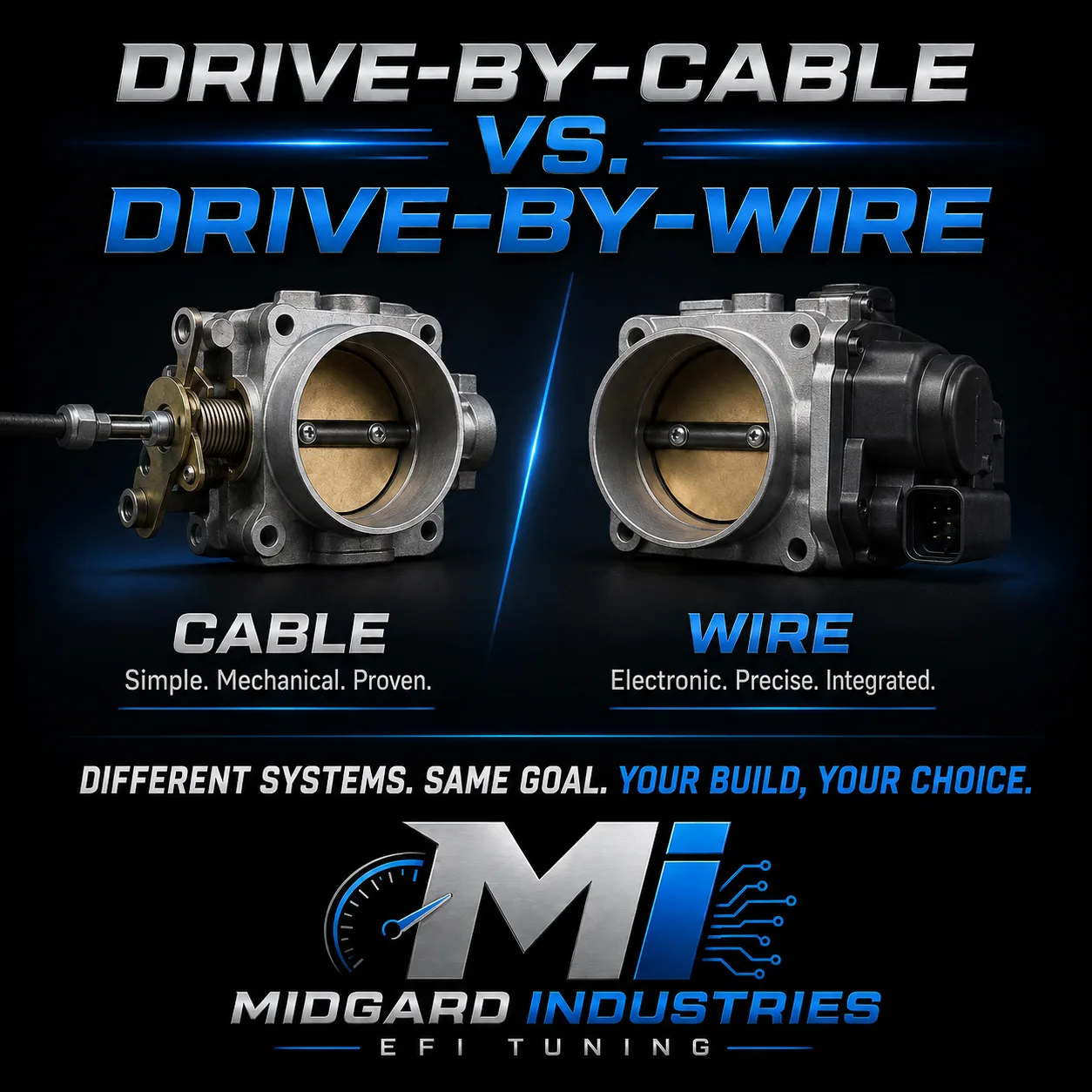
When planning an LS swap, one decision that comes up early is whether to use a drive-by-cable (DBC) or drive-by-wire (DBW) throttle body.
Both systems work well. Neither is automatically better for every build.
The best choice depends on the ECU, wiring harness, transmission, intended use, available parts, and how simple or factory-like you want the swap to be.
What Is Drive-by-Cable?
A drive-by-cable system uses a physical throttle cable between the accelerator pedal and throttle body.
When you push the pedal, the cable mechanically opens the throttle blade.
A typical Gen 3 DBC setup uses:
- Cable-operated throttle body
- Mechanical accelerator cable
- Idle Air Control valve
- Throttle Position Sensor
- Compatible P01 or P59 calibration
- DBC-compatible wiring harness
There is no electronic accelerator pedal controlling the throttle blade.
What Is Drive-by-Wire?
Drive-by-wire replaces the throttle cable with electronic throttle control.
The accelerator pedal contains position sensors. The ECU receives the pedal request and commands an electric motor inside the throttle body to move the throttle blade.
On many Gen 3 GM DBW systems, the complete setup includes:
- Electronic throttle body
- Accelerator pedal assembly
- TAC module
- Matching wiring
- Compatible ECU and calibration
The exact components vary by year and application, so mixing random pedals, throttle bodies, TAC modules, and calibrations can cause problems.
Why People Choose Drive-by-Cable
DBC is popular for LS swaps because it is simple.
You push the pedal and a cable opens the throttle.
Advantages of DBC
- Simple wiring
- Fewer electronic components
- Easy to troubleshoot
- Easy to adapt to older vehicles
- Familiar throttle feel
- Good choice for race cars and basic swaps
- Does not require an electronic accelerator pedal
- Often easier when using an older factory pedal assembly
For something like a C10, S10, muscle car, hot rod, or dedicated race vehicle, DBC can make the installation very straightforward.
If simplicity is the main goal, DBC is difficult to beat.
Why People Choose Drive-by-Wire
DBW is more complicated electrically, but it offers several advantages when everything is matched and calibrated correctly.
Advantages of DBW
- No throttle cable to route
- Easy pedal placement
- ECU directly controls idle airflow
- Excellent cold-start and idle control potential
- Factory-style cruise-control capability
- Better integration with factory torque-management strategies
- Flexible throttle response
- Cleaner engine-bay installation
- Works well with many later Gen 3 factory combinations
Because the ECU controls the throttle blade, it can make very small throttle adjustments that would otherwise require an Idle Air Control valve on a cable-operated system.
For a street-driven swap where you want factory-like behavior, DBW can be an excellent choice.
Does Drive-by-Wire Have Throttle Lag?
This is one of the biggest complaints people have about DBW systems.
A properly calibrated DBW system should not feel excessively delayed.
What people sometimes describe as “drive-by-wire lag” can actually come from:
- Pedal-to-throttle calibration
- Torque-management settings
- Throttle-area tables
- Transmission behavior
- Incorrect calibration
- Mismatched throttle components
The ECU does not always command throttle blade angle one-for-one with pedal position.
That is intentional.
GM uses electronic throttle control for drivability, torque management, transmission protection, traction functions, cruise control, idle control, and other strategies.
A poorly matched calibration can feel lazy. A properly configured one can feel very responsive.
DBC Does Not Automatically Mean Better Throttle Response
A cable physically connects the pedal to the throttle body, but that does not mean the engine itself will respond better.
Throttle response is also affected by:
- Ignition timing
- Fueling
- Accelerator enrichment
- Intake volume
- Camshaft
- Converter
- Transmission
- Gearing
- Throttle-body size
Installing a huge cable-operated throttle body does not automatically make an LS respond faster.
Idle Control Is Different
This is an important tuning difference.
DBC idle control
A cable-operated throttle body generally uses an Idle Air Control valve to bypass air around the closed throttle blade.
The ECU manages idle using things such as:
- Base running airflow
- IAC airflow
- Startup airflow
- Idle spark
- Throttle follower
- Throttle cracker
A cammed DBC engine may require considerable adjustment to these tables.
DBW idle control
With DBW, the ECU can physically move the throttle blade to control airflow.
This gives the calibration another powerful way to maintain idle speed.
DBW can work extremely well on cammed engines when the airflow model and idle settings are correct.
It can also work poorly if someone simply installs a large cam and makes no calibration changes.
What About a Cammed LS?
Either system can work well with a camshaft.
A larger cam changes:
- Idle vacuum
- Airflow requirements
- Cylinder filling
- VE
- Idle stability
- Startup airflow
- Deceleration behavior
A cammed LS needs the calibration adjusted regardless of whether the throttle is cable-operated or electronic.
Switching to DBC does not eliminate the need to tune a cammed engine.
Likewise, DBW itself is not the reason a cammed engine surges, stalls, or hangs RPM.
The calibration needs to match the engine.
What About Cruise Control?
DBW has a major advantage here.
Because the ECU can control the throttle blade electronically, cruise control can often be integrated without a separate mechanical cruise-control actuator.
With DBC, cruise control generally requires additional hardware to physically operate the throttle cable.
For a street-driven swap where factory-style cruise control is important, DBW deserves serious consideration.
Which Is Easier to Wire?
DBC is usually simpler.
A DBC swap primarily needs the throttle-body sensors and IAC circuit incorporated into the engine harness.
DBW may require:
- Correct electronic pedal
- Correct throttle body
- Correct TAC module on applicable Gen 3 systems
- Additional wiring
- Correct ECU pins
- Correct calibration
The advantage disappears quickly if the DBW components do not match.
If you buy a complete donor drivetrain with the engine, harness, ECU, throttle body, pedal, and TAC components, keeping DBW can actually be easier than converting everything to cable.
Do Not Mix Random DBW Components
This is one of the most important things to understand about drive-by-wire swaps.
Just because two GM throttle bodies physically bolt to the same intake does not mean they are electronically compatible.
The same applies to pedals and TAC modules.
A mismatch can cause:
- Reduced Engine Power
- Throttle-related trouble codes
- No throttle response
- Limited throttle opening
- Limp mode
- Engine that starts but will not respond correctly to the pedal
Whenever possible, keep the DBW components together as a matched system.
What About the ECU?
The ECU calibration must match the throttle system.
With Gen 3 LS swaps, you will commonly encounter:
- P01 ECUs
- P59 ECUs
P01s are commonly associated with earlier Gen 3 applications and are extremely popular for DBC swaps.
P59s are common in later Gen 3 applications and are frequently seen with DBW systems.
However, you should not determine throttle compatibility from the ECU case or connector colors alone.
The operating system and calibration matter.
A P59 that came from a DBW truck should not simply be assumed to work correctly with a DBC setup without the proper calibration changes.
Transmission Choice Matters Too
Whether you run:
- 4L60E
- 4L80E
- Manual transmission
- TH350
- TH400
- Other non-electronic transmission
the tune should be configured around the actual drivetrain.
DBW systems also allow the ECU greater control over engine torque during automatic transmission shifts.
That can improve shift quality and transmission durability when properly calibrated.
Which One Should You Use?
For a basic older-vehicle LS swap where simplicity is the priority:
DBC is often the easiest choice.
It works especially well for:
- Race cars
- Hot rods
- Older trucks
- Simple standalone-style swaps
- Manual transmission combinations
- Builds where cruise control is not important
For a street-driven vehicle where you want more factory-style functionality:
DBW is often the better choice.
It works especially well for:
- Daily drivers
- Modernized classic vehicles
- Automatic transmission combinations
- Builds where cruise control is important
- Vehicles where smooth factory-style idle control is desired
- Complete donor drivetrain swaps
If You Already Have a Complete Donor, Think Before Converting It
If your donor engine already has:
- DBW throttle body
- Correct pedal
- TAC module
- Harness
- ECU
there may be very little reason to convert it to DBC.
Likewise, if you already have a complete DBC engine, cable pedal arrangement, and compatible ECU, converting everything to DBW may add unnecessary expense and complexity.
Use the system that makes sense for the combination instead of changing parts simply because one system is considered “better.”
The Bottom Line
Both systems can deliver excellent results.
Drive-by-cable offers simplicity.
Drive-by-wire offers greater integration and electronic control.
For a simple race car or traditional LS swap, DBC may be the easiest route.
For a street vehicle where you want cruise control, factory-like idle control, and modern drivability, DBW may be worth the additional wiring.
Most importantly, the ECU, throttle system, wiring, and calibration all need to match.
A good LS swap is not about choosing DBC or DBW because someone on the internet said one was better.
It is about choosing the system that fits the build.
Need help determining which setup is right for your LS swap? Send your engine year, ECU service number, transmission, throttle body, pedal information, wiring-harness setup, and intended use.
Midgard Industries EFI Tuning
Longview, Texas
midgardind.com
#LSSwap #DriveByWire #DriveByCable #DBW #DBC #LSTuning #HPTuners #P01 #P59 #EFITuning
Follow Midgard Industries
Don't want to tune it yourself?
Mail in your P01/P59 and get a VATS-deleted, swap-ready base tune for $100. Typical turnaround is 1-2 business days after the ECU is received.