How Camshaft Duration Affects Idle Vacuum
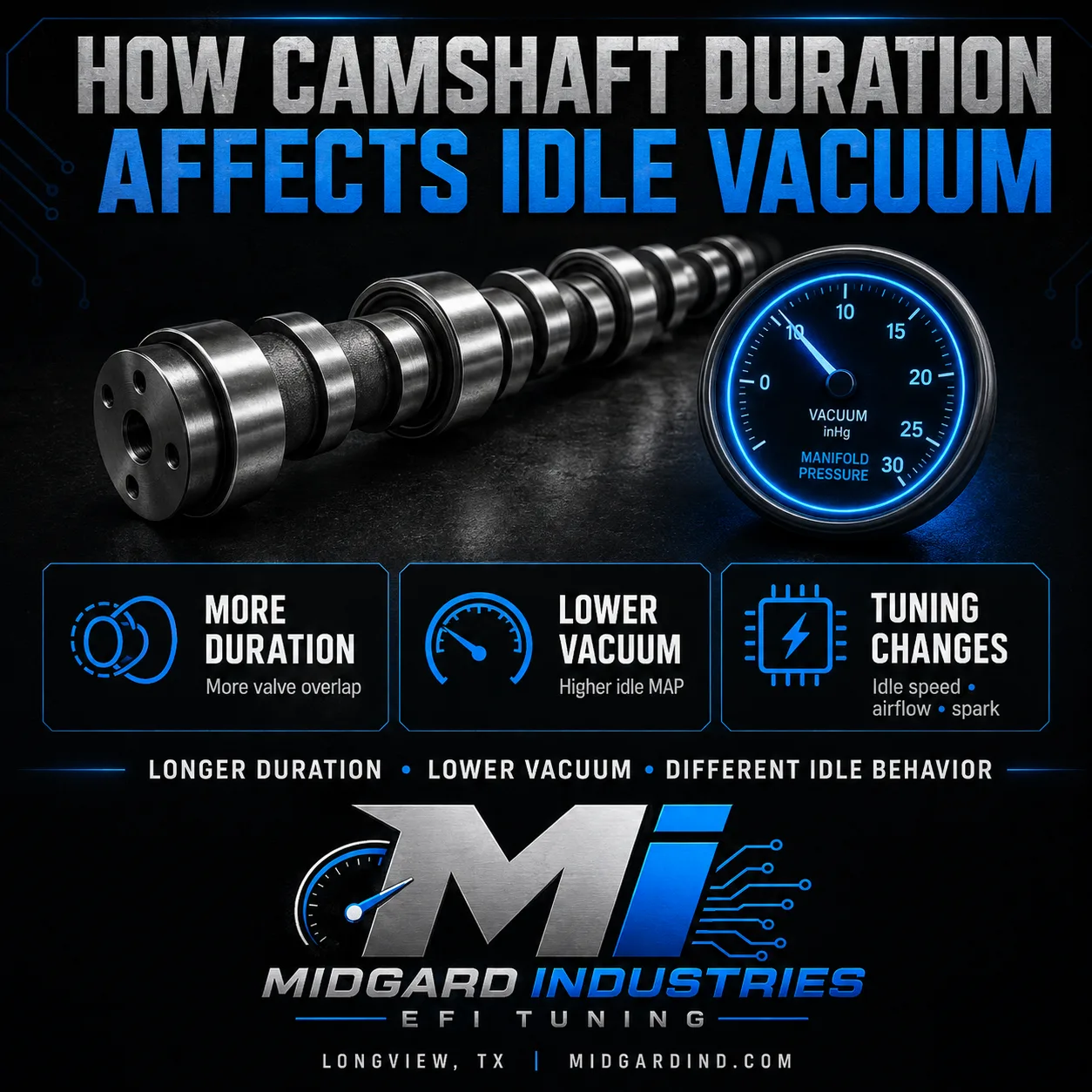
Ever notice that a cammed LS has less vacuum and a higher MAP reading at idle than a stock engine?
That is usually normal.
As camshaft duration increases, the intake and exhaust valves stay open longer. That also increases valve overlap — the period where both valves are open at the same time.
At higher RPM, overlap can help cylinder filling.
At idle, it creates more reversion and less stable airflow. That usually means:
- Lower manifold vacuum
- Higher idle MAP
- Rougher idle
- Higher idle RPM requirements
- More idle airflow needed
- More sensitivity to spark and fueling
A mostly stock LS may idle around 25–40 kPa, while a moderate cam may be closer to 40–55 kPa. A larger cam may idle around 55–70 kPa or higher, depending on the combination.
Duration is not the only thing that matters. Lobe separation angle, engine size, idle RPM, compression, intake, exhaust, converter, and installed cam position all affect idle vacuum.
That is also why saying “it has a Stage 2 cam” is not enough information for a tuner.
The actual cam specs matter.
A cammed LS often needs changes to:
- Base running airflow
- Startup airflow
- Desired idle RPM
- Idle spark
- VE and MAF calibration
- Startup fueling
- Throttle follower / cracker settings
And remember: very low vacuum is not always caused by the cam. Vacuum leaks, incorrect cam timing, misfires, low compression, or poor calibration can create similar symptoms.
More duration changes how the engine breathes. The tune needs to change with it.
Need help with a cammed LS? Send me your engine size, cam specs, transmission, converter, injectors, sensors, and complete build information.
Midgard Industries EFI Tuning
Longview, Texas
midgardind.com
#LSSwap #CammedLS #Camshaft #IdleVacuum #LSTuning #HPTuners #EFITuning
Follow Midgard Industries
Don't want to tune it yourself?
Mail in your P01/P59 and get a VATS-deleted, swap-ready base tune for $100. Typical turnaround is 1-2 business days after the ECU is received.