What Information Does Your Tuner Need?
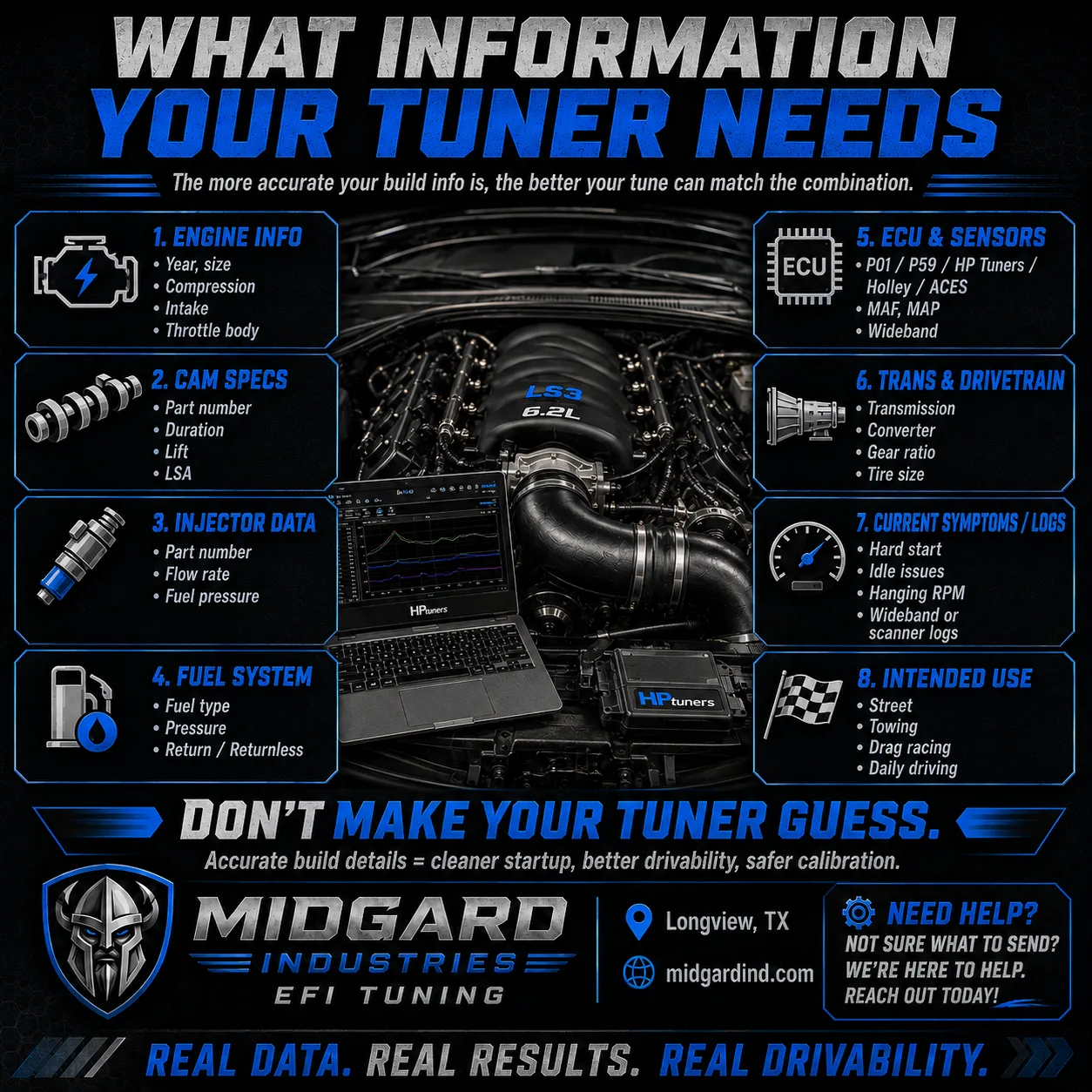
A good tune starts with good information.
The more accurate your build details are, the better your tuner can match the calibration to the actual engine, transmission, fuel system, and vehicle. Missing or incorrect information can lead to poor startup, unstable idle, incorrect fueling, transmission problems, or unsafe operation.
Before requesting a tune, be prepared to provide the following.
Engine information
Your tuner needs to know:
- Engine year
- Engine displacement
- Compression ratio, if known
- Cylinder-head information
- Intake manifold
- Throttle-body size and type
- Naturally aspirated, supercharged, turbocharged, or nitrous
A stock 5.3 and a cammed 6.0 may use similar electronics, but they do not need the same calibration.
Camshaft specifications
Do not describe the cam as only “Stage 2” or “big cam.”
Provide the actual specifications when possible:
- Intake and exhaust duration
- Valve lift
- Lobe-separation angle
- Installed centerline
- Camshaft part number
- Manufacturer
Cam specifications affect idle airflow, vacuum, startup behavior, fueling, spark, converter requirements, and overall drivability.
Injector information
Injector data is one of the most important parts of the tune.
Provide:
- Injector manufacturer
- Part number
- Advertised flow rate
- Pressure at which the flow rate was measured
- Actual fuel pressure
- Injector data sheet, when available
“50-pound injectors” is not always enough. Two injectors with the same advertised flow rate may require completely different offset, short-pulse, and flow data.
Fuel-system information
Your tuner should know:
- Fuel type
- Gasoline ethanol content
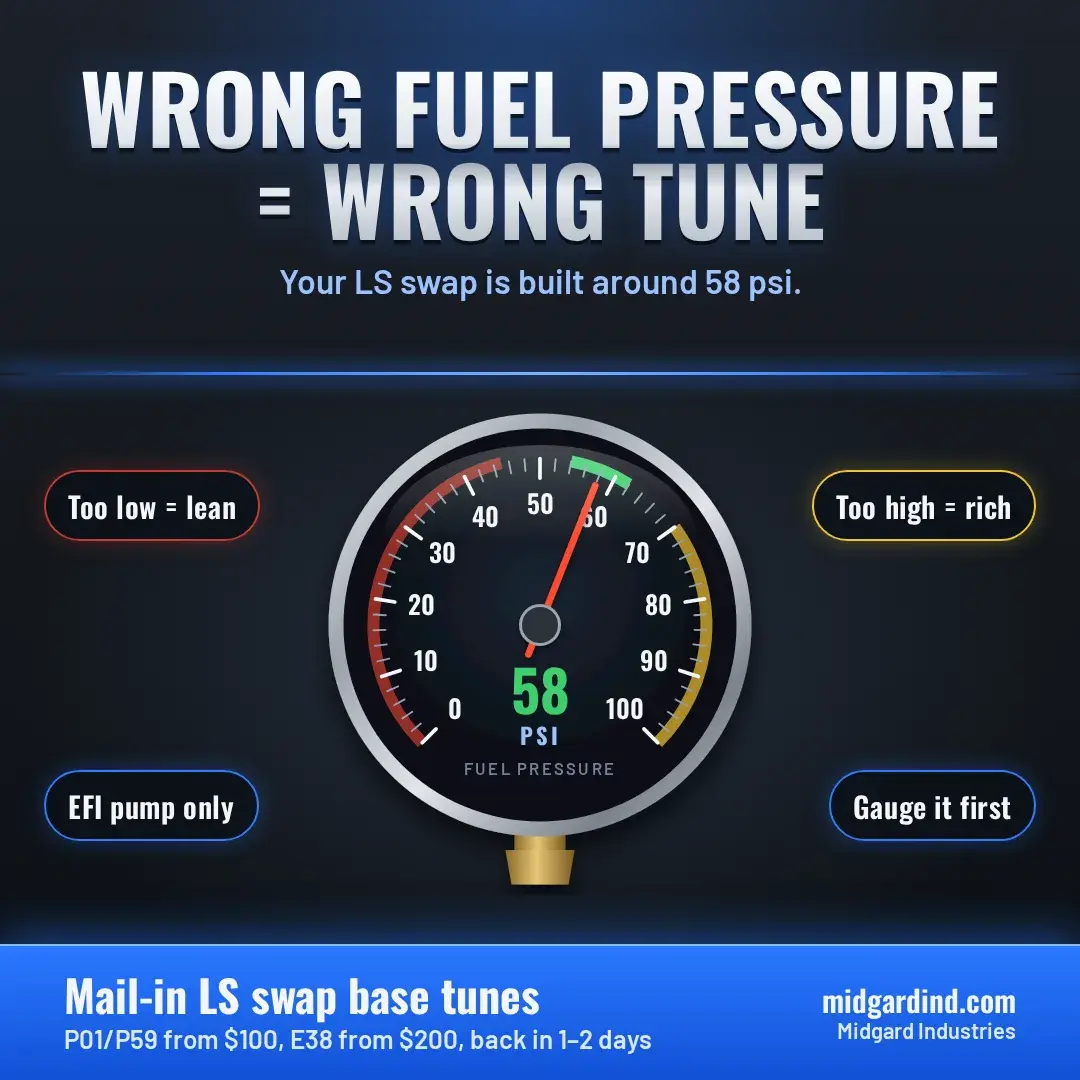
- Fuel pressure
- Return or returnless system
- Vacuum-referenced or fixed fuel pressure
- Fuel-pump information
- Flex-fuel sensor, if installed
Fuel pressure and fuel type directly affect injector flow and commanded air-fuel ratio.
ECU and sensor information
Provide:
- ECU type
- ECU service number
- Operating system, if known
- Drive-by-cable or drive-by-wire
- MAF sensor part number
- MAF housing size
- MAP sensor type
- One-bar, two-bar, or three-bar MAP
- Oxygen-sensor and wideband information
For Gen 3 LS swaps, clear photos of the ECU label and connector colors are also helpful.
Transmission and drivetrain
Your tuner needs:
- Transmission type
- Automatic or manual
- Converter stall speed
- Transfer case, if applicable
- Rear gear ratio
- Tire height
- Vehicle weight, if known
- Intended use
Transmission tuning depends heavily on tire size, gearing, converter, vehicle weight, and driving purpose.
Exhaust and engine modifications
List all major modifications, including:
- Headers
- Exhaust size
- Catalytic converters
- Cold-air intake
- Ported intake or throttle body
- Cylinder heads
- Camshaft
- Injectors
- Fuel pump
- Power adder
- Converter
- Gear change
Do not assume a modification is too small to mention.
Current symptoms
Tell your tuner exactly what the vehicle is doing.
Useful details include:
- Hard cold start
- Hard hot start
- Needs throttle to start
- Stalls when placed in gear
- Hanging RPM
- Idle surge
- Rich or lean condition
- Hesitation
- Poor throttle response
- Transmission flare
- Converter shudder
- Diagnostic trouble codes
The more specific the description, the easier it is to separate tune-related issues from mechanical or wiring problems.
Logs and wideband data
For street or remote tuning, provide:
- Scanner logs
- Wideband air-fuel data
- Current tune file
- Diagnostic trouble codes
- Fuel trims
- Idle MAP
- Idle airflow
- Coolant temperature
- Intake-air temperature
- Spark timing
- Knock-retard data
A street tune should be based on real data from the actual vehicle, not guesses.
Intended use
Let your tuner know how the vehicle will be used:
- Daily driving
- Towing
- Street performance
- Drag racing
- Off-road use
- Highway cruising
- Fuel-economy focus
- Maximum-power setup
A tow vehicle should not be calibrated the same way as a drag vehicle.
The simplest rule is:
Do not make your tuner guess.
Accurate build information helps create a calibration that starts cleaner, idles better, drives more predictably, and operates more safely.
Need help with an LS swap, HP Tuners, Holley EFI, or ACES EFI setup? Send your complete build information along with your current symptoms and tuning goals.
Midgard Industries EFI Tuning
Longview, Texas
midgardind.com
#LSSwap #LSTuning #HPTuners #HolleyEFI #ACESEFI #EFITuning #CammedLS #RemoteTuning
Follow Midgard Industries
Don't want to tune it yourself?
Mail in your P01/P59 and get a VATS-deleted, swap-ready base tune for $100. Typical turnaround is 1-2 business days after the ECU is received.